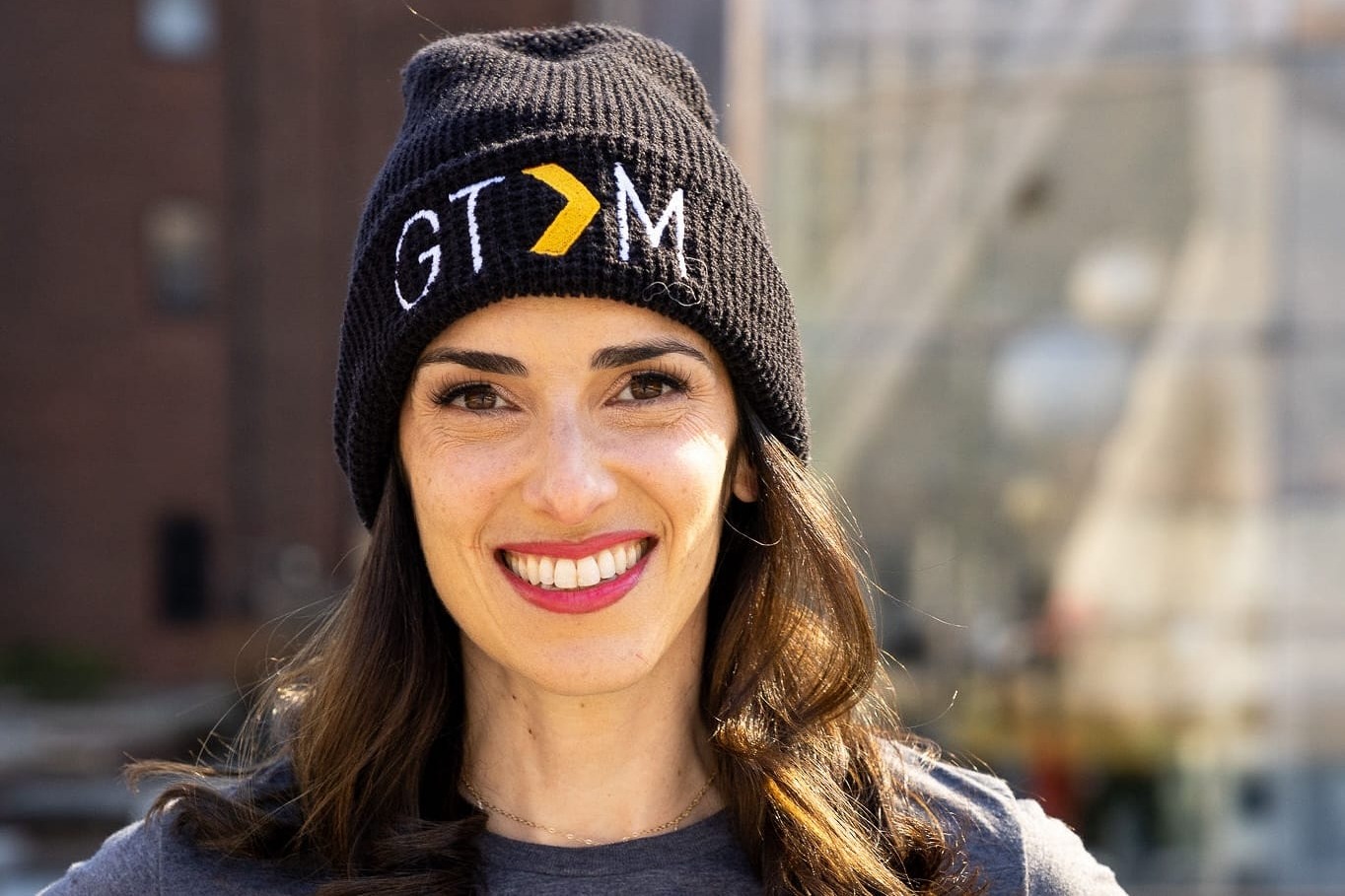
Amanda Hofman is the co-founder and CEO of Go To Market, a New York City studio that designs custom print-on-demand merchandise shops for brands, founders and organizations. She is a two-time entrepreneur who founded and sold the popular women's networking group Urban Girl Squad before reinventing herself — and the swag industry — with an inventory-free business model. Her story matters to women founders because it shows that a second act, launched years after the first, can be bigger than the original.
The timing is hard to ignore. The global print-on-demand market was valued at USD 12.15 billion in 2025 and is projected to reach USD 46.43 billion by 2031, growing at a compound annual rate of 25.05% (Mordor Intelligence, 2026). Hofman entered that market in November 2019, when print-on-demand was still an obscure e-commerce technique, and turned it into a woman-owned studio that builds sustainable, size-inclusive branded apparel for clients who want merchandise people actually keep.
Table of Contents
- From Market Research to Urban Girl Squad
- Selling at 38 Weeks Pregnant
- Discovering Print-on-Demand in 2019
- Inside Go To Market Studio
- Sustainability and the Anti-Junk Swag Philosophy
- The Business Case for Better Merchandise
- Lessons for Aspiring Entrepreneurs
- Frequently Asked Questions
- Conclusion
- Sources
From Market Research to Urban Girl Squad
Amanda Hofman did not start out as a founder. A former collegiate resident assistant and corporate market researcher, she worked in New York City until she noticed that she was always most successful when she was running her own projects — a connection to entrepreneurship she only made several years into her career. Once she connected the dots, she says, there was no going back.
In 2008 she founded Urban Girl Squad, a social networking group for women in their 20s and 30s that made a big city feel smaller through localized events, perks and community. The company launched on just $3,000 in startup costs (YFS Magazine, 2011) and grew into one of New York City's best-known networks for young professional women. Hofman ran it for years as its founder and CEO, learning firsthand the unglamorous side of entrepreneurship: logistics, budgets, marketing and the discipline of showing up every day.
Her Barnard College education, in an all-women's environment, left a lasting impression. Hofman says she saw the magic of that kind of support for the first time at Barnard, and she has sought out women's networking and mentorship communities ever since — including becoming a member of the Entreprenista League, a network for female founders.
Selling at 38 Weeks Pregnant
In 2014 Hofman sold Urban Girl Squad — two weeks before her second child was born, at 38 weeks pregnant. The decision gave her several years at home with her two kids, and she admits she enjoyed it. But once the children were in school full time, the CEO itch returned and she very much wanted to run another business again.
The interlude was not idle. She explored different career paths — including making lamps — and accidentally signed up to run the creation of merchandise for her children's school. That detour would turn out to be the seed of her next company, because it introduced her to print-on-demand technology and gave her the confidence to launch a venture of her own once again.
Discovering Print-on-Demand in 2019
Hofman discovered print-on-demand in 2019 while looking for high-quality branded merchandise for her own team and community — and hitting the same roadblocks every time. Bulk printing forced her to commit to a single design, pick sizes at random, meet high minimum order quantities, and find space to warehouse boxes in her New York City apartment. Print-on-demand solved all of it at once: items are produced only after an order is placed, so there is no inventory, no fulfillment work and no large upfront investment. It is the same zero-inventory model we break down in our guide to print-on-demand for women.
She saw a gap in a large and growing market. North American promotional products distributors posted a record $27.7 billion in sales in 2025, up 4.2% from 2024, according to the Advertising Specialty Institute. Yet much of that spend still flowed through traditional bulk ordering. Hofman's insight was that entrepreneurs — and the people who buy from them — would benefit dramatically from an alternative that was higher quality and more sustainable than the standard promotional-products playbook.
She launched Go To Market in November 2019 with her business partner Jessie, whom she had met while they worked together at Urban Girl Squad. The two have opposite skill sets, which Hofman credits for why the partnership works, and they share the same approach to work-life balance and the same values.
Inside Go To Market Studio
Go To Market is a full-service merchandise studio. The company designs custom print-on-demand stores for businesses and individuals, takes clients from design ideation to a shop integrated with their existing website, and handles the details so founders can focus on growing their business. In industry terms, businesses are the dominant customers of the model: they commanded 73.88% of print-on-demand market revenue in 2025, with apparel the leading product category at 40.20% (Mordor Intelligence, 2026).
The studio's work spans four main use cases. Social media tie-ins turn real-world merchandise into content and brand awareness. Client gifts go beyond the forgettable mousepad toward items people actually use. Conference merch lets brands sell pre-event collections or run a standout booth without bulk waste. And employee swag is designed to survive past the retreat — replacing plain logo tees with true-to-brand pieces that enter the team's regular rotation. Clients include founders such as Carly Jean Wright of Vibrant Mama, whose store shifted her business "from a brand to a movement," and Michelle Valiukenas of The Colette Louise Tisdahl Foundation.
Sustainability and the Anti-Junk Swag Philosophy
What sets Go To Market apart is a deliberate anti-junk philosophy. Hofman rejects the keychains, thumb drives and pens that end up in the trash, and instead pushes for high-quality, size-inclusive pieces people keep for years. Because print-on-demand produces only what is ordered, no product gets thrown away because a size or color was not popular — a direct answer to the waste problem of bulk printing, where a large share of overprinted goods never sells.
Sustainability here is practical, not decorative. Clients can switch designs and products as they see what sells, without being locked into thousands of units of an unpopular style. For brands, that means lower financial risk and a smaller environmental footprint at the same time — a combination that resonates with the values-driven customers many women-led brands serve.
The Business Case for Better Merchandise
Hofman's bet on quality swag is backed by data. In Custom Ink's 2024 Employee Swag Survey of 1,064 U.S. employees, 94% of workers who receive swag at least monthly said they were "very satisfied" with their employer, compared with 18% at companies that never give swag. Ninety-three percent said a favorite piece of swag would make them more likely to stay another year, and 92% said wearing company swag increased their sense of connection to their team.
The economics work on the brand side, too. The print-on-demand model lets companies test merchandise with essentially zero inventory risk, then scale what works — a flexibility traditional bulk orders cannot match. With the market forecast to grow more than threefold between 2025 and 2031, founders who learn to use merchandise as marketing rather than as an afterthought are positioning themselves early in a fast-expanding channel.
Lessons for Aspiring Entrepreneurs
Three lessons stand out from Hofman's journey. First, a setback or pause is not the end of a career: she sold her first company, stepped away for several years, and returned with a stronger, better-aimed business. Second, let friction become the idea — every annoyance she hit while ordering merch became the product thesis for Go To Market. Third, start with people you trust: Hofman offered her services to a small group of friends and business owners for honest feedback, then worked outward through her network before pitching strangers. That same outward-from-your-network logic applies to building a strong personal brand as a female founder.
For women weighing their own next move, her path is a reminder that entrepreneurship compounds. The events company she built in 2008 gave her the network, the confidence and eventually the co-founder that made the 2019 launch possible — eleven years later.
Frequently Asked Questions
Who is Amanda Hofman?
Amanda Hofman is the co-founder and CEO of Go To Market, a New York City studio that designs custom print-on-demand merchandise shops for brands and organizations. She previously founded and led the NYC women's networking group Urban Girl Squad.
What is Go To Market?
Go To Market is a woman-owned branded merchandise studio founded in 2019. It designs custom print-on-demand online stores for businesses, from initial design to a fully integrated shop, with a focus on sustainable, high-quality and size-inclusive products.
How did Amanda Hofman get into print-on-demand?
After selling Urban Girl Squad and taking time off to raise her children, Hofman accidentally ended up running merchandise production for her children's school. That experience introduced her to print-on-demand technology in 2019 and showed her how to solve the inventory and minimum-order problems she had faced with bulk printing.
What is print-on-demand and why does it matter?
Print-on-demand produces items only after a customer orders them, so businesses hold no inventory, meet no minimum quantities and waste less product. The global print-on-demand market was worth USD 12.15 billion in 2025 and is expected to reach USD 46.43 billion by 2031.
What does Go To Market sell?
The studio creates branded apparel and merchandise for four main uses: social media campaigns, client gifts, conference and event gear, and employee swag — all produced through print-on-demand partner stores connected to the client's website.
What advice does Amanda Hofman give to new founders?
She recommends starting with a small circle of trusted people who will give honest feedback, then expanding through your personal and professional network before pitching strangers. She also encourages founders to treat their own frustrations as business ideas and to value discipline over motivation.
Conclusion
Amanda Hofman's career is a study in patient reinvention. She built a community company on a $3,000 budget, sold it before her second child was born, took years off, and returned with a business aligned with where commerce was heading: sustainable, on-demand and personal. Go To Market turns ordinary promotional merchandise into wearable marketing that people keep, in a market growing at more than 25% a year. For women entrepreneurs, her message is that the second act can be the best one — and that the best business ideas are often hiding inside your own frustrations.
Sources
- Mordor Intelligence — Print On Demand Market Size, Share & Research 2026-2031 (market size 2025, 2031 forecast, CAGR, segment shares)
- Advertising Specialty Institute — North American Promotional Products Industry Grows 4.2% in 2025 to Record $27.7 Billion
- Custom Ink — 2024 Employee Swag Survey (1,064 U.S. employees, satisfaction and retention findings)
- Nasdaq — How Amanda Hofman Is Revolutionizing Branded Merchandise (Dec 2023)
- Entreprenista — Amanda Hofman of Go To Market on leaning into your entrepreneurial spirit (Nov 2021)
- CanvasRebel — Meet Amanda Hofman
- IdeaMensch — Amanda Hofman (profile and portrait)
- YFS Magazine — How Urban Girl Squad Founder Amanda Hofman Built A NYC Community For Women (2011)
- Go To Market Studio — official website