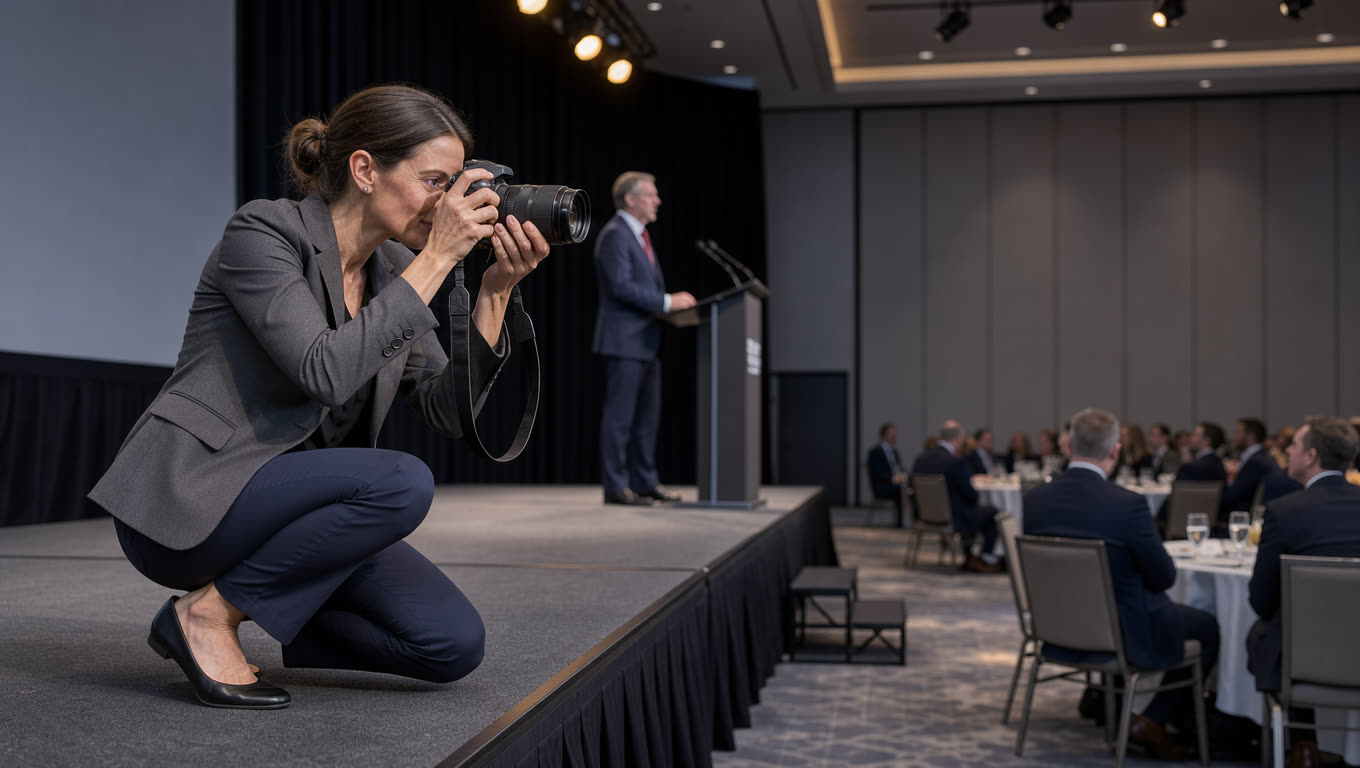
An event photography business is a service company that is paid to photograph weddings, corporate conferences, galas, launches and private parties — and it is one of the few creative businesses whose demand scales directly with how many events people hold. HTF Market Intelligence valued the global event photography market at USD 29,850 million in 2025 and projects USD 48,700 million by 2034, a 5.6 % compound annual growth rate. This guide explains, step by step, how to launch that business in 2027: the gear you really need, when to hire a second shooter, how to price each event, which contracts protect you, and how to deliver a client gallery that wins the next booking.
Table of Contents
- What the Business Really Involves
- Gear You Actually Need
- Second Shooters and the Team
- Pricing Your Events
- Contracts and Insurance
- Client Galleries and Delivery
- Getting Your First Bookings
- Frequently Asked Questions
- Conclusion
- Sources
What the Business Really Involves
An event photography business earns money by selling coverage of live events, not by selling prints: a client books a number of hours, you shoot the event, and you deliver a curated set of edited images through an online gallery. The work is roughly 10 hours of shooting for every event, but the shooting is the smallest part of the job — editing, culling, admin and client communication make up the rest of the contract.
That distinction matters for your income expectations. The U.S. Bureau of Labor Statistics reported a median hourly wage of USD 20.44 for photographers in May 2024, with employment projected to grow only 2 % between 2024 and 2034 (BLS, 2025). The photographers who outperform that median are almost always the ones who price per event and systemise their post-production, rather than those who bill like employees.
Gear You Actually Need
You need two camera bodies, one fast zoom (24–70 mm f/2.8), one prime for low light (35 mm or 50 mm f/1.4), an on-camera flash with diffusers, two card slots worth of memory cards, and batteries for a full day — that kit covers 95 % of weddings, conferences and galas. A second body is not a luxury: a sensor failure mid-ceremony with no backup is the single most common way a new event photographer loses a client permanently.
Protect the kit from day one. Insureon's published medians for freelance photo and video businesses put equipment insurance at USD 43 per month (USD 519 per year), while general liability cover averages USD 29 per month (Insureon, 2026). Buy the insurance before your first paid event, not after your first scare.
Second Shooters and the Team
A second shooter is a second photographer hired to cover another room, another angle or the groom's side while you handle the couple — and you need one whenever two things happen simultaneously in different spaces. Published 2026 price lists put a second photographer at USD 120 per hour on one list, and client-facing pricing guides quote clients paying about USD 185–250 per hour for a second position; on weddings specifically, add-ons run USD 300–700 per event (Paperlust, 2026).
Hire your second shooters as contractors with a short written brief: call time, shot list, card handover, and a rule that they never edit or keep images. Start with one reliable person you can call twice a month, then add a bench as your booking calendar fills. If you are building a wider creative service business, the same team logic applies in our guide to starting a social media management studio.
Pricing Your Events
Price per event with a clear hourly floor: in 2026, U.S. event photographers publish rates of USD 150–500 per hour with roughly USD 250 typical, corporate half days (about four hours) run USD 1,500–2,500, and full days (about eight hours) run USD 2,500–4,500 (2026 pricing surveys of published rate cards). Set a two- or three-hour minimum so a one-hour booking still pays for travel, setup and editing.
Weddings anchor the top of the market. The Knot's 2026 Real Weddings Study, based on 10,474 U.S. couples who married in 2025, found an average spend of USD 3,000 on a wedding photographer, a median of USD 2,800, and a quartile spread of USD 1,500 to USD 4,700. Build three packages (half day, full day, full day plus second shooter) instead of a single rate: buyers choose within a menu rather than deciding whether to buy at all.
Contracts and Insurance
A contract is the document that tells you what happens when something goes wrong — date, coverage hours, deliverables, delivery deadline, cancellation terms, copyright and usage rights — and you should never shoot a paid event without one signed and a deposit paid. Most photographers combine contracts and invoicing in one platform: ShootProof includes them in paid plans, and HoneyBook starts at USD 29 per month billed yearly (Grain Issue pricing check, 28 September 2026).
Insurance is the second half of the legal baseline. Event specialists sell general liability from about USD 59 for a one-to-three-day event policy or USD 129 per year, with many venues asking to be named as an additional insured (Insurance Canopy, 2026). Read your contract's cancellation clause out loud before you sign a client's version: rescheduling fees and force-majeure wording are where unpaid weekends disappear.
Client Galleries and Delivery
A client gallery is a branded web page where attendees download, favourite and buy prints from your images — it is both your delivery mechanism and your best marketing asset. Gallery platforms run USD 10–50 per month (Pixieset USD 10–50, ShootProof USD 9.99–60, Pic-Time USD 8–50), with free tiers that take a commission on print sales (Grain Issue, 28 September 2026).
Delivery speed is where the money leaks. A UK survey of more than 300 professional wedding photographers found that editing absorbs 55 % of working time while shooting takes only 4 %, with about 14 hours of editing per wedding (PetaPixel, 2020; Wedissimo, 2024), and a Neurapix study of 423 photographers found 50.4 % report mental exhaustion after long editing sessions (PetaPixel, 2024). Publish a turnaround you can hit in your busiest month, use presets or an AI-assisted batch edit, and you will free up the hours that used to go to selling the next event.
Getting Your First Bookings
Your first bookings come from three channels: venues and planners who refer you, past clients who rebook, and inbound leads from a portfolio that answers "what does a corporate or wedding event look like through your lens". Demand is not the constraint — 87–88 % of couples hire a photographer, making it the third most popular vendor category (The Knot, 2026).
Work the referral channel deliberately: send three venues or planners your sample gallery and a one-page rate card each week, and follow up once. On the inbound side, publish every event as a case study with the shot list you delivered, and pair it with a social media presence — the same playbook we use in the social media management studio guide. If you are already shooting, related creative niches like freelance video editing for creators and wedding planning from home reuse the same client base.
Frequently Asked Questions
How much does it cost to start an event photography business?
A lean start — one used mirrorless body, a fast zoom, a flash and memory cards — lands between USD 2,000 and USD 4,000. Add general liability insurance at roughly USD 129 per year or USD 59 per event, a gallery plan at USD 10–30 per month, and a contract and invoicing tool from USD 29 per month, and your first-year fixed costs stay under USD 5,000.
What gear do I need for my first paid event?
Two bodies, a 24–70 mm f/2.8 zoom, a 35 mm or 50 mm f/1.4 prime, one flash with diffuser, dual-card redundancy and batteries for twelve hours. Rent anything beyond that until the same item is requested three times — rentals cost less than buying a lens you use twice a year.
How much should I charge for my first event?
Charge at the entry tier of your market: USD 150–200 per hour with a two- to three-hour minimum, or USD 600–1,000 for a half-day package. Published 2026 rate cards put the typical event rate at about USD 250 per hour, so discounting below USD 150 undervalues the editing time the job requires.
Do I need insurance to shoot events?
Yes, and many venues require it before they let you in. General liability policies for photographers start around USD 59 for a one-to-three-day event or USD 129 per year, equipment cover adds roughly USD 43 per month on average, and venues often ask to be named as an additional insured on the policy.
How do I deliver photos to clients after an event?
Through a branded online gallery with downloads, favourites and print sales — Pixieset, ShootProof and Pic-Time all start between USD 8 and USD 10 per month. Promise a turnaround you can meet in your busiest month, typically two to four weeks for a full event gallery, and charge a premium for rush delivery.
How many events can I realistically shoot in a year?
Most full-time wedding photographers shoot 28 to 31 events a year once editing, culling and admin are counted — roughly 31 hours of work per wedding in UK industry surveys. Start at eight to twelve events in year one while you build your gallery library and referral network, then increase volume only when your editing capacity can absorb it.
Conclusion
Starting an event photography business in 2027 is less about buying a better camera and more about building a repeatable service: a redundant gear kit, one trusted second shooter, per-event pricing with a two-hour floor, a signed contract backed by insurance, and a gallery delivery process that turns every event into a referral. Price for the editing, not the shutter clicks, protect the dates you commit to, and treat each gallery as your next sales pitch — the market is growing at 5.6 % a year, and the photographers who show up prepared will capture most of it.
Sources
- U.S. Bureau of Labor Statistics — Occupational Outlook Handbook, Photographers (median hourly wage USD 20.44, May 2024; 2 % employment growth 2024–2034): https://www.bls.gov/ooh/media-and-communication/photographers.htm
- HTF Market Intelligence — Global Event Photography Market (USD 29,850 million in 2025, USD 48,700 million by 2034, 5.6 % CAGR): https://htfmarketintelligence.com/report/global-event-photography-market
- The Knot — 2026 Real Weddings Study, 10,474 U.S. couples married in 2025 (average USD 3,000, median USD 2,800, quartiles USD 1,500–4,700, 87–88 % hire a photographer): https://www.theknot.com/content/average-cost-wedding-photographer
- XPOSRE Media — 2026 Corporate Event Photography Pricing Guide (USD 150–400 per hour, half day USD 1,500–2,500, full day USD 2,500–4,500): https://xposre.com/guides/event-photography-pricing
- ProShoot — Event Photography Cost in the US (2026) (second photographer USD 120–250 per hour, rush and gallery add-ons): https://proshoot.io/blog/event-photography-cost-hiring-guide-us-2026
- Paperlust — How Much Does a Wedding Photographer Cost (second shooter USD 300–700): https://paperlust.co/blog/how-much-does-a-wedding-photographer-cost/
- PetaPixel — Wedding Photographers Spend Only 4 % of Their Work Time Taking Photos (UK survey of 300+ photographers, 2020): https://petapixel.com/2020/02/20/wedding-photographers-spend-only-4-of-their-work-time-taking-photos-survey-shows
- Wedissimo — The Real Cost of Wedding Photography (14 editing hours per wedding, 31 hours total): https://wedissimo.com/blog/real-cost-wedding-photography/
- PetaPixel — Over Half of Photographers Often Experience Editing Fatigue (Neurapix study, 423 photographers, 50.4 %): https://petapixel.com/2024/09/27/over-half-of-photographers-often-experience-editing-fatigue-says-study/
- Grain Issue — Pixieset, HoneyBook & Pic-Time pricing compared (checked 28 September 2026): https://grainissue.com/resources/photography-software-pricing
- Insurance Canopy — Photographer Insurance (event policy from USD 59, annual from USD 129): https://www.insurancecanopy.com/photo-video-services-insurance/photographer
- Insureon — Photographer Insurance Cost (medians: general liability USD 29/month, equipment USD 43/month): https://www.insureon.com/photography-video-business-insurance/photographers/cost