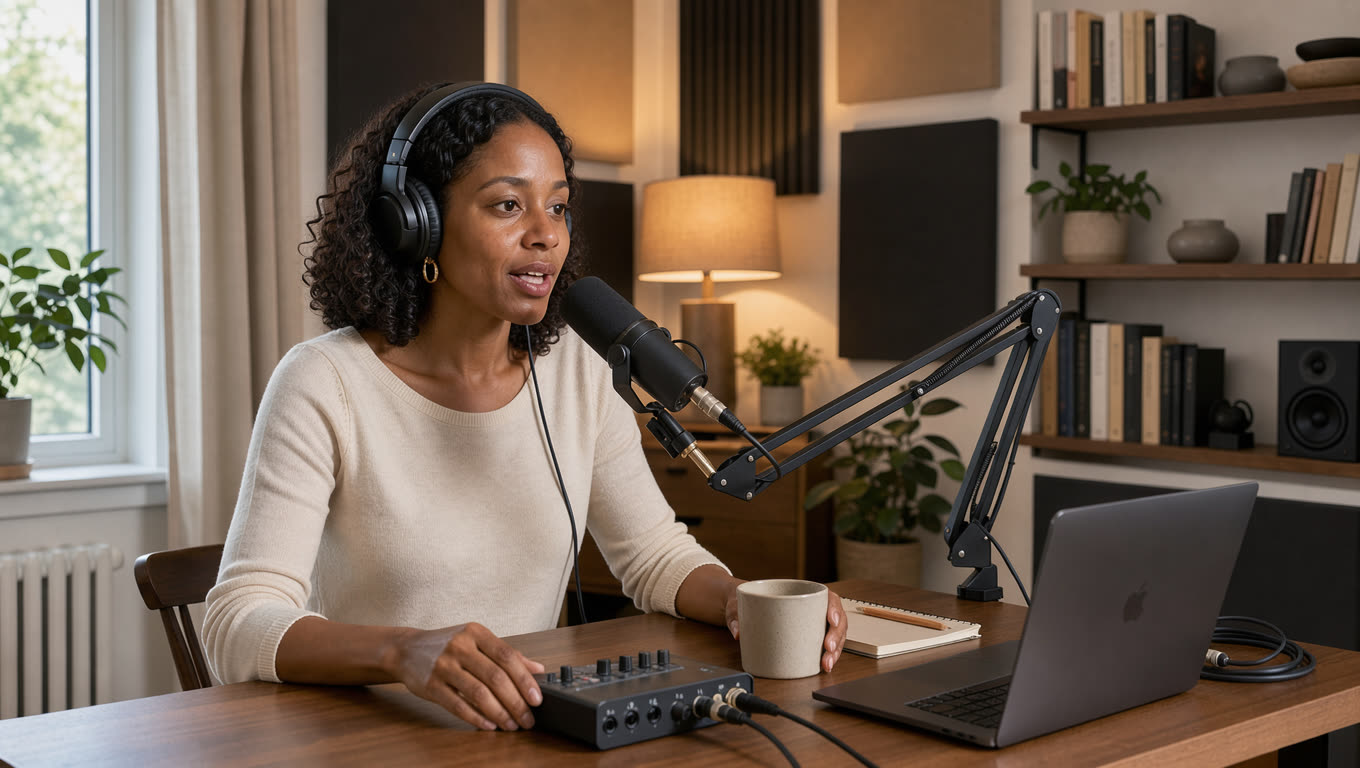
Podcasting is no longer a side hobby for tech enthusiasts: it is one of the most accessible media businesses a woman can launch from home, with a laptop, a $100 microphone and a defined niche. Edison Research's Infinite Dial 2025 found that 70% of Americans aged 12 and older have listened to a podcast and 55% are monthly consumers — an estimated 158 million people in 2025, up from 46 million a decade earlier. Yet women remain a minority of host chairs: a 2025 USC Annenberg study found only 35.9% of hosts across the top 100 podcasts are women. That gap is the opportunity. Here is how to launch your show and turn listeners into revenue in 2027.
Table of Contents
- Why Podcasting Is a Real Business Opportunity for Women
- Choose Your Niche and Format
- Build a Low-Cost Startup Stack
- Record, Edit and Publish Your First Episodes
- Grow Your Audience Before You Monetize
- Seven Ways to Monetize Your Podcast
- Common Mistakes to Avoid
- Frequently Asked Questions
- Conclusion
Why Podcasting Is a Real Business Opportunity for Women
Podcasting is a real business opportunity for women because the audience is massive, growing and commercially valuable, while women-led shows still lag behind demand. Americans spent an estimated 773 million hours per week listening to podcasts in 2025 — a 355% increase over ten years, according to Edison Research's Podcast Consumer 2025. The audience is also premium: 47% of monthly consumers earn $75,000 or more per year (versus 43% of the general population), 51% hold college degrees, and 18% of weekly consumers are business owners.
That audience attracts serious money. The IAB/PwC Internet Advertising Revenue Report for full-year 2025 put U.S. podcast ad revenue at $2.9 billion, up 17.6% year over year — the fastest-growing major digital format in the report. Meanwhile, women host only 35.9% of the top 100 shows and women of color just 6.6% (USC Annenberg, 2025). For a woman launching in a specific niche, that imbalance means less direct competition and an underserved listener.
Choose Your Niche and Format
The fastest way to fail at podcasting is to launch a generalist show; the fastest way to build loyalty is one niche listener and one format you can sustain. Listen Notes indexes at least 3.8 million podcasts and 196 million episodes worldwide, with roughly 198,000 new shows launched in 2025 alone. In that ocean, a narrow promise — "financial planning for first-generation entrepreneurs" or "marketing tactics for handmade brands" — is what makes a listener choose you.
Decide two things before recording: the niche, ideally adjacent to a service you could later sell; and the format — solo, interview, or hybrid. Solo 15-to-20-minute episodes are cheapest and most scalable; interviews build authority but add scheduling friction. Either way, commit to a weekly or biweekly cadence — consistency, not polish, retains listeners.
Build a Low-Cost Startup Stack
You can launch a professional-sounding podcast for under $150 in equipment and about $15 to $20 a month in hosting. The essentials: a USB microphone, headphones, free editing software, and a host that distributes your RSS feed to Apple Podcasts, Spotify and YouTube Music.
Hosting is the only mandatory recurring cost, and pricing is transparent. The Podcast Host Lab's price tracker (May 2026) lists Buzzsprout at about $18/month ($15 annually), Podbean's Unlimited Audio at $17 ($12 annually), and Captivate's Personal plan at $19 ($17 annually) with unlimited uploads and up to 30,000 downloads per month. On a zero budget, Spotify for Creators (formerly Anchor) is free with unlimited uploads, and Buzzsprout keeps a free plan limited to two upload hours per month. All were verified as active services in 2026. With free editors like Audacity or GarageBand, a realistic first-year budget stays under $400 including hardware.
Record, Edit and Publish Your First Episodes
Record your first three episodes before you announce the show, because episode one is almost never your best. The workflow that keeps you consistent: write a loose outline, record in a quiet, soft-furnished room, cut long pauses and filler words, add licensed intro and outro music, and export as a 128 kbps mono MP3.
Then set up the feed once and leave it alone. Create the show in your hosting platform, write a description rich in the keywords your niche listener searches for, upload 3000 x 3000 pixel cover art, and submit your RSS feed to Apple Podcasts, Spotify and YouTube. Publish the three pilots together so new listeners can binge, then move to your weekly cadence. Reserve one afternoon per month to batch-produce four episodes: batching is what separates shows reaching episode 100 from those that fade after six.
Grow Your Audience Before You Monetize
Grow your audience before you monetize, because sponsorship rates and membership conversions both depend on a download number you do not have at launch. Distribution matters as much as content: Edison Podcast Metrics (Q4 2024) found YouTube is the service used most often by 33% of U.S. weekly podcast listeners, ahead of Spotify at 26% and Apple Podcasts at 14%. Publishing a video version of every episode — even a static image over your audio — doubles your surface area at almost no cost.
The most reliable growth levers: guesting on podcasts in adjacent niches, repurposing episodes into short social clips, and building an email list from day one. A podcast compounds your personal brand as a female founder like no other medium, because audio creates trust that text cannot. Treat the first 90 days as audience acquisition, measuring subscribers and email signups rather than revenue.
Seven Ways to Monetize Your Podcast
There are seven reliable ways to earn money from a podcast, and the strongest shows combine at least three rather than depending on one sponsor.
- Sponsorships and advertising. Ads are sold on CPM — price per thousand downloads. The Podcast Consultant's 2026 guide puts host-read mid-rolls at $25 to $40 CPM and pre-rolls at $15 to $30, with business and finance shows at the top of the range. At 5,000 downloads per episode and a $30 CPM, one mid-roll earns about $150. And 88% of weekly consumers told Edison Research that hearing ads is a fair price for free content.
- Listener memberships. Platforms like Patreon let fans pay monthly for bonus episodes or early access. Patreon's standard plan takes 10% plus processing, so 100 members at $5/month yields roughly $420 monthly.
- Affiliate marketing. Recommend tools you genuinely use and earn commissions on signups. It works from episode one and needs no audience minimum — the ideal first stream under 1,000 downloads.
- Digital products. Templates, toolkits and guides convert a niche audience better than mass-market products: a pricing template for a bookkeeping show, a wholesale pitch kit for a handmade-brands show.
- Services and coaching. For many women the podcast is the top of a service funnel — consulting, done-for-you work or coaching. A targeted show pre-qualifies every listener, which is why niche choice matters early.
- Paid newsletters. Pairing your show with a newsletter opens paid subscriptions and email sponsorship slots. Kit (formerly ConvertKit), built for creators, has a free plan up to 10,000 subscribers.
- Live events and merchandise. With a regional or highly engaged audience, live recordings, workshops and branded products become viable — typically a year-two stream, but worth planning for from the start.
Common Mistakes to Avoid
The most common mistakes are all avoidable. Chasing a broad topic instead of a narrow niche makes growth nearly impossible against 3.8 million indexed shows. Waiting for perfect equipment delays launch indefinitely — listeners forgive imperfect audio, but they never discover episodes that were never published. Quitting before episode 20 is equally fatal, since download curves are back-loaded. Skipping the email list hands your audience's reach to an algorithm you do not control. And pitching sponsors before you have consistent download data wastes everyone's time: start with affiliates and products, then approach sponsors once you can report 90 days of reliable numbers.
Frequently Asked Questions
How much does it cost to start a podcast in 2027?
Expect $100 to $200 for a microphone and headphones plus $12 to $19 per month for hosting — roughly $400 all-in for the first year. Free hosting on Spotify for Creators cuts the startup cost to equipment only.
Do I need expensive equipment to sound professional?
No. One quality USB microphone in a quiet, soft-furnished room delivers audio listeners accept. Technique and room acoustics beat gear, and free editors like Audacity are enough for your first fifty episodes.
How many downloads do I need before brands will sponsor me?
There is no official threshold, but shows in the 2,000 to 10,000 download range can sell flat-rate sponsorships of $60 to $400 per episode, per 2026 rate guides. Below that, affiliates and listener support are more productive.
Is it too late to start a podcast in 2027?
No. U.S. podcast ad revenue hit $2.9 billion in 2025, up 17.6%, and monthly consumption reached record highs. Many of the 3.8 million indexed shows are dormant, so consistent niche shows still stand out.
Should my podcast have video from the start?
Yes, if you can manage it. YouTube is the most-used service for podcast listening among U.S. weekly listeners (33%), ahead of Spotify (26%) and Apple Podcasts (14%). Even a static-image video unlocks a discovery platform audio-only shows miss.
How long does it take to make money from a podcast?
With affiliate links and a service funnel, some hosts earn within the first few months; meaningful sponsorship income usually takes 12 to 18 months of consistent weekly episodes.
Conclusion
Starting a podcast as a woman creator in 2027 is one of the lowest-cost, highest-trust businesses you can build: over 150 million monthly consumers, hosting from about $15 a month, and seven revenue streams that stack on top of each other. The formula is simple — pick a narrow niche, launch with three episodes, stay consistent for a year, and layer monetization as downloads grow. Women host only a third of the top shows, so the opportunity is still wide open. The best time to start was a year ago; the second-best time is this week.
Sources
- Edison Research — The Infinite Dial 2025
- Edison Research — The Podcast Consumer 2025 (158M monthly consumers, 773M weekly hours, demographics, 88% ad acceptance)
- IAB / PwC — Internet Advertising Revenue Report, Full Year 2025 ($2.9B, +17.6%)
- USC Annenberg — Inequality in Popular Podcasts? (2025)
- Listen Notes — Podcast Stats
- Podcast Host Lab — Hosting Price Tracker (May 2026)
- The Podcast Consultant — Podcast Advertising Guide (2026)
- Patreon — Pricing
- Kit (formerly ConvertKit)