Starting a vending machine business as a side hustle means placing one or two self-service machines in high-traffic locations and earning from every sale while you keep your day job. A first used machine costs $2,750 to $4,850, the average U.S. machine generated about $524 in sales per month in 2023, and site commissions run 10% to 25% of gross sales. This guide covers costs, location contracts, products, cashless payments, the weekly route and the mistakes that kill vending profits.
Table of Contents
- Why Vending Works as a Side Hustle
- What It Costs to Start
- Choosing Locations That Pay
- Products, Payments and Profitability
- Running the Weekly Route
- Scaling From One Machine to a Fleet
- Common Mistakes to Avoid
- Frequently Asked Questions
- Conclusion
- Sources
Why Vending Works as a Side Hustle
A vending machine business fits a side hustle because the asset is small, the floor space belongs to someone else, and the machine sells while you are at work. U.S. convenience services revenue reached an estimated $31.1 billion in 2025, up from $26.6 billion in 2023 — 8.1% average annual growth — and vending remains its largest business line (NAMA Foundation, 2026).
The wider channel is growing just as fast: combined vending and micro market sales rose 30% in 2024, from $26.04 billion to $33.85 billion, with an estimated 2.3 million machines in location, 7% more than in 2023 (Vending Market Watch, 2025). New operators keep arriving on social-media "passive income" promises — treat this as semi-passive, not set-and-forget.
- Low overhead: no storefront lease, no counter staff, no inventory warehouse.
- Replaceable equipment: a failed machine can be repaired, relocated or sold.
- Repeatable economics: every location is a measurable unit you can copy once it works.
What It Costs to Start
Budget $2,750 to $4,850 for a used snack machine and $3,700 to $6,500 for a new one; a combo snack-and-beverage unit runs $5,400 to $8,300 new (Clarify Capital, 2026). Add the items below; operators most often underestimate the italicized ones.
- Initial inventory: $300 to $1,500 per machine. Understocking saves little and costs the first weeks of sales.
- Payment hardware: card reader plus coin and bill upgrades, around $600, plus processing fees.
- Delivery and installation: roughly $300 to $1,000 per machine.
- Licenses and permits: set locally — the Small Business Administration notes vending is commonly regulated at city and county level.
- Insurance and repairs: general liability at minimum; used machines carry more repair risk.
For revenue, the NAMA Foundation census puts average sales per machine at $6,284 in 2023 — about $524 a month — with the typical operator running 277 machines. Ignore sellers promising four figures per machine: that is an exception, not a benchmark.
An illustrative month (not a forecast). A machine grossing $900: product cost at 45% leaves $495, a 12% commission takes $108, card fees about $50, software and repairs $40 to $60 — roughly $280 to $300 net before your labor. On a $3,500 machine, payback needs 12 to 16 months of that performance; at $400 gross a month, it takes three years or never.
Choosing Locations That Pay
A location pays you through commission on gross sales — typically 10% to 25% — or nothing at all at small, low-traffic sites (ContractsCounsel, 2026). Commission is the price of floor space, and it decides whether a machine is worth keeping.
Published contracts show the real range: a Maryland school district reported about 20%, a California community college district's 2022 solicitation stated 28.1% on gross sales, and a 2023 Los Angeles airport board report showed a concession paying up to 59.5% of gross sales (VMFS, 2026).
Best sites for beginners: manufacturing plants, office lobbies, hospital waiting areas, campuses, gyms, laundromats and hotels — captive audiences with fixed break times. Put the deal in writing before installing: a one-to-five-year contract stating the commission rate and base (gross or net), maintenance and restocking duties, who pays electricity (a refrigerated machine draws about 1,354 kWh a year, near $16 a month at recent commercial rates), and an exit clause so a slow site can be abandoned at renewal.
Products, Payments and Profitability
Cashless payment is no longer optional: cashless made up 71% of all vending sales in 2024, 17 points above 2023, and 77% of those payments were contactless (Cantaloupe, Micropayment Trends Report 2025). The same data shows why it matters — the average cashless ticket was $2.24 against $1.78 for cash, and consumers spent over $3.5 billion at food and beverage vending machines in 2024, 15% more than in 2023.
Build the product mix around the site, not your own taste. In NAMA's 2024–25 census, 65% of operators cited client requests for healthier mixes and 59% saw better-for-you products as a growth opportunity — a gym asking for protein bars is telling you what sells there. Track four ratios per machine: cost of goods (40% to 50% of sales), commission, card processing and fixed monthly costs — your own hours included, since that is where side hustles quietly die.
Running the Weekly Route
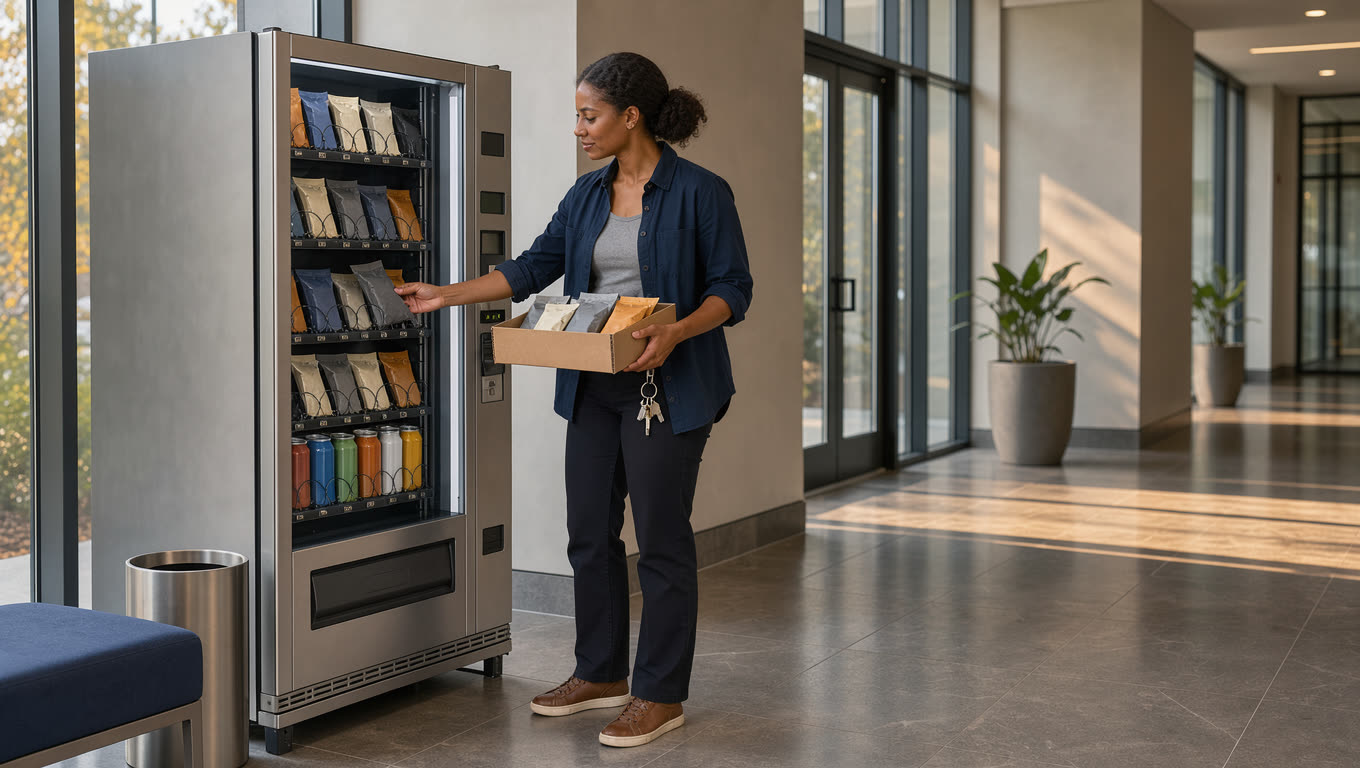
The weekly route is the real work: restock, collect, clean, note what sold, repeat. The average location holds 2.9 machines (NAMA census), so one stop often services a bank of units — which is why route density, not how many machines you own, decides how well your hours pay.
- Before the visit: pull sales data and pre-kit the exact products each site needs; restocking blind wastes the trip.
- On site: refill, rotate near-dates forward, wipe glass, clear coin and bill jams, confirm the card reader is online.
- After: log sales, commission owed and repair tickets — ten minutes per stop.
- Monthly: compare each machine with the $524 average and decide: keep, reprice, re-merchandise or relocate.
Choose payment and telemetry hardware you can still service in three years. Nayax (nayax.com) remains an active listed provider, and 365 Retail Markets completed its $848 million acquisition of Cantaloupe in May 2026 — the sector is consolidating, so avoid one-off gadgets with a dead app.
Scaling From One Machine to a Fleet
Scale by replicating a machine that already works. In 2024 industry data, small operators under $1 million in revenue were 52% of operators but only 7.4% of sales, while extra-large operators were 10% of operators and 65.2% of sales — the gap is route density and service efficiency, not luck.
- Machine one: prove a site, target at least $200 net a month and payback inside 16 months.
- Machines two and three: add sites within a short drive, so one trip services all of them.
- Then: replace underperformers before adding — relocating a $400-a-month machine costs less than a new one.
- Beyond vending: micro markets grew to 55,770 locations in 2024, up 30%, but cost $15,000 to $50,000 per install; they are the upgrade for a site that already proves itself.
Reinvest early profits into equipment. If vending is not for you, our round-up of 20 trending business ideas for women in 2027 lists side businesses with even lower entry costs, such as a home cleaning business.
Common Mistakes to Avoid
- Skipping cashless payment — with 71% of 2024 sales cashless, a cash-only machine turns away most buyers.
- Signing an open-ended location deal with no exit clause or unclear commission base.
- Buying used without a warranty — a $1,500 saving can become $2,500 of first-year repairs.
- Stocking for yourself, not the site — sweets in a gym loses the location fast.
- Underestimating route time — a machine netting $100 while eating four hours a week pays below minimum wage, so log your hours from day one.
Frequently Asked Questions
How much does it cost to start a vending machine business?
One machine runs $2,750 to $4,850 used or $3,700 to $6,500 new, plus $300 to $1,500 of inventory, about $600 for payment hardware, $300 to $1,000 for delivery, and local permits and insurance. A realistic all-in entry for a used machine is roughly $4,000 to $6,000.
How profitable is a vending machine?
The average machine generated about $6,284 in sales in 2023, roughly $524 per month. After product cost, commission, card fees and fixed costs, a well-placed machine might net $200 to $300 a month, with payback commonly in the 12-to-24-month range.
Do I need a license or permit to run vending machines?
Usually yes, and it depends on your location. The Small Business Administration notes that vending is commonly regulated locally, and most states also require business registration, a sales tax permit and, for food vending, health clearance.
How much commission does a location owner get?
Between 10% and 25% of gross sales is standard for commercial sites; published public contracts sit near 20% and 28.1%, and airport concessions can go far higher. Small offices frequently accept no commission at all because the machine is a staff amenity.
How many hours a week does a side-hustle route take?
Plan one restocking visit per machine each week or fortnight plus monthly bookkeeping. Route density decides the real wage: three machines in one building serviced in a single trip beats three machines in three towns.
Is the vending machine business still growing in 2027?
Yes. U.S. convenience services revenue reached an estimated $31.1 billion in 2025, up from $26.6 billion in 2023, and the NAMA Foundation census projects about 6.5% annual growth ahead, led by cashless payments, healthier product mixes and micro-market expansion.
Conclusion
A vending machine business works as a side hustle when you buy one machine, sign a written location deal with a sane commission, install cashless payment from day one and judge every site against real numbers — about $524 in average monthly sales and $200 to $300 net after costs. Start with one used machine in a site you understand, and let three months of route data decide whether a second is justified.
Sources
- NAMA Foundation — 2024–25 State of Convenience Services census (industry revenue of $31.1 billion in 2025, 65% healthier-mix requests), March 2026.
- NAMA Foundation / Technomic — 2022–2023 Industry Census (average sales per machine of $6,284, 277 machines per typical operator, 2.9 machines per location).
- Vending Market Watch — 2024 State of the Vending and Micro Market Industry ($33.85 billion in sales, 2.3 million machines, 55,770 micro markets).
- Cantaloupe — Micropayment Trends Report 2025 (71% cashless share in 2024, $2.24 cashless ticket, $3.5 billion spent).
- Clarify Capital — How To Start a Vending Machine Business (machine prices, inventory and installation costs), October 2026.
- ContractsCounsel — Vending Machine Contract guide (10% to 25% commission range, standard contract terms).
- VMFS USA — Vending Machine Revenue Split (published school, college and airport commission rates, power costs).
- 365 Retail Markets — Completion of the Cantaloupe acquisition, May 2026.
- Nayax — Vending payment systems (payment and telemetry provider, verified active in 2026).