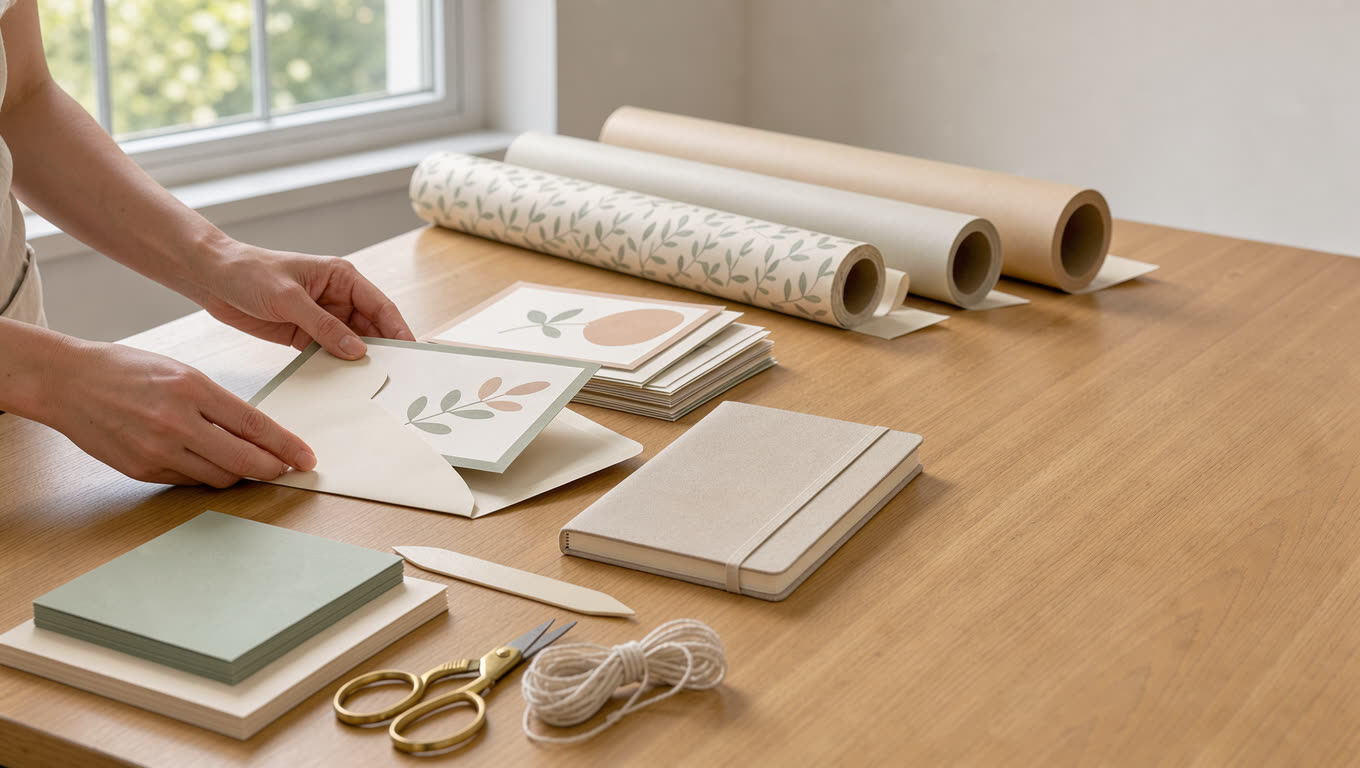
Greeting cards and stationery remain one of the most reliable product categories for a small brand: the U.S. greeting cards market alone was worth USD 7.12 billion in 2025, and the global stationery and supplies market passed USD 152 billion the same year. Unlike trendy product fads, paper goods are bought all year round, need no app store, and can be launched from a laptop with print-on-demand partners. This guide walks you through the practical steps of launching a greeting card and stationery brand in 2027 — from niche selection and printing to pricing, selling channels and seasonal cash flow.
Table of Contents
- Why Greeting Cards Are Still a Good Market
- Choose Your Niche and Collection
- Design and Print Your Stationery
- Price Your Cards for Profit
- Where to Sell Cards and Stationery
- Manage Seasonality and Cash Flow
- Frequently Asked Questions
- Conclusion
- Sources
Why Greeting Cards Are Still a Good Market
A greeting card brand is still worth starting because the market is large, stable, and only loosely tied to digital substitution. Grand View Research valued the U.S. greeting cards market at USD 7.12 billion in 2025, on track to reach USD 8.07 billion by 2033, while the global market stood at USD 19.8 billion in 2025 and is projected to hit USD 23.0 billion by 2033.
The numbers behind that stability are striking. The Greeting Card Association estimates that Americans purchase approximately 6.5 billion greeting cards each year, generating USD 7–8 billion in annual retail sales, and that 9 out of 10 U.S. households buy greeting cards. Demand is also broad: North America accounted for 42.7% of global greeting card revenue in 2025, and stationery-style cards made up 65.30% of the U.S. market — the exact segment an independent card and stationery label competes in. Beyond cards, the wider stationery and supplies market grew from USD 152.43 billion in 2025 to a forecast USD 205.64 billion by 2031, a 5.11% CAGR, so a brand that starts with cards can expand into notebooks, notepads and paper accessories without leaving a growing category. The trade-off is concentration: Hallmark and American Greetings account for roughly 80% of the U.S. market, which means independents win on niche design and community, not on shelf space in supermarkets.
Choose Your Niche and Collection
Pick your niche by occasion and audience first, then let the collection grow from it — a focused range sells better than a general one. The market splits neatly into everyday occasions (birthdays, thank you, sympathy, thinking of you) and seasonal occasions, and the everyday side is the larger, steadier half of the business.
The Greeting Card Association reports that birthday is by far the most popular everyday card-sending occasion, while seasonal volume is dominated by Christmas at around 1.6 billion units per year, followed by Valentine's Day at 145 million units and Mother's Day at 133 million units. A workable starting collection is 10 to 15 everyday designs plus one seasonal capsule of 5 to 8 designs, all sharing a consistent illustration style, colour palette and voice. From there, extend the artwork across formats: the same motif can become a folded card, a flat notecard set, a notebook cover, a sticker sheet or a gift tag — paper-based products captured 42.78% of the stationery and supplies market in 2025, so cross-format extension keeps you inside proven demand. Two practical filters before you commit to a niche: is the occasion repeatable every year, and can you imagine designing 20 more designs in it? If either answer is no, narrow the niche further — "funny cat birthday cards" outperforms "cards for everyone".
Design and Print Your Stationery
You do not need a printing press: print-on-demand and short-run online printers produce professional greeting cards with no minimums, so you can launch without inventory. The route that fits your stage is simple — test with POD, then switch to short print runs once a design proves itself.
For zero-inventory testing, Printify prints folded greeting cards with no order minimum from USD 1 per card (and premium printing at up to 20% off product costs on its paid plan), while Fourthwall sells custom cards from USD 3.95 with matching envelopes and no minimums. When a design starts selling steadily, short-run specialists such as MOO and Vistaprint deliver better paper stocks and finishes at low quantities — both verified active and trading in November 2026, with Vistaprint's parent company Cimpress still acquiring print businesses as recently as May 2026. Whichever partner you choose, prepare print-ready files properly: 300 DPI artwork with 3 mm bleed, a standard size (A6, A2 or 4 × 6 in) so envelopes are easy to source, and a proof order before you list anything. Keep at least two printers in your back-up plan; lead times slip exactly when you need them most, which is October.
Price Your Cards for Profit
Price greeting cards at retail, not at cost: a card that wholesales for USD 1.41–3.08 typically retails around USD 5.00, and the standard keystone rule (retail = wholesale × 2) still delivers a 50% gross margin. In practice, most independent card brands price single cards between USD 4.50 and 6.00 and boxed sets accordingly higher.
The channel you sell through changes your real margin more than your printing cost does. Faire reports that wholesale greeting card prices commonly run between USD 1.41 and 3.08 against a retail price of about USD 5.00, with first-order minimums for boutiques between USD 75 and 200. Selling direct on Etsy means a USD 0.20 listing fee, a 6.5% transaction fee on the item price plus shipping, and a 3% + USD 0.25 payment processing fee in the US — roughly 10% of the sale before any advertising. Your own Shopify store costs USD 39 per month on the Basic plan (USD 29 billed yearly) with card rates from 2.9% + USD 0.30, which becomes cheaper than marketplace fees once you pass a few dozen orders a month. Worked example: a card printed for USD 1.20 and sold for USD 5.00 on Etsy keeps about USD 3.20 after fees and printing, while the same card wholesale at USD 2.50 keeps USD 1.30 — which is why most brands use marketplaces and their own store for full-price volume, and wholesale for moving stock and reaching new shoppers.
Where to Sell Cards and Stationery
Sell in three places at once — local shops for volume, an online marketplace for discovery, and your own store for margin — because 71.55% of U.S. greeting card sales still happened offline in 2025. Physical retail is not optional in this category: gift shops, bookstores and museum stores are where card shoppers browse.
Start with a wholesale pitch to independent retailers: approach 20 to 30 shops with a line sheet showing wholesale and suggested retail prices, pack sizes and reorder lead times, and expect keystone margins — retailers buy at roughly half of retail. Faire operates as a marketplace connecting brands with boutiques and takes a commission instead of upfront inventory risk, which suits a first wholesale effort. For direct sales, use Etsy for discovery — its fee structure is built for small volumes — and graduate to your own store once repeat customers justify the USD 39 monthly cost; our Etsy shop guide breaks down the marketplace route, and the print-on-demand guide covers the zero-inventory model in depth. Craft fairs and maker markets remain the fastest way to test designs face to face: one good weekend market can tell you more about which cards sell than a month of analytics. If your long-term plan is a full brand rather than a card side hustle, the handmade jewelry playbook shows how to move beyond marketplaces into wholesale and your own boutique presence.
Manage Seasonality and Cash Flow
Plan production three to four months before the holiday peak: about 1.6 billion of the 6.5 billion cards Americans buy each year are Christmas cards, and they are ordered in a narrow window. A card brand that prints in November is too late — the season is won in August and September.
The Christmas spike is enormous but not the whole year: Valentine's Day (145 million units) and Mother's Day (133 million units) create two smaller, predictable peaks, while birthday and everyday cards keep orders flowing between them. The U.S. Postal Service's Household Diary Study found that more than 1.3 billion holiday greeting cards were mailed in the fiscal year ending September 2018 — a 3.8% increase over three years — and that holiday cards represented about 43% of all U.S. household personal correspondence that year, a reminder that physical mail still carries emotional weight. Operationally, treat the calendar as four production runs: order your Christmas capsule by late summer, Valentine's designs by November, Mother's Day by February, and a core everyday reprint each quarter. Cash-flow discipline follows the same rhythm — take pre-orders or a 50% deposit on seasonal wholesale runs, keep everyday designs in continuous print so revenue never falls to zero, and hold one printer with short lead times for last-minute reorders.
Frequently Asked Questions
How much does it cost to start a greeting card brand?
You can launch for under USD 500 with print-on-demand: no inventory, cards printed only after a sale. The main costs are design files, packaging samples, a domain, and marketplace or store fees (Etsy charges USD 0.20 per listing; Shopify Basic costs USD 39 per month).
Do I need to print my own cards to sell them?
No. Print-on-demand partners such as Printify (folded cards from USD 1, no minimum) and Fourthwall (from USD 3.95 with envelopes) print and ship for you, and short-run printers like MOO and Vistaprint handle small batches. You only pay for cards you have already sold.
How much should a greeting card sell for?
Most independent brands retail single cards at USD 4.50–6.00. Faire reports wholesale prices of USD 1.41–3.08 with a typical retail around USD 5.00, which follows the keystone rule of doubling wholesale to set retail (a 50% gross margin).
Where is the best place to sell greeting cards and stationery?
Local retailers first: 71.55% of U.S. greeting card sales were offline in 2025, so gift shops, bookstores and craft fairs matter as much as the internet. Pair them with an Etsy shop for discovery and your own store for full-price, repeat-customer sales.
How many designs do I need to launch?
Launch with 10 to 15 everyday designs plus a seasonal capsule of 5 to 8. A tight collection is easier to photograph, cheaper to proof, and simpler for retailers to display — you can add formats and themes once bestsellers emerge.
When should I start preparing for the Christmas season?
Three to four months ahead — finalise designs by August and place print orders by September. Christmas accounts for roughly 1.6 billion of the 6.5 billion cards bought annually in the U.S., so late production means missed sales rather than extra effort.
Conclusion
A greeting card and stationery brand pairs a USD 7 billion U.S. market with startup costs low enough to test on evenings and weekends. The playbook is consistent: choose a repeatable occasion-based niche, launch 10 to 15 designs through print-on-demand, price at keystone so everyone in the chain makes money, and sell through local shops, a marketplace and your own store at the same time. Treat seasonality as a production calendar rather than a surprise, and the same 6.5 billion annual card purchases can turn a small collection into a durable brand.
Sources
- Greeting Card Association — Greeting Card Facts (6.5 billion cards, USD 7–8 billion retail)
- U.S. Chamber of Commerce — The Greeting Card Revival (GCA data, household penetration, market concentration)
- Grand View Research — U.S. Greeting Cards Market Size, 2033 (USD 7.12 billion in 2025, segment shares)
- Grand View Research — Global Greeting Cards Market, 2026–2033 (USD 19.8 billion in 2025, North America share)
- Mordor Intelligence — Stationery and Supplies Market 2026–2031 (USD 152.43 billion in 2025, 5.11% CAGR)
- USPS News — Season's Greetings (Household Diary Study: 1.3 billion holiday cards mailed, FY2018)
- Etsy — Fees & Payments Policy (USD 0.20 listing fee, 6.5% transaction fee)
- Shopify — Pricing (Basic USD 39/month, card rates from 2.9% + 30¢)
- Faire — Greeting Card Wholesale Buying Guide (wholesale USD 1.41–3.08, retail ~USD 5.00)
- Printify — Custom Greeting Card Printing (no minimum, folded cards from USD 1)
- Fourthwall — Custom Greeting Cards (from USD 3.95, no minimum)
- MOO — Online Printing Services (verified active, November 2026)
- Cimpress IR — Acquisition of SAXOPRINT and viaprinto (May 2026, Vistaprint parent activity)