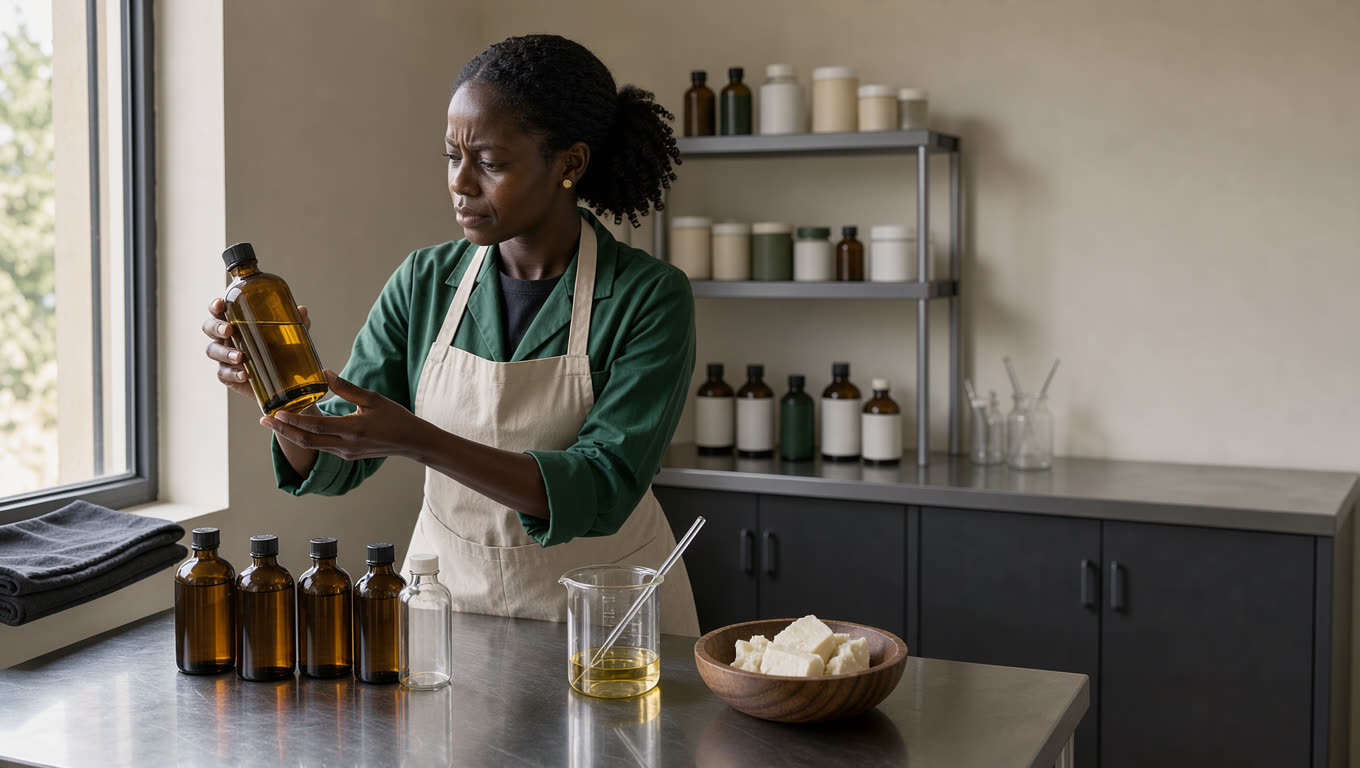
Launching a natural hair care brand in 2027 is easier to start than at any point in the last decade, and harder to get wrong. The global market for natural hair care products was worth USD 10.2 billion in 2024 and is projected to reach USD 16.99 billion by 2030, a compound annual growth rate of 9.4% (Grand View Research, 2024). At the same time, the FDA's MoCRA rules, INCI labelling obligations and marketplace fees now decide who scales and who stalls.
This guide covers the seven decisions that determine whether a new natural hair care line survives its first year: niche, formulation route, regulation, community, sales channels, pricing and operations — with the numbers you need for each one.
Table of Contents
- Why the natural hair care market is growing
- Choose your niche and your first formulas
- Formulation routes: white label, private label or custom
- Regulation and labelling: INCI, MoCRA and claims
- Build the brand and the community
- Where to sell: DTC, marketplaces and wholesale
- Pricing and unit economics
- Frequently Asked Questions
- Conclusion
- Sources
Why the natural hair care market is growing
The market is growing for two reasons: shoppers are switching to naturally derived formulas, and they are buying them online. Grand View Research values the global natural hair care products market at USD 10.2 billion in 2024, with a forecast of USD 11.7 billion in 2026 and USD 16.99 billion by 2030 at a 9.4% CAGR; the online channel is the fastest-growing distribution route at a 9.7% CAGR over the same period. Women accounted for 71.4% of global revenue in 2024, which is exactly the audience a founder-led natural hair care brand speaks to most naturally.
In the United States alone, the category generated USD 2,287.8 million in 2024 and is projected to reach USD 3,824.4 million by 2030 (Grand View Research, 2025), with the fastest growth sitting in textured and coily hair categories that legacy brands have historically under-served — the gap a small brand can actually win, because it cannot out-spend Procter & Gamble.
Choose your niche and your first formulas
Pick one hair concern and one hair type before you pick a single ingredient. A brand that launches with a leave-in conditioner for 4C hair, a scalp oil for locs and a curl cream for loose waves will be remembered by nobody; a brand built around one repeatable hero product gets reorders, reviews and word of mouth.
Validate the niche in three steps. First, read the reviews and questions under the top ten competing products on Amazon and Sephora — repeated complaints about residue, fragrance or protein overload are product briefs. Second, check salon and stylist communities: professionals who recommend a product become a wholesale channel later. Third, confirm the problem is durable: Mintel reports that hair relaxer sales fell 38% between 2012 and 2017 while natural-hair products kept taking share of the Black hair care market.
Keep the launch range to two or three SKUs: one cleanser, one conditioner or leave-in, and one styling or scalp product. Every additional SKU multiplies inventory, stability testing and label artwork at the exact stage where cash is scarcest.
Formulation routes: white label, private label or custom
There are three routes to a formula, and they differ by cost, exclusivity and minimum order quantity. White label means reselling an already-manufactured formula under your own label: minimums can start as low as 50 units per SKU, but the same base sits on other brands' shelves too. Private label means a manufacturer makes a proven base for you with your packaging and fragrance: minimums typically start around 1,000 units per SKU. Custom formulation with a cosmetic chemist is the most expensive path — chemist fees of roughly $100 to $300 per hour, $2,000 to $5,000 per formula iteration, plus stability and preservative-efficacy testing.
For a first line, private label is the pragmatic middle: you get a formula with documentation, your own packaging and a realistic cost per unit, without paying for laboratory development. Industry cost guides put a three-product small cosmetics line at roughly USD 15,000 in production, with turnkey starter programs in the USD 500 to 2,500 range for pre-filled stock packaging. Whatever the route, ask for the stability data, the preservative system and the batch traceability before you pay a deposit — a manufacturer that cannot produce those documents is not a manufacturer.
Regulation and labelling: INCI, MoCRA and claims
Labelling is where new natural hair care brands get into trouble, because a cosmetic label is a legal document. In the United States, the Modernization of Cosmetics Regulation Act of 2022 (MoCRA) requires manufacturers and processors to register their facilities with the FDA and renew every two years, and requires the responsible person to list each marketed product with its full ingredient list, updating annually; new products must be listed within 120 days of first marketing. Serious adverse events must be reported to the FDA within 15 business days.
The relief for small founders is the small business exemption: a responsible person or facility whose average gross annual US sales of cosmetic products over the previous three-year period is less than USD 1,000,000 (adjusted for inflation) is exempt from registration, product listing and good manufacturing practice requirements — provided none of your products regularly touch the mucous membrane of the eye, are injected, are for internal use, or alter appearance for more than 24 hours (21 U.S.C. § 364h; FDA guidance, December 2024). A rinse-out shampoo or curl cream qualifies; an eyelash extension glue does not.
Ingredient names must follow the INCI nomenclature (International Nomenclature of Cosmetic Ingredients), the same standard used under EU Regulation (EC) No 1223/2009, which also governs allergen declaration if you ever sell in Europe. Two practical rules follow. List ingredients in descending order of weight, using the exact INCI name — "Butyrospermum Parkii Butter", not "pure shea magic". And keep claims cosmetic: "moisturises and detangles" is safe, while implying a product treats alopecia or a medical condition turns your cream into an unapproved drug.
Build the brand and the community
Natural hair is a community before it is a category, and the brand that shows up inside the community wins. The cultural context is measurable: 30 states have now enacted some version of the CROWN Act banning race-based hair discrimination (Economic Policy Institute, 2026), and the 2023 CROWN Workplace Research Study found that Black women's hair is 2.5 times more likely to be perceived as unprofessional, that one in four Black women believe they were denied a job interview because of their hair, and that 20% of Black women aged 25 to 34 had been sent home from work over their hair.
Those numbers define the brand promise. Your content should teach, not just sell: wash-day routines, porosity tests, protective style aftercare, ingredient literacy. Build the audience on the channels your customer already uses — short-form video demonstrations, a stylist ambassador program, and an email list you own rather than an audience you rent. Treat stylists and barbers as a first-class channel: they validate the product in front of the exact customer you want, and their salons become your first wholesale accounts. For the content machine behind that, see our guide on starting a social media management studio.
Where to sell: DTC, marketplaces and wholesale
Sell where your customer already shops: 41% of all US beauty and personal care purchases now happen online, up from 34% in 2020, and online beauty sales are growing roughly nine times faster than in-store sales (NielsenIQ, 2025). A three-channel mix is the realistic starting point — your own store for margin and data, a marketplace for discovery, and wholesale for volume.
On direct-to-consumer, Shopify's Basic plan costs USD 39 per month when billed monthly (USD 29 per month billed annually) with card rates from 2.9% + 30¢. On marketplaces, Etsy charges a USD 0.20 listing fee, a 6.5% transaction fee and a 3% + $0.25 payment processing fee — cheap enough for testing, expensive enough that it should not be your only channel. For retail, Faire remains the largest wholesale marketplace and reported USD 750 million in annualized revenue, up 49% year on year as of late 2026 (Fortune), so the wholesale channel is healthy; independent retailers that discover you there become repeat reorders rather than one-off sales.
Wholesale also forces retail discipline: case packs, barcodes, safety documentation and consistent margins — the same progression our piece on launching a handmade jewelry brand beyond Etsy describes for product brands.
Pricing and unit economics
Price from the unit cost backwards, not from the competitor's shelf price forwards. Contract production data shows small-run turnkey formulas at roughly USD 4.00 to 9.00 per unit for runs of 50 to 250 units, USD 2.50 to 5.50 per unit at 500 to 2,500 units, and below USD 2.50 only at 5,000 units or more. Add packaging, labels, shipping supplies and your platform fees, and a 250 ml curl cream that costs USD 6 landed realistically needs a USD 16 to 22 retail price to leave a workable margin after a 6.5% marketplace fee, payment processing and returns.
The common structure is a 4x to 5x multiple on landed cost for direct-to-consumer, with wholesale at roughly half of retail so both you and the retailer make money. Guard the two numbers that quietly kill product brands: inventory sitting longer than it sells (aim to turn stock in under six months) and discounts used as a substitute for positioning. A realistic first-year budget runs from USD 15,000 to 30,000 for one or two private label products with branding, website and initial marketing — see our breakdown of launching a digital products shop for a lighter-cost comparison of the same launch mechanics.
Frequently Asked Questions
How much does it cost to start a natural hair care brand?
Most founders launch with USD 15,000 to 30,000 for one or two private label products, branding, a website and initial marketing. Turnkey starter programs with pre-filled stock packaging can start from around USD 500 to 2,500, while custom formulation with a chemist pushes the budget well past USD 10,000 before inventory.
Do I need FDA approval to sell shampoo or hair oil?
No premarket approval is required for cosmetic hair products, but MoCRA obligations apply: facility registration and product listing with the FDA unless you qualify for the small business exemption (under USD 1,000,000 average annual US cosmetic sales over three years), plus safety substantiation, labelling and serious adverse event reporting within 15 business days.
What does INCI mean on a hair care label?
INCI stands for International Nomenclature of Cosmetic Ingredients, the standardised naming system used for ingredient lists in the US and EU. Ingredients must appear in descending order of weight using their exact INCI names, which is why you read "Aqua" and "Cetearyl Alcohol" rather than marketing words.
Should I start with white label or private label?
Start with white label if you need to test demand with 50 to 250 units per SKU at low cost, accepting that the formula is not exclusive. Move to private label, with minimums around 1,000 units per SKU, once reviews and reorder rates prove the product — that is when custom packaging and a distinctive formula start paying for themselves.
Where is the best place to sell a new natural hair care brand?
Use three channels together: your own Shopify store for margin and customer data, a marketplace such as Etsy for discovery (6.5% transaction fee plus a 3% + $0.25 processing fee), and wholesale through Faire for volume with independent retailers. With 41% of US beauty purchases happening online, an online-first mix is the default.
How long until a natural hair care brand becomes profitable?
Plan for 12 to 24 months. The first six months are usually consumed by product development, compliance and a founding batch that sells slowly; repeat purchases from a hero SKU, salon reorders and a content engine that compounds are what turn the brand profitable in year two.
Conclusion
Launching a natural hair care brand in 2027 comes down to four disciplines: pick one hair problem and prove it with two or three products, choose the formulation route that matches your cash (white label to test, private label to scale), treat labelling and MoCRA as a launch checklist rather than an afterthought, and build the community before you need the sales. The market is growing at 9.4% a year toward USD 16.99 billion by 2030 — the opportunity is real, but it rewards founders who launch small, document everything and sell consistently across their own store, marketplaces and wholesale.
Sources
- Grand View Research — Natural Hair Care Products Market Size Report, 2025-2030 and press release "Natural Hair Care Products Market To Reach $16.99Bn By 2030" (December 2024): https://www.grandviewresearch.com/industry-analysis/natural-hair-care-products-market
- Grand View Research — U.S. Natural Hair Care Product Market Size & Outlook, 2030 (USD 2,287.8 million in 2024): https://www.grandviewresearch.com/horizon/outlook/natural-hair-care-product-market/united-states
- U.S. Food and Drug Administration — Modernization of Cosmetics Regulation Act of 2022 (MoCRA): https://www.fda.gov/cosmetics/cosmetics-laws-regulations/modernization-cosmetics-regulation-act-2022-mocra
- U.S. Food and Drug Administration — Guidance for Industry: Registration and Listing of Cosmetic Product Facilities and Products (small business definition, December 2024): https://www.fda.gov/media/170732/download
- U.S. Food and Drug Administration — Small Businesses & Homemade Cosmetics: Fact Sheet: https://www.fda.gov/cosmetics/resources-industry-cosmetics/small-businesses-homemade-cosmetics-fact-sheet
- 21 U.S.C. § 364h — Small businesses (MoCRA section 612): https://www.govinfo.gov/content/pkg/USCODE-2024-title21/html/USCODE-2024-title21-chap9-subchapVI-sec364h.htm
- EUR-Lex — Regulation (EC) No 1223/2009 on cosmetic products (INCI and EU labelling): https://eur-lex.europa.eu/legal-content/EN/TXT/?uri=CELEX:32009R1223
- Economic Policy Institute — Thirty states have passed a version of the CROWN Act to ban hair discrimination (2026): https://www.epi.org/blog/thirty-states-have-passed-a-version-of-the-crown-act-to-ban-hair-discrimination-continued-action-needed-more-than-ever-as-trump-administration-abandons-equity/
- CROWN — Data Behind the CROWN Act (2023 Dove/LinkedIn CROWN Workplace Research Study): https://crown.ngo/legislation/crown-act-data/
- NielsenIQ — The Beauty Edition / Mid-Year Consumer Report 2025 (41% of beauty purchases online): https://nielseniq.com/wp-content/uploads/sites/4/2026/08/Content-That-Converts-The-Beauty-Edition.pdf
- Etsy — Fees & Payments Policy ($0.20 listing, 6.5% transaction fee): https://etsy.com/legal/fees?language=en-US
- Shopify — Pricing (Basic USD 39/month monthly, 2.9% + 30¢): https://www.shopify.com/pricing
- Fortune — Wholesale marketplace Faire survived the 'fog of crazy valuations.' Now, it's eyeing an IPO (November 2, 2026): https://www.fortune.com/2026/11/02/wholesale-marketplace-faire-survived-fog-of-crazy-valuations-now-eyeing-ipo
- HuffPost — How Much It Costs To Maintain Natural Black Hair (citing Mintel: relaxer sales fell 38% between 2012 and 2017): https://www.huffpost.com/entry/costs-natural-black-hair_l_5e441e19c5b6d0ea3811b813
- SBL Comp — How Much Does It Cost to Start a Cosmetic Business (2025): https://sblcomp.com/how-much-does-it-cost-to-start-a-cosmetic-business
- Lovedetour — Private Label Cosmetics Cost: Budgeting Your Launch: https://lovedetour.com/how-much-does-private-label-cosmetics-cost
- Supliful — What Is the Cost of Starting a New Beauty Brand?: https://supliful.com/blog/cost-of-starting-a-new-beauty-brand