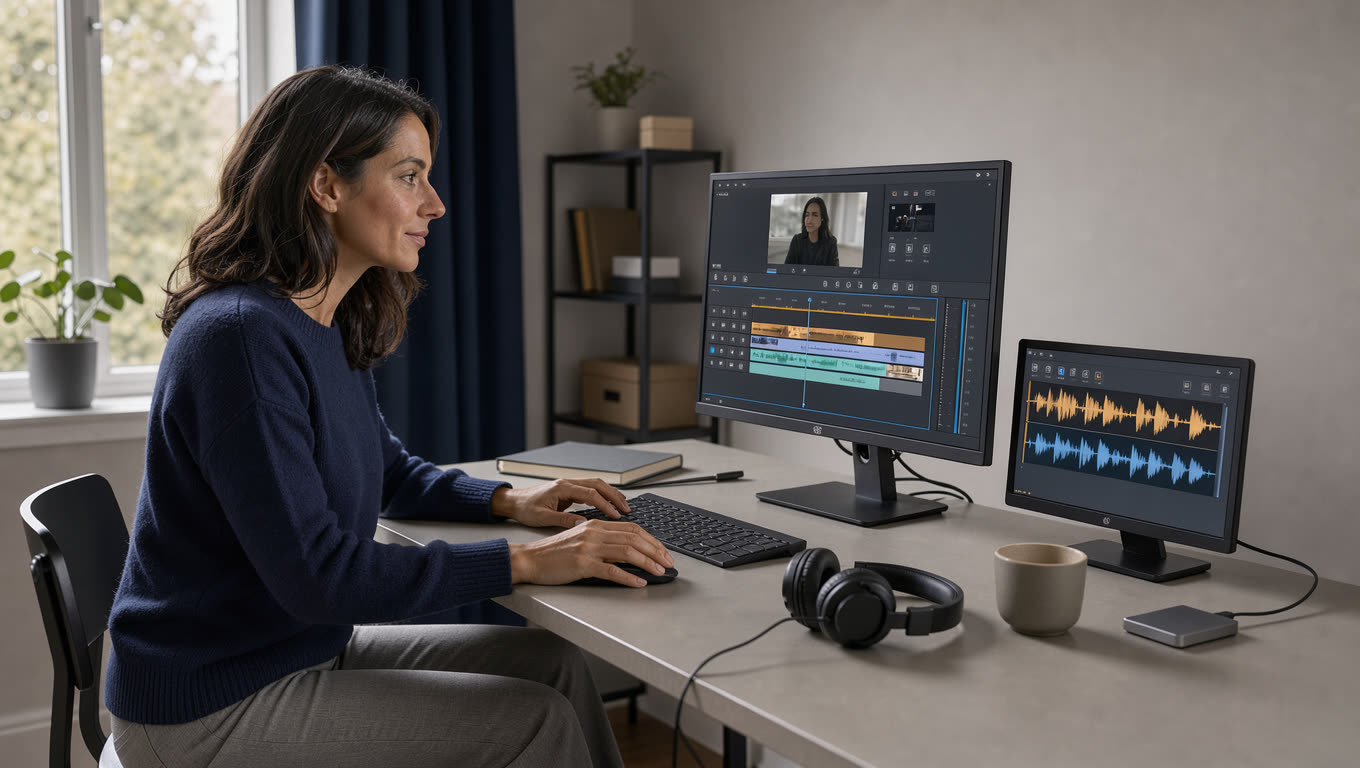
A freelance video editing business is one of the few service businesses you can start with a decent laptop, one free piece of software and a folder of raw footage somebody else already shot. Creators publish far more video than they can finish themselves, businesses now treat video as a default marketing format, and the editing seat is where that backlog finally gets cleared. This guide covers the path for 2027: niche, rates, toolkit, workflow and first clients.
Table of Contents
- Why Creators Need Video Editors
- Choose Your Niche Before Your Tools
- Set Your Rates With Real Numbers
- Build a Lean Toolkit
- Design a Workflow Clients Can Repeat
- Land Your First Clients
- Avoid These Costly Mistakes
- Frequently Asked Questions
- Conclusion
Why Creators Need Video Editors
Creators need video editors because video has become the default marketing format and the volume of footage being published keeps growing faster than anyone can cut it. In Wyzowl's 2026 survey of 266 marketing professionals and consumers, 91% of businesses used video as a marketing tool, 93% of video marketers called video an important part of their strategy, and 92% planned to spend the same or more on video. YouTube is the most used channel (82% of video marketers) and the most effective (69%), ahead of LinkedIn at 70% and Instagram at 69%.
Short-form is where the workload actually sits. Metricool analysed more than 5 million videos and 582,456 accounts in its 2025 State of Short-Form Video report and found that short-form video posts grew 71% year over year while the number of accounts posting them rose 51%. Brands now publish an average of 16.21 short videos a month on YouTube Shorts alone, and every one has to be cut by someone — increasingly a freelance editor working from a shared drive.
The buyer base is large and still professionalising: around 207 million people identify as content creators worldwide, 45 million of them in the United States, and roughly 46.7% create full-time (DemandSage, 2026). If audio-first formats appeal to you more, the same editing backlog exists in podcast production and monetisation, and the skill set sits directly beside running a social media management studio.
Choose Your Niche Before Your Tools
Choose your niche first, because the editing work that pays best is niche-specific and each niche sells a different outcome rather than different hours. In Cutjamm's 2025 Video Editor Salary Survey of 201 freelance editors, corporate and branded content was named the highest-paying niche, requiring polished editing and strong storytelling, while social media content paid less per project but made up for it in volume and fast turnaround. The niche you pick decides your rate card, your software and your outreach list, so pick it before you buy anything.
The practical options for a solo editor are narrow enough to be useful:
- YouTube long-form for coaches, educators and business creators posting weekly eight- to fifteen-minute videos.
- Podcast and webinar clipping, turning one long recording into eight to twelve vertical clips with captions.
- Short-form social packs for local businesses and brands that need four to twenty Reels or Shorts a month.
- Course and e-learning creators, where lesson structure and captions matter more than flashy transitions.
- Corporate and branded video, the highest-paying segment, usually reached through agencies rather than direct sales.
Artificial intelligence is part of this niche decision, not a threat to it: 63% of video marketers used AI to create or edit video in 2026, up from 51% a year earlier (Wyzowl). Captions, filler-word removal and clip selection now cost minutes instead of hours, so clients pay for what is not automated — pacing, story order, a hook in the first three seconds, and consistency across a catalogue.
Set Your Rates With Real Numbers
Set your rates from published market data rather than from what you hope to earn, because freelance video editing rates cluster into predictable bands you can position against. Cutjamm's 2025 survey of 201 editors found an average hourly rate of $27.55, an average flat project fee of $287.16, an average charge of $148.95 per finished minute, and an average monthly retainer of $1,206.60. On the model itself, 35% of freelance editors charge per project, 16% hourly, 12% on a monthly retainer and 11% per finished minute.
Use the United States as your benchmark. The Bureau of Labor Statistics reported a median wage of $36.26 an hour ($75,420 a year) for employed film and video editors in May 2025, with the top 10% above $71.42 an hour, and noted that 35% of editors are self-employed — the highest self-employed share of any occupation it tracks. Upwork's tiers run $15 to $30 an hour for entry-level work, $30 to $60 for intermediate, and $60 to $150 or more for expert editing, motion graphics and VFX.
A sensible starting ladder: $25 to $150 per short-form clip, $75 to $600 for an eight- to fifteen-minute YouTube video, $500 to $2,500 for branded or corporate pieces, and a monthly retainer once a client has booked you three times. Retainers deserve the push — they average $1,206.60 a month in the Cutjamm data, and a 10% to 20% discount for guaranteed monthly volume is a trade worth making once the pipeline is steady.
Build a Lean Toolkit
You need one timeline editor, one review tool and one storage plan to start, and adding more software does not make you more employable. DaVinci Resolve is a free, colour-grade-capable editor from Blackmagic, Adobe Premiere Pro is the agency standard on a monthly subscription, Final Cut Pro is a one-time purchase for Mac users, and CapCut handles fast short-form edits with auto-captions and a free 1080p export. Descript edits talking-head video by letting you delete words from a transcript, and Opus Clip turns long episodes into vertical clips automatically.
Every tool named here was checked online in November 2026 and is actively maintained: Descript ships a public changelog with recent releases, Opus Clip documents a live API as recently as November 2026, and CapCut remains the default short-form editor despite a brief United States outage in January 2025 and a ban in India — so keep a second editor installed for clients who will not use ByteDance apps. For review and delivery, use Frame.io or a shared drive with timestamped comments.
Hardware is the one place not to economise. 4K footage and multi-camera projects eat storage and rendering power, so budget an external SSD for active projects, keep proxies enabled for long timelines, and state a footage archive period — ninety days is a defensible default you can put in the contract.
Design a Workflow Clients Can Repeat
A repeatable workflow is what lets you take on more clients without adding more hours: brief, ingest, assembly cut, fine cut, revisions, delivery. Never open the footage without a written brief, because the brief is what turns "make it pop" into a decision you can execute once. Use Upwork's one-to-four-hours-per-finished-minute rule to estimate capacity before you quote, and send the estimate in writing before the first file arrives.
The structure that survives contact with real clients is boring on purpose: a shared folder layout (01_raw, 02_project, 03_exports), proxy playback for heavy footage, two revision rounds in every price, captions and a normalised sound mix as standard deliverables, and a review link instead of email attachments. State the revision window — seven days is common — because scope creep is almost always a missing sentence in the contract rather than a difficult client.
Capacity is the part beginners underestimate: at one to four hours of editing per finished minute, a ten-minute YouTube video represents ten to forty hours of work before revisions. That arithmetic is the argument for per-project pricing — when a client sends forty minutes of raw footage for "a short video", hourly billing punishes your efficiency while per-minute billing pays you for the outcome.
Land Your First Clients
Land your first clients by putting finished clips in front of specific creators rather than by outbidding everyone on a generic job board. Start with three spec edits: re-cut a public video from a creator you would love to work with, credit the original footage, and send a two-line note naming exactly one change you would make to their next upload. A finished clip beats a paragraph of credentials every time.
From there, work the channels in order of friction. Creators with 50,000 to 500,000 subscribers post weekly and rarely have an in-house editor, so direct outreach there converts better than broad platforms. Video shooters, podcast producers and freelance copywriters refer overflow work constantly. Marketplaces such as Upwork and Fiverr are fine for early reviews, but remember the economics: Fiverr keeps 20% of every order and Upwork charges around 8% to 10% — platform prices are floor prices, not business models. The buyers are already spending: YouTube is used by 82% of video marketers and rated effective by 69% (Wyzowl).
Move every relationship toward recurring work. After three projects, offer a monthly package at a 10% to 20% discount in exchange for volume and a fixed delivery day, and pair your editing offer with adjacent services such as a niche newsletter or thumbnail and title work. Editors who own the publishing rhythm are the last ones a creator cuts when budgets tighten.
Avoid These Costly Mistakes
- Editing before the brief. Two hours discarded because the client wanted a different hook is a pricing problem disguised as a production problem.
- Racing the cheapest bidder. Editors in the Philippines quote $5 to $20 an hour (Cutjamm). You will not win that auction; sell reliability, taste and turnaround instead.
- Unlimited revisions in a small package. Cap revisions at two rounds and price the third.
- Chasing tools instead of clients. New AI releases are not a marketing plan; a finished spec edit is.
- Selling only to creators who cannot pay. 50.71% of creators earn under $15,000 a year and 56.55% of full-time creators sit below the US living wage of $44,000 (NeoReach, 2025 Creator Earnings Report, 3,000+ creators surveyed). Aim instead at the 44.8% who own a business or brand, plus agencies, course creators and local businesses.
- Working without a contract. Define deliverables, revision limits, payment terms, kill fee and footage archive period before the first invoice.
Frequently Asked Questions
How much can a freelance video editor charge in 2027?
Market averages from Cutjamm's 2025 survey of 201 freelance editors are $27.55 an hour, $287.16 per project, $148.95 per finished minute and $1,206.60 per month on retainer. US benchmarks run higher: the Bureau of Labor Statistics reported a median of $36.26 an hour for employed editors in May 2025, and Upwork's tiers are $15–$30 entry, $30–$60 intermediate and $60–$150+ expert. Most beginners start at $25–$150 per short clip and $75–$600 per YouTube video.
Do I need a degree or certification to edit video for clients?
No. There is no licence or mandatory certification for video editing, and clients hire on the strength of a portfolio, turnaround and communication. Learn one editor deeply — DaVinci Resolve is free — build three finished clips in your chosen niche, and show them. Proof of delivery, not a certificate, is what converts a first prospect into a first invoice.
Which software should a beginner learn first?
Learn one timeline editor first: DaVinci Resolve if you want a free, industry-grade tool with strong colour grading, Adobe Premiere Pro if you expect to work inside agencies, or Final Cut Pro on a Mac. Add Descript for transcript-based talking-head edits and Opus Clip for clipping long episodes only once a client pays for that workflow. Tool breadth matters far less than speed in one editor.
How long does it take to edit one video?
Upwork's rule of thumb is one to four hours of editing per finished minute, so a ten-minute YouTube video typically takes ten to forty hours before revisions, and a sixty-second short usually takes one to four hours. Turnaround expectations differ by niche: social clips are often same-day or next-day, while branded and corporate pieces allow a week. Quote from the rule, then add buffer for revisions.
How do I get my first paying client without a portfolio?
Make the portfolio yourself: re-cut two or three public videos from creators in your niche, credit the original footage, and send a short note naming one specific change you would make. Then approach creators with 50,000 to 500,000 subscribers, agencies with overflow work, and referral partners such as video shooters and podcast producers. Marketplaces like Upwork and Fiverr work for early reviews, but platform fees of 8% to 20% make them a launchpad rather than a destination.
Will AI replace freelance video editors?
AI now handles captions, filler-word removal and clip selection — 63% of video marketers used AI to create or edit video in 2026, up from 51% a year earlier (Wyzowl) — but that automates the mechanical layer, not the judgement layer. Editors who can structure a story, protect a brand's tone and deliver on a schedule are still the bottleneck for the 91% of businesses using video. Position yourself as the person who directs the tools rather than the person they replace.
Conclusion
Starting a freelance video editing business in 2027 is mostly a positioning exercise: pick one niche, price from the published numbers, run one editor well, and replace guesswork with a workflow a client can trust. The demand side is not the problem — 91% of businesses use video, short-form output grew 71% in a single year, and hundreds of millions of creators publish faster than they can cut. What separates a hobbyist with a laptop from a paid editor is a written brief, a rate card anchored to real data, two revision rounds, and a retainer offer after the third project.
If you are still comparing options, our roundup of trending business ideas for women in 2027 covers other service businesses you can start with the same lean model.
Sources
- Wyzowl — Video Marketing Statistics (survey of 266 respondents, late 2025): https://wyzowl.com/video-marketing-statistics
- Cutjamm — 2025 Video Editor Salary Survey Report (201 editors surveyed): https://cutjamm.com/blog/2025-video-editor-salary-survey-report
- Cutjamm — Freelance Video Editing Rates in 2026: https://www.cutjamm.com/blog/video-editing-rates
- Freelance Nation — Video editing rates and freelance video editor rates per hour (BLS May 2025 and Upwork rate data): https://freelancenation.com/video-editing-rates
- Invoicewebsite — How Much Do Video Editors Make? 2025 Pay by State (BLS Occupational Employment and Wage Statistics, May 2025): https://invoicewebsite.com/rates/video-editors
- Metricool — State of Short-Form Video in Social Media in 2025 (5M+ videos, 582,456 accounts): https://metricool.com/social-media-short-video-report-2025
- DemandSage — Creator Economy Statistics 2026: https://www.demandsage.com/creator-economy-statistics/
- Visa and Morning Consult — Monetized: Visa 2025 Creator Report (1,067 creators surveyed): https://images.globalclient.visa.com/Web/InovantElqVisaCheckout/%7B0cadbc53-5daf-42f9-ab7c-8abe1faeb333%7D_VS0248i_Creators_Whitepaper_v7.1_251028_MA_Final_11032025_ACCESSIBLE_V2.pdf
- NeoReach — Creator Earnings Report 2025 (3,000+ creators surveyed): https://neoreach.com/reports/creator-earnings-report-2025
- Expert Ranking — Best CapCut Alternatives 2026 (tool availability and January 2025 US outage): https://theexpertranking.com/tools/capcut/alternatives