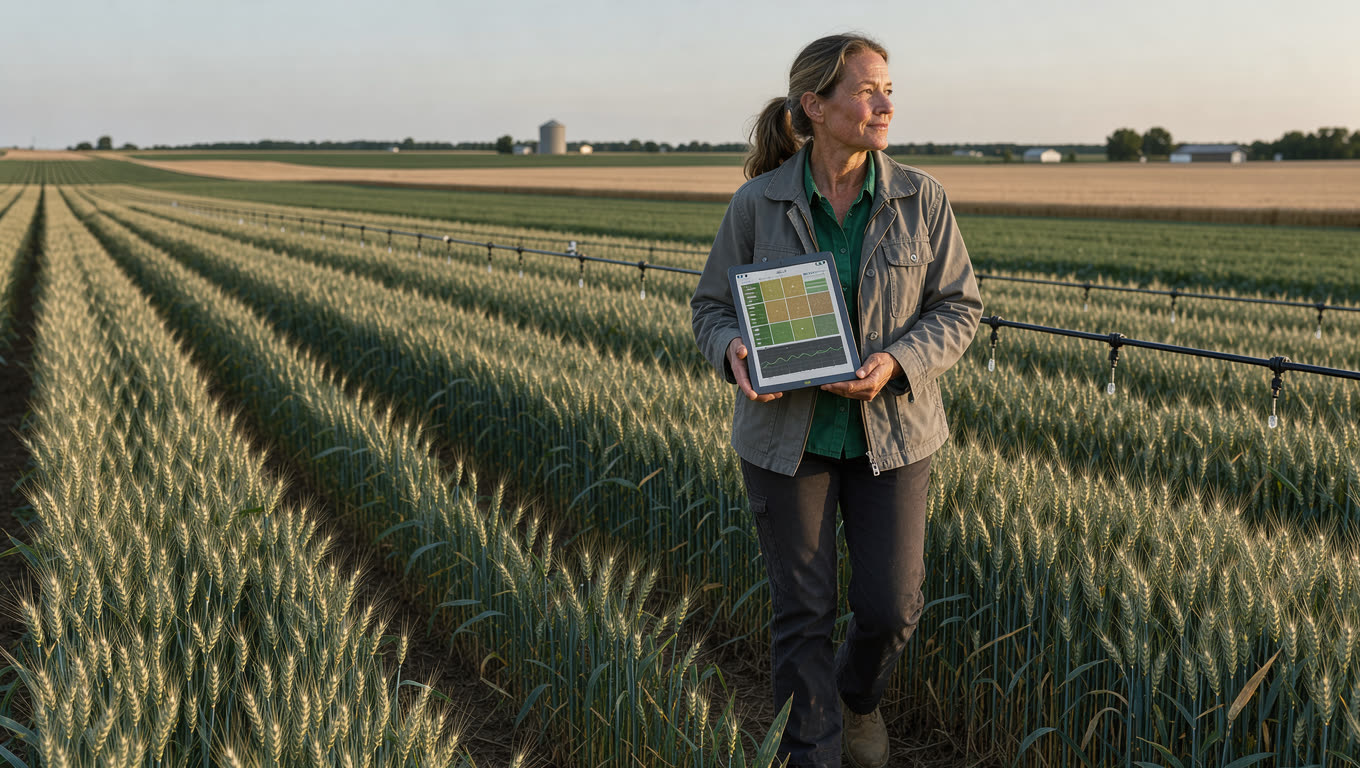
Agriculture has long been coded as male work, yet women farmers now make up 39.6 percent of the world's agricultural workforce — 363 million of the 916 million people employed in agriculture, forestry and fishing in 2023, according to the FAO. In Africa and Asia they are the backbone of smallholder production, even while owning a fraction of the land they farm.
This article profiles four women farmers and agriculturists who turned that gap into an opportunity: a third-generation Iowan who rebuilt her family farm around regenerative practices, a Mexican-born urban grower tackling food insecurity in US cities, a South African agronomist opening the sector to women, and a Chinese agtech founder wiring the field to the cloud. Their paths are different; the playbook they share is transferable.
Table of Contents
- Sowing the Seeds: The Regenerative Turn
- Cultivating Dreams: From Subsistence to Urban Farms
- Blooming Against Odds: Opening the Sector to Women
- Harvesting Innovation: Precision Farming at Scale
- The Common Thread: What Their Journeys Share
- Lessons for Aspiring Women Farmers
- Frequently Asked Questions
- Conclusion
- Sources
Sowing the Seeds: The Regenerative Turn
Jane Patel is a third-generation farmer who grew up on her family's grain and livestock farm in rural Iowa. Like many successors in the Corn Belt, she inherited land, machinery and a conventional rotation of corn and soybeans — a system optimised for yield, not for soil. Her decision to study agronomy rather than take over the fields unchanged was the first break with family tradition.
On returning home she converted the farm to regenerative practices: extended crop rotation including cover crops, reduced tillage, organic amendments and integrated pest management. The economics were not automatic — cover crops cost money before they save it, and neighbours were sceptical — but within several seasons the farm reported lower input bills, better water infiltration during dry summers and improved soil organic matter.
Jane's second move was educational. She runs seasonal workshops for neighbouring farmers on cover-crop seeding rates, grazing covers for cash and scouting for pests without routine sprays. Her story illustrates a broader shift: the FAO reports that agriculture employed 916 million people worldwide in 2023, and that productivity increasingly depends on knowledge-intensive practices rather than simply more hectares.
Cultivating Dreams: From Subsistence to Urban Farms
Maria Sanchez grew up in a small village in Mexico where her family farmed a few hectares of maize and beans for subsistence. Migrating to the United States as a young adult, she landed in a dense urban neighbourhood where fresh produce was scarce and expensive — a food desert in all but name.
She began with a vacant lot: cleared rubble, raised beds, a partnership with a church, and a weekly market stall. That plot became the seed of a network of community gardens and small urban farms supplying restaurants, school cafeterias and a neighbourhood box scheme — the same local, product-driven energy that drives the founders profiled in 5 Innovators in the Food and Beverage Industry. Urban agriculture now spans community gardens, rooftop farms and hydroponic facilities, and the USDA funds it explicitly — its Urban, Indoor, and Emerging Agriculture programme and Community Food Projects Competitive Grant Program both channel federal money into exactly this kind of project.
Maria's bigger achievement is policy. She testified in municipal consultations that led to a city ordinance simplifying permits for community gardens on public land, and she trains other first-time growers on business planning, food-safety paperwork and grant writing. Her route shows that urban farming is as much an organising job as an agricultural one.
Blooming Against Odds: Opening the Sector to Women
Aisha Mbeki was raised in a conservative village in South Africa's Eastern Cape, where cattle and maize farming were understood to be men's work. When she announced she wanted to study agriculture, relatives assumed she would marry into farming rather than run one. She enrolled anyway, qualified as an agronomist, and returned to lease land for a horticulture operation supplying local markets.
Her frustration became an organisation. Aisha runs skills programmes for women in agriculture — production planning, post-harvest handling, access to credit — and lobbies agribusinesses and government programmes to publish the gender breakdown of their beneficiary lists. The pressure works because the underlying numbers are stark: women make up 46.4 percent of employment in agriculture in Africa, yet the FAO finds that across 90 countries with wage data, women are only 26.6 percent of paid agricultural employees — the lowest shares appear in Panama (6.7 percent), Honduras (6.5 percent), Egypt (5.2 percent) and Jordan (2.1 percent).
Rwana-style exceptions exist: Rwanda records 55.8 percent female share of agricultural employees. Aisha cites it in every funding conversation as proof that the barrier is institutional, not biological.
Harvesting Innovation: Precision Farming at Scale
Li Wei grew up in Beijing to engineer parents who encouraged her obsession with how machines work. Trained in engineering and drawn to agriculture through China's push for food security, she founded an agtech company building precision-farming tools: soil moisture sensors, variable-rate irrigation controllers and an analytics layer that turns field data into sowing and fertilisation recommendations.
Her pitch to sceptical farm managers is blunt — sensors pay for themselves when they stop over-watering. Li Wei's deployments combine on-farm telemetry with satellite imagery, letting growers see variability within a single field instead of treating the whole block as one unit. She also licenses her analytics to cooperatives so that smaller farms get the same agronomic advice at a fraction of the cost of a full-time consultant.
The gender dimension persists even in the newest segment of the sector: the FAO notes that women's participation in agrifood systems has stayed around 40 percent globally, and that they are consistently under-represented in the higher-value, non-farm segments. Li Wei hires deliberately — half her field engineering team is female — arguing that a sector serving 584 million women workers needs women building its tools.
The Common Thread: What Their Journeys Share
Education as leverage. All four women used formal training — agronomy, business planning, engineering — to convert experience into scalable practice. Jane and Li Wei turned scientific method into competitive advantage; Maria and Aisha turned it into institutional credibility.
Community, not just farm, economics. Each measures success beyond her own gate: workshops, cooperatives, municipal ordinances, hiring policies. Their operations are businesses, but their growth engine is the ecosystem around them.
Persistence through scepticism. Every one of them worked against a prior that the sector belonged to someone else. The pattern across their careers — study, prototype, publish results, bring others along — is repeatable.
Lessons for Aspiring Women Farmers
- Pair tradition with evidence. Respect what works locally, then test it with data — soil tests, water meters, cost-per-acre records.
- Treat land access as the first business problem. Leases, community land trusts, municipal lots and cooperative ownership all unlock entry without a large purchase.
- Write the grant, not just the crop plan. Public funding for urban and beginning farmers is substantial and under-used; Maria's and Aisha's organisations both run on it.
- Build a network before you need it. Workshops, producer groups and women-in-agriculture associations convert into buyers, lenders and advocates when something goes wrong.
- Adopt technology selectively. Start with the constraint that costs the most — usually water or fertiliser — and digitise that first.
Frequently Asked Questions
How many women work in agriculture worldwide?
According to the FAO, women represented 39.6 percent of the 916 million people employed in agriculture, forestry and fishing in 2023 — about 363 million workers. In agrifood systems overall, 584 million women were employed, representing 43.8 percent of all working women.
What did Jane Patel change on her family farm?
She converted a conventional corn-and-soybean operation to regenerative practices — extended rotations with cover crops, reduced tillage, organic amendments and integrated pest management — then ran training workshops so neighbouring farmers could copy the system.
How does urban agriculture fight food insecurity?
Urban farms produce fresh food inside the neighbourhoods that lack it, shortening supply chains and cutting prices. USDA programmes such as Community Food Projects Competitive Grants fund these operations, which also create local jobs and training ground for first-time growers.
Why are women under-represented among paid farm workers?
Women do much of the world's farm work but hold fewer wage jobs: across 90 countries with data, women are 26.6 percent of paid agricultural employees, and only 1 percent in the United Arab Emirates, 2.1 percent in Jordan and 5.2 percent in Egypt. Land ownership rules, credit access and hiring bias drive the gap — not capability.
Is precision farming only for large operations?
No. The costliest inputs — water and fertiliser — are exactly where sensors pay back fastest, and shared analytics let cooperatives offer small farms agronomic advice at low cost. Li Wei's model deliberately targets that price point.
How can a first-time woman farmer get started?
Start with land access that does not require a purchase — a lease, a municipal lot, a community land trust or a cooperative. Pair it with a training programme, keep production records from day one, and apply for beginning-farmer or urban-agriculture grants rather than self-funding every step.
Conclusion
Jane, Maria, Aisha and Li Wei did not wait for agriculture to become inclusive before entering it. They studied the science, financed the first plot, organised the people around them and shipped technology that made the whole system work harder per hectare and per hour. With women already 39.6 percent of the world's farm workforce, the question for the next decade is not whether they will farm, but whether the sector's capital, land and tools will catch up to them.