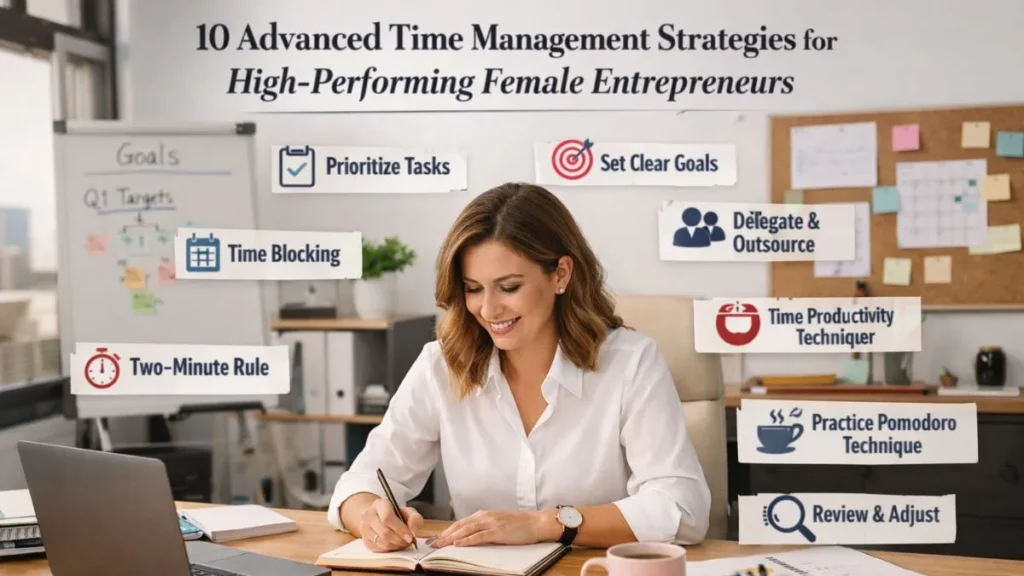
In today’s dynamic business environment, female entrepreneurs are redefining leadership, innovation, and resilience. Yet behind every thriving business lies a constant challenge: managing time effectively in the face of competing priorities. From strategic decision-making and team leadership to personal responsibilities and self-care, the demands are multifaceted and often relentless.
Time, unlike other resources, is finite and non-renewable. For women entrepreneurs—many of whom navigate not only professional ambitions but also societal expectations and personal commitments—mastering time management is not merely a productivity exercise; it is a strategic advantage.
This article explores ten sophisticated and practical time management strategies tailored for female entrepreneurs who seek not just to stay organized, but to operate at peak performance, sustain growth, and maintain a meaningful work-life integration.
1. Strategic Prioritization: Moving Beyond To-Do Lists
Traditional to-do lists often fail because they treat all tasks as equal. High-performing entrepreneurs understand that not all tasks contribute equally to business outcomes.
Start each day by identifying high-impact activities—those that directly contribute to revenue generation, strategic growth, or long-term positioning. A useful framework is to categorize tasks into:
- Critical and strategic
- Operational and necessary
- Low-value or optional
Focus your energy on the top three strategic priorities of the day. Completing these ensures that even if unexpected disruptions occur, your most valuable work is already accomplished.
This approach shifts your mindset from busyness to effectiveness.
2. Goal Architecture: Designing Clear and Measurable Outcomes
Clarity is the foundation of efficient execution. Without clearly defined goals, time is often wasted on reactive work rather than proactive progress.
Establish a structured goal system:
- Long-term vision (1–3 years): Where is your business heading?
- Mid-term goals (quarterly): What milestones define progress?
- Short-term execution (weekly/daily): What actions drive results?
Break large objectives into smaller, actionable tasks. Assign deadlines not just as constraints, but as commitment mechanisms that reinforce accountability.
Well-defined goals eliminate decision fatigue and allow you to allocate time with precision.
3. Intelligent Delegation and Strategic Outsourcing
One of the most common bottlenecks among entrepreneurs is the reluctance to delegate. Attempting to control every aspect of the business leads to inefficiency and burnout.
Effective leaders focus on leveraging their time, not just managing it.
Identify tasks that:
- Do not require your expertise
- Are repetitive or operational
- Can be standardized
These tasks should be delegated or outsourced. Whether through hiring virtual assistants, freelancers, or building a team, the objective is to free your cognitive bandwidth for high-value activities such as strategy, partnerships, and innovation.
Delegation is not a loss of control—it is a scaling mechanism.
4. Time Blocking: Structuring Your Day for Deep Work
Time blocking is a powerful technique that transforms your calendar into a strategic tool rather than a passive schedule.
Instead of working reactively, allocate dedicated blocks of time for specific categories of work:
- Deep work (strategy, creation, analysis)
- Meetings and communication
- Administrative tasks
- Personal time and recovery
During each block, focus exclusively on the assigned activity. This reduces context switching, which is a major source of inefficiency.
For female entrepreneurs managing multiple roles, time blocking creates predictability and control, enabling you to balance professional and personal priorities more effectively.
5. The Two-Minute Rule: Eliminating Micro-Backlogs
Small tasks often accumulate silently, creating mental clutter and reducing overall efficiency.
The two-minute rule is simple:
If a task can be completed in two minutes or less, do it immediately.
Examples include:
- Responding to a quick email
- Confirming an appointment
- Filing a document
By addressing these tasks instantly, you prevent the formation of a backlog that can later consume significant time and energy.
This technique is particularly effective for maintaining operational fluidity and reducing cognitive load.
6. Monotasking Over Multitasking: Optimizing Cognitive Performance
Multitasking is often perceived as a productivity skill, but research consistently shows that it reduces efficiency and increases error rates.
When you switch between tasks, your brain incurs a “switching cost,” which leads to:
- Reduced focus
- Increased fatigue
- Lower quality output
Instead, adopt a monotasking approach:
- Work on one task at a time
- Eliminate distractions during focused sessions
- Complete tasks before moving to the next
This approach enhances both speed and quality, allowing you to achieve more in less time.
7. Leveraging Technology as a Force Multiplier
Technology, when used strategically, can significantly enhance productivity. However, excessive or poorly managed tools can have the opposite effect.
Focus on solutions that:
- Automate repetitive tasks
- Centralize information
- Improve collaboration
Examples include:
- Project management platforms for task tracking
- Scheduling tools to eliminate back-and-forth communication
- Automation tools for invoicing, emails, or customer onboarding
The objective is not to use more tools, but to use the right tools efficiently.
Technology should simplify your workflow, not complicate it.
8. Advanced Time Management Frameworks
Structured methodologies can provide clarity and consistency in how you manage your time.
Two particularly effective frameworks include:
The Pomodoro Technique
Work in focused intervals (typically 25 minutes), followed by short breaks. This enhances concentration and prevents mental fatigue.
The Eisenhower Matrix
Categorize tasks into four quadrants:
- Urgent and important
- Important but not urgent
- Urgent but not important
- Neither urgent nor important
This framework helps you prioritize strategically and avoid spending time on low-value activities.
Experiment with these methods and adapt them to your workflow. The goal is to create a system that supports sustained productivity.
9. Intentional Breaks and Energy Management
Time management is not only about hours—it is also about energy.
Working continuously without breaks leads to diminishing returns. Cognitive performance declines, creativity drops, and decision-making suffers.
Schedule intentional breaks throughout your day:
- Short walks
- Mindfulness or breathing exercises
- Physical movement
These breaks are not interruptions—they are performance enhancers.
For female entrepreneurs balancing multiple roles, maintaining energy levels is critical for long-term sustainability.
10. Continuous Optimization: Reflect, Analyze, Improve
Effective time management is not static. It requires continuous evaluation and adjustment.
At the end of each week, conduct a brief review:
- What tasks created the most value?
- Where did time get wasted?
- What can be delegated, automated, or eliminated?
Use these insights to refine your approach.
This iterative process ensures that your time management strategy evolves alongside your business.
Beyond Productivity: Redefining Success Through Time Mastery
For female entrepreneurs, time management is not just about doing more—it is about doing what matters most.
It is about:
- Creating space for strategic thinking
- Maintaining personal well-being
- Building a business that aligns with your values
True success lies in intentional execution, not constant activity.
By implementing these ten strategies, you can move from reactive management to proactive leadership—transforming time from a constraint into a competitive advantage.
Final Perspective
The modern female entrepreneur operates in a complex ecosystem that demands agility, resilience, and clarity. Time management, when approached strategically, becomes a powerful tool for navigating this complexity.
The objective is not perfection, but precision:
- Precision in priorities
- Precision in execution
- Precision in decision-making
Master your time, and you gain control over your business trajectory—and ultimately, your life.
Frequently Asked Questions
What are the 10 time management hacks?
Strategic prioritization, goal architecture, intelligent delegation, time blocking, the two-minute rule, monotasking, technology as a force multiplier, advanced frameworks like Pomodoro, intentional breaks and energy management, and continuous optimization.
What is the two-minute rule?
If a task can be completed in two minutes or less, do it immediately — it prevents micro-backlogs from creating mental clutter.
Why monotasking instead of multitasking?
Research shows multitasking reduces efficiency and increases error rates: every task switch incurs a “switching cost” in focus and energy.
Which advanced frameworks are recommended?
The Pomodoro Technique — focused intervals of about 25 minutes followed by short breaks — alongside structured goal systems for long-, mid- and short-term outcomes.
How do you continuously improve your time use?
Run a brief weekly review: what created the most value, where time was wasted, and what can be delegated, automated or eliminated.