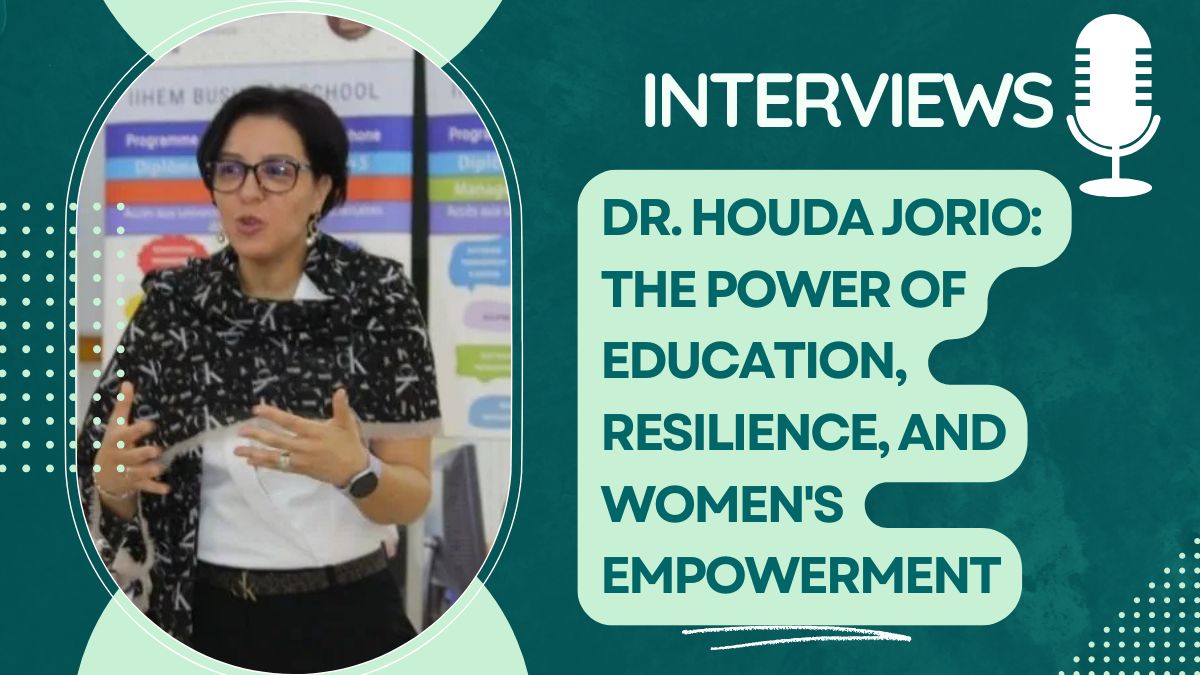
Dr. Houda Jorio has been a research professor and academician since September 2002. She completed her graduate studies in the United States at Southern Polytechnic State University in Georgia, where she earned her Bachelor's and Master's degrees in Management Science with a major in Marketing, Production Management and Operations. Her doctoral degree is in Management Studies, with a focus on cultural economics and sustainable development, from Université Ibnou Toufail in Morocco.
In this interview, Dr. Houda Jorio talks about her professional life, the field that chose her, her upcoming projects, the moment that changed everything, and her advice for women who want to succeed — with education as the ultimate lever for change.
A Brief Introduction
Dr. Houda Jorio, Research Professor and Academician since September 2002. My graduate studies were pursued in the USA at Southern Polytechnic State University in the state of Georgia, where I obtained my Bachelor's and Master's degrees in Management Science with a major in Marketing and Production Management and Operations. My doctoral degree is in Management Studies with a focus on cultural economics and sustainable development, from the Université Ibnou Toufail in Morocco.
Her Professional Life
When I finished my studies, I did a final internship at IBM in Atlanta and then decided to return to Morocco (a decision shared by my late mother), from which you can see the impact on many of my life's decisions. At first, I was hired by Meditelecom, now known as Orange. I worked for a year, shuttling between Rabat and Casablanca for a young lady who had just finished her studies in the States, so that she could experience professional life.
I realized very early on that it was a good job, but one that wouldn't last very long. I wanted a job with more contact, more commitment, and above all with a satisfying impact — a job that would enable me to see my efforts in the lives of others, above all in the long term, a job that would connect me to generations, families, relatives and that would enable me to live my daily life with passion and love. In short, a job that will please me so much that I can see myself motivated every day of my life.
With little effort on the part of my mom, I ended up starting out in higher education, where the doctorate stepped in — it is an asset for a teacher in higher education. As far as I'm concerned, I started with the job and then I got my doctorate degree. I can say that I started by loving my job and then refined it with a doctorate degree. In short, I LOVE MY JOB…
Why She Chose Higher Education
It's a field that rather chose me — I'd say more also that my mom contributed a lot to this choice; she always wanted me to be a doctor in my discipline, and of course a PhD is more linked to academia and research. I always say that I don't see myself doing or being anything else. I'm a strong believer and I know that we are led in this life by the path of the good Lord who only chooses excellent things and always puts us on the right track.
The reason for my choice, as I mentioned earlier, is because I want to have an impact across the generations. I feel and see myself as being obliged to keep learning — what we call lifelong learning. I'm obliged to keep up to date: the generations are different in terms of needs but not values, and learning is part of that. My vocation is: as long as I'm alive, I have to learn. I'm not necessarily talking about diplomas. In the world of higher education, once the pedagogy is in hand, courses and cross-disciplines become a given. Basically, the choice is linked to learning and the need to connect with students and above all have an impact on their lives, decisions, and futures, whether personal or professional.
Seeing my students succeed, especially those I have mentored in their PhD or Masters research, is a very gratifying moment. Mentoring and teaching have a profound influence on a professor, especially when I see my students win prizes, scholarships or obtain prestigious positions thanks to my guidance.
Upcoming Projects
On the academic front, I plan to set up courses adapted to the needs of the job market of the future, and also to innovate in terms of content, sharing and advice. I even plan to create courses aimed at the general public in hybrid mode, including digital and interactive resources. The launch of research and collaboration projects, and more publications, are also part of current and future projects.
Self-training is also very important, as it enables me to learn so that I can pass on my knowledge. Students are more in touch with professors: after parents at home, there are us at the university, and then colleagues and partners at work.
Community work and charity are also important. Participating in projects to encourage diversity and equality in academia — for example by creating programs to support women or under-represented minorities — can be a time when the professor feels particularly involved and determined to bring about change.
Nowadays, globalization is highly connected to higher education. I've already given courses in different countries around the world through international organizations, and I've always found it rich in terms of culture, diversity, and networking at a different scale, enabling us to get to know students whose cultures, origins and principles are different, but whose value chains are just as distinct. I still plan to be involved in international higher education and reach even different destinations.
Thanks to Covid for enabling us to set up distance learning courses and interact with our dear students, ensuring that studies continue regardless of the conditions and with all the means necessary. We must never stop learning.
The Moment That Changed Everything
Yes, it was the death of my dear mother in the middle of Covid, but not the cause. I experienced moments of lockdown that didn't affect me as much as my mom's illness. In fact, for me, deconfinement was more linked to the death of my dear mother. I realized that I had acquired my strength from her, from her suffering, from her death. It was an event that had such an impact on me that I became a different person.
What eased my pain slightly was my doctoral thesis defense. In fact, I was ready well before Covid and in the middle of preparing for it, my thesis supervisor passed away. A few months later: Covid, my mom's brief illness, then deconfinement, and finally death. I thought it was the end, but as I said before, God chooses only good things for us. I defended my thesis a few months after my mom's death. I considered it as a healing method. I was able to pull myself together and rebound back. It was certainly painful, but I learned a lot from it, especially that it's important to leave good footprints. I thank God for everything I was, am and will be, incha'Allah.
Her Advice for Women
Never confuse your missions in life; try to find a balance between your personal and professional life — to be a good daughter, wife, mother, sister, cousin, and aunt. I specify good, not excellent. In this sense, allowing yourself to make mistakes, to fail, to let go. It's okay, once in a while. The road to success is often strewn with obstacles. Failures and obstacles are part of the process. The key is to bounce back from each setback, learn from our mistakes and keep moving forward.
Learn and teach others to learn, pass on positive messages or keep quiet, empathize. Learn power skills: how to communicate positively, keep smiling, control our words, speak without hurting, love ourselves so we can love, and keep negative vibes away. It's essential to stay true to our principles and beliefs. Let's not try to conform to society's expectations or standards but pursue what we're truly passionate about. It's therefore crucial to know how to set our limits and not let ourselves be overwhelmed by too many responsibilities. Learning to say “no” strategically preserves our energy and allows us to focus our efforts on what's really important to us.
In short, let's protect our aura. Success comes from within, before it becomes public.
Women in Morocco Today
The situation of women in Morocco has evolved significantly over recent decades, but many challenges remain. Although progress has been made in terms of women's rights, equality and access to education, persistent inequalities, both social and economic, remain to be overcome. Despite progress in rights and legislation such as the family code (Moudawana) and the law on gender-based violence, women in Morocco still face obstacles such as discrimination, wage inequalities and concentration in lower-paid or precarious sectors. Women are also under-represented in decision-making and leadership positions.
This last word embodies the conviction that education is a fundamental lever for changing mentalities and building a more egalitarian future, while underlining the central role of women in this transformation.
Thoughts on the Website
An excellent networking and sharing tool, this site has enabled me to get to know powerful women — women who succeed in silence, they only share to set an example, ladies whose footprint is much stronger than their visibility.
A website that promotes women's achievements is invaluable for many reasons, not least inspiration and empowerment thanks to the presentation of women's achievements that motivate others, especially young girls, to pursue their goals with confidence. It's a site that breaks down stereotypes by showcasing successful women in various fields, challenging traditional gender norms and broadening perspectives on what women can achieve. It is a tool with visibility and recognition, as many women's achievements go unnoticed; such a website offers a dedicated platform to celebrate their contributions. The site can connect like-minded people, fostering mentoring, collaboration and opportunities for growth. By highlighting women's successes, it promotes a more balanced and fairer representation in different business sectors. It is also a valuable tool for students, researchers and educators, providing concrete examples of female excellence.
Final Words
As a professor, my commitment is to share not only knowledge, but also the values of respect, solidarity and equality. The path to success and emancipation for women lies through education. It is through the transmission of knowledge that we can break the chains of stereotypes and inequality. Every young girl and boy have the right to dream big and aspire to a future where their potential is never limited by their gender. We, women in higher education, have a crucial role to play in shaping these future leaders, entrepreneurs and responsible citizens. Together, we can build a more inclusive society, where education is the key to opening all doors.
My most sincere thanks for the opportunity to share with Women Entrepreneurs.
Frequently Asked Questions
Who is Dr. Houda Jorio?
Dr. Houda Jorio is a research professor and academician since 2002. She holds Bachelor's and Master's degrees in Management Science from Southern Polytechnic State University in the USA and a doctorate in Management Studies focused on cultural economics and sustainable development.
Why did she choose a career in higher education?
“It's a field that rather chose me,” she says. She wants to have an impact across the generations, and lifelong learning is her vocation: “as long as I'm alive, I have to learn.”
What moment changed her life?
The death of her mother in the middle of Covid, and the loss of her thesis supervisor shortly before. She defended her thesis a few months after her mother's death and “considered it as a healing method” — a painful period from which she learned the importance of leaving good footprints.
What is her advice for women who want to succeed?
Find balance — “good, not excellent” — accept failure as part of the process, stay true to your principles instead of conforming to expectations, and learn to say “no” strategically. “Success comes from within, before it becomes public.”
What role does education play for women?
“The path to success and emancipation for women lies through education.” It is through the transmission of knowledge that stereotypes and inequality can be broken — education is the key to opening all doors.