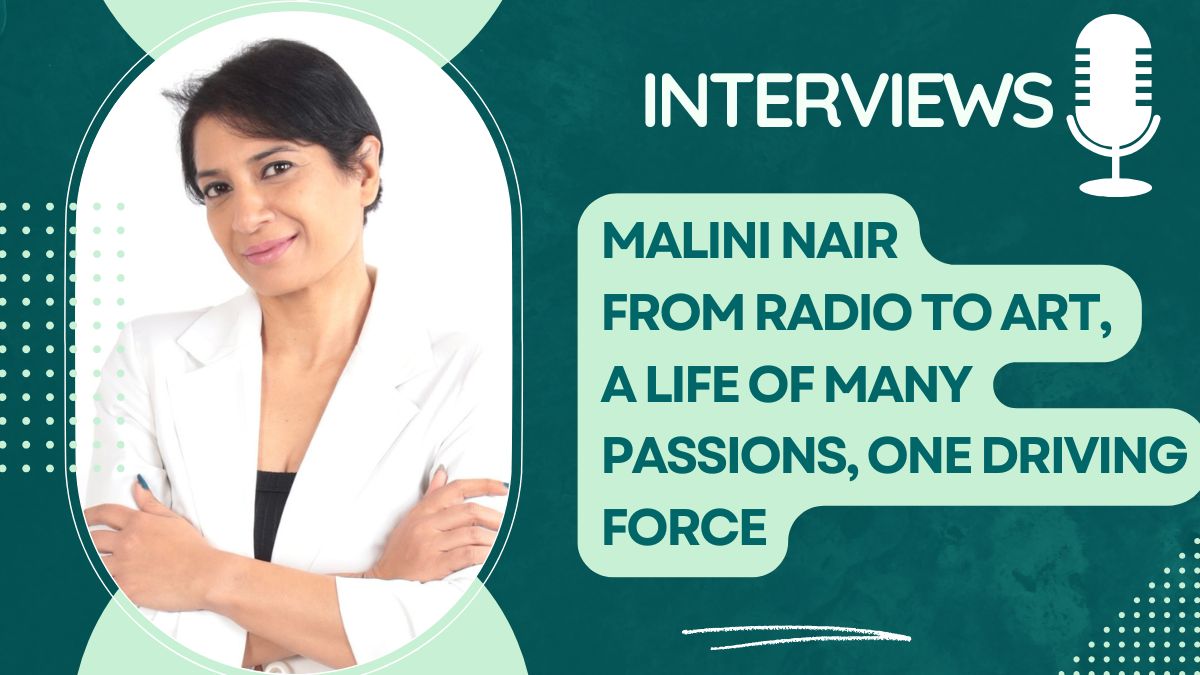
Malini Nair is a journalist, corporate communications specialist, marketer, consultant, artist, poet and entrepreneur. She started her career as a radio jockey with All India Radio, moved into print and then television news reporting, and today runs her own news and media agency in Europe — Now Action Station (NAS) — along with a business consultancy and an art sales company.
In this interview, Malini Nair opens up about her professional life, the chance that led her into journalism, her upcoming projects, the loss that changed everything, and her advice for women who want to succeed.
Her Professional Life
My career spans from journalism, corporate communications, marketing, event management, consultancy work to art, poetry and entrepreneurship. I started my career as a radio jockey with All India Radio and soon moved to reporting for print and then to television news reporting. I currently run my own news and media agency in Europe — Now Action Station (NAS). In addition I have a business consultancy, NOW Consultancy, and an art sales company, Now Art.
Under NAS we create content for social media, work on news reports for all media, and will soon also foray into publishing books and social media channels. Academically, apart from my journalism honors degree, I possess an MBA, an MSc in Neuroscience and Psychology and a Doctorate in Business Administration. All these showcase my ability and interest in research and human behavioral psychology, which helps me immensely in all my work.
I also have an art sales company, and it came about after I started dabbling in painting and realized I not only liked it but was reasonably decent at it. I started receiving offers from people to buy my creations and that gave me an idea to make it a business. In the near future I also intend to curate art from various parts of the world, starting with Indian local artists.
Why She Chose This Field
I was always interested in research and writing. I was very good with languages and I loved reading anything and everything I could lay my hands upon. So I knew I would be doing something related to either research or writing. I planned to pursue Mass Communications as my postgraduate, but fell into the field sooner and purely by chance.
You see, post schooling, as I was applying for colleges, my sister came across a graduation level honors degree course in Journalism. She phoned to check if I'd be interested. I told her to go ahead. The catch, however, was that there was an entrance exam to be followed by an in-person interview, and out of all the students from across India only 20 would make the cut. The other catch was that the written exam was scheduled for the following day. I asked her to apply anyway with little hope of making it. I cleared the written exam and then the in-person interview — and there I was in a field I would come to enjoy and cherish for the rest of my life.
Upcoming Projects
Well, as I mentioned earlier there are a couple of scientific research-based books on the anvil, and bringing art from local Indian artists to Europe. There is another news-based project for which I am currently in talks with a media entity, but details on that will be disclosed at a later, more opportune time.
Moments That Changed Her Life
I have had too many to count, but I think losing my father was a pivotal moment in my life. I suddenly grew up. Up until then I enjoyed working and was doing a good job. But I didn't even know how to file my taxes as he would take care of all the backend work for me. I grew up overnight and suddenly matured up. I took the reins of my life in my own hands but never forgot all that he had taught me through all my growing up years.
I think my habit of reading and research can be attributed to him. In times when there was no Google, my father was an encyclopedia on pretty much any and all topics — be it sports, current affairs, politics, economics or anything else. In addition he was a very hardworking man, and I feel I learnt to never fear failure and just keep putting in the work from him. And that has held me in good stead. I also think my mother played an important role in my early years. She was an engaging parent and I think my confidence comes from her gamifying the process of public speaking and thinking in the spot.
Professionally, I think the most impactful time was when I decided to establish my first branding and events concern in India. I had been receiving offers from various people who wanted me to partner with them and start an events agency, but I kept refusing these offers. Then one morning I felt ready, and it took me one day to finalize the name, design the logo, create the corporate kit and presentation as well as stationery and website on my desktop at home. I was registered within a week and I had spent a total of INR 5,000 on printing stationery and another 10,000 on company registration. I brought in my first pan-India project worth INR 20 lakhs within less than a month. Having done everything from scratch on this entrepreneurial venture gave me immense confidence in my abilities as a businessperson. I worked with big brands in electronics, IT, aviation, land transport as well as beverages among others under my company.
Her Advice for Women
First and foremost: stop seeking external validation, be it from your life partner, parents, professional colleagues, friends or people in general. I think the biggest pitfall is not putting yourself and your ambitions and goals first. Do not try and fit into a mould created by society. Learn to appreciate yourself and what you bring to the table. Acknowledging one's own self-worth is paramount.
And once you are past this hurdle and have learnt to self-validate, put in the hard work and don't worry about failure. Like they say: fall nine times, rise ten.
The Situation of Women
Though I am a Dutch citizen now, I originally come from India, and it is a very large country — so to speak about the state of women in a generalized manner is not possible. Apart from being a culturally diverse nation, it is also represented by various economic classes, and this class and caste divide also plays a role in how women fare. Through my lineage I belong to Punjab (maternal side) and Kerala (paternal), two states where women have enjoyed freedom in different ways. Punjab forever has encouraged girls to be groomed into various physically challenging sports; some of the best sportspersons come from the Punjab and Haryana belt, and this is true even for rural areas. Kerala has the highest literacy rate in the entire country, so women are very highly educated and suitably employed. They enjoy freedom to earn their livelihood and contribute towards the household income.
But I also acknowledge that being a child of two cultures and belonging to a middle-class family with educated parents afforded me both a privileged life and a liberal upbringing — and the sum of these two states does not make a whole. Women still struggle to have a voice in several households across India. It's a mixed bag, so to speak. Rural women probably are more at a disadvantage due to lack of awareness impeding their growth.
I must also add that various state ministries have introduced women-friendly initiatives facilitating employment opportunities for women across sectors, even at the rural level. For example, women in Madhya Pradesh are being trained in martial arts so they can secure jobs as bodyguards to VIP women figures that travel to the state. How fantastic is that!? Similarly, there are pink taxi services available now that allow women to travel with women drivers at odd hours to ensure their safety.
Additionally, the central government has several schemes that allow for girl child education and funds for women entrepreneurs. So while people would like to hear all is bad news, it is not so. Favorable schemes for the feminine gender are the first step towards gender equity, and I think these initiatives will surely pay off if implemented effectively and with rigour.
Here in the Netherlands and European Union states, women largely enjoy equal treatment, which makes it a very conducive environment for growth for women.
However, since you've spoken of the state of women, I would also like to bring your attention to how women in the most developed region of the world are being treated as well. The Supreme Court of the USA revoked the verdict passed in the Roe v. Wade case, effectively criminalizing abortion in a majority of US federal states. This stifles women in more ways than one can imagine. For starters, their health and entry into the workforce is severely compromised. This has a negative impact on their economic independence in the household and also on society at large in the long run. It is nothing short of regression and gender discrimination.
Interestingly enough, the Indian apex court passed a verdict making third-party consent redundant, so women do not any longer need consent to seek abortion. This is such a pathbreaking verdict and puts the power of choice back in the hands of women — and surely deserves applause.
So to my mind, patriarchal formats irrespective of regions are the real issue. And of course, policies, schemes and laws can only go so far in bettering a society. The public and women in general too need to be made aware of their rights, especially in rural India.
I would also like to add that OTT platforms are proving to be a blessing as well. Difficult and non-commercial content which addresses social issues has a platform now, and OTT platforms have a great reach even in the rural parts of India where there are no cinema halls. So a rural woman can also watch Laapataa Ladies and absorb and process the message of empowerment and learn from it. Having said that, the fight for gender equity — which someday can truly turn into gender equality — is an uphill battle, and every small firm foothold upwards is a small step towards that goal, I feel.
Thoughts on the Website
I think it is a fantastic website, and I feel honored to be chosen for an interview for it.
Final Words
I would only like to add here that women need to support each other instead of tearing each other down. Prioritize yourself and your aims, goals, hopes and dreams — and see the magic happen.
Frequently Asked Questions
What is Malini Nair's professional background?
Her career spans journalism, corporate communications, marketing, events and consultancy. She began as a radio jockey with All India Radio, moved into print and television news, and now runs Now Action Station (NAS), NOW Consultancy and Now Art in Europe — backed by an MBA, an MSc in Neuroscience and Psychology and a Doctorate in Business Administration.
How did she end up in journalism?
By chance: her sister spotted a journalism honors course with an entrance exam for only 20 places nationwide, and the written test was the next day. She applied “with little hope”, cleared the exam and the in-person interview — and found the field she would cherish for life.
What event changed her life?
Losing her father. “I suddenly grew up,” she says — she had never handled her own taxes, and overnight she took the reins of her life while keeping everything he had taught her about hard work and never fearing failure.
What is her advice for women?
“Stop seeking external validation.” Do not fit into a mould created by society, acknowledge your own self-worth, then put in the hard work without fearing failure: “fall nine times, rise ten.”
What is her view on the situation of women?
It is “a mixed bag”: progress in Indian states like Punjab and Kerala, new women-friendly initiatives and schemes, equal treatment in the Netherlands and the EU — but patriarchal formats remain the real issue everywhere, so awareness and implementation matter as much as laws.