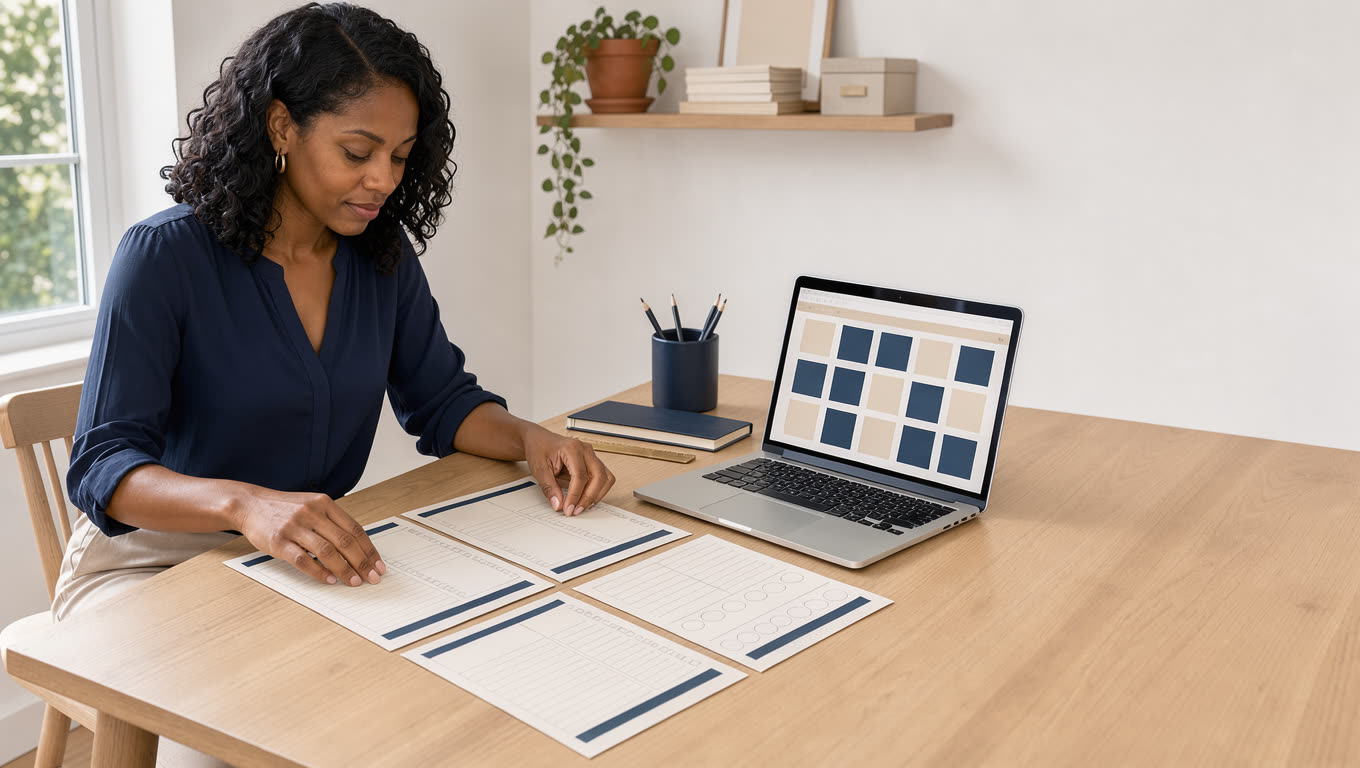
A digital products shop sells files a buyer downloads the second payment clears: printable planners, social media templates, worksheet packs, business toolkits. No inventory, no parcel, no restocking — which is why this is one of the lowest-risk ways to start earning in 2027. The short answer to "how do I launch one?" is: pick a single niche, design three to five products, list them on a marketplace and on your own checkout, then send steady visual-search traffic to both. Here is that sequence, with real fees, real market numbers and a weekend launch checklist.
Table of Contents
- Why Digital Products Are a Strong 2027 Business
- Choose Your Product Line: Printables, Templates and Toolkits
- Build the Production Workflow Before You Design
- Marketplace or Your Own Shop?
- Pricing and Packaging That Converts
- Drive Traffic with Pinterest
- Your 2027 Launch Checklist
- Frequently Asked Questions
- Conclusion
- Sources
Why Digital Products Are a Strong 2027 Business
Digital products are a strong 2027 business because you build the file once and sell it an unlimited number of times, so profit margins stay between 70% and 95% of every sale — far above anything you could ship. Easy Digital Downloads, updated in October 2026, states that digital products "typically keep 70 to 95% of every sale as profit" and that templates and printables "cost almost nothing to create, so margins stay above 90%".
The demand side is not small either. Etsy's marketplace transacted $10.46 billion of gross merchandise sales in 2025 and closed the year with 86.5 million active buyers. Because production cost is near zero, a failed product costs you a few evenings rather than a garage full of stock — the asymmetry that makes this model forgiving for a first business.
Choose Your Product Line: Printables, Templates and Toolkits
Choose printables if you can design, templates if you already work inside a software tool, and toolkits if you teach or consult — the three lines differ in how much explanation they need, not in how they are delivered. All three ship as a single file behind a download link.
The best-selling digital categories on Etsy in 2026 are digital planners, printable wall art, wedding templates, business templates and educational printables for teachers. That list matters because it shows where buyers already search: organisation, celebration, business and education. Pick the category where you have real subject knowledge, then narrow to one audience — "budget planners for freelancers" outperforms "printable planners" every time, because a general listing competes with millions of results while a specific one competes with hundreds.
Do not launch ten products at once. Three focused, well-photographed listings convert better than thirty thin ones, and marketplaces reward consistent new listings over raw volume.
Build the Production Workflow Before You Design
Build the workflow first because a digital shop fails on inconsistency far more often than on lack of ideas: fixed page sizes, fixed fonts, fixed export settings and a fixed publishing day remove the friction that kills most first attempts. Lock your formats up front — PDF at 300 DPI for anything printed, editable files only when the buyer genuinely needs to edit — and reserve one weekly slot in which a product is finished, photographed and listed.
The tooling is cheap and mature. Canva closed 2025 with 265 million users and 31 million paid subscribers, and its free tier is enough to produce printables to a professional standard; Affinity's photo, layout and vector apps became free in 2025 and passed five million downloads. Your fixed monthly cost can stay at zero until revenue arrives.
Photograph every product as a mockup — the thumbnail earns the click — and name files the way a buyer understands after download: niche-product-name-v1.pdf, never final_final2.pdf.
Marketplace or Your Own Shop?
Sell on both: a marketplace such as Etsy gives you discovery from buyers already searching, while your own checkout on Gumroad, Payhip or Lemon Squeezy gives you better margins and the customer relationship. Choosing only one is the most common structural mistake in this business.
The cost gap is real. Etsy charges a $0.20 listing fee, a 6.5% transaction fee and a 3% + $0.25 processing fee, with no monthly fee — about $4.25 taken from a $40 sale. Gumroad takes 10% plus $0.50 per sale with no way to reduce it; Payhip takes 5% on its free plan and 2% on its $29 plan; Lemon Squeezy takes 5% plus $0.50 and, as merchant of record, files sales tax and VAT for you, which matters the moment you sell into Europe. All three were re-checked in October 2026 and all three operate normally: Gumroad is not shutting down despite rumours, and Lemon Squeezy, part of Stripe since 2024, shipped an update in January 2026.
Run it as a funnel: the marketplace earns visibility and reviews, your own shop earns margin and an email list. Add your own checkout once twenty sales tell you which product moves. Our guide to starting an Etsy shop that makes money covers the marketplace side.
Pricing and Packaging That Converts
Price on the outcome your buyer wants, then bundle, because a bundle raises revenue per customer without raising production cost. A single printable typically sells for $4 to $8 on Etsy, while a bundle of ten related printables sells for $15 to $25 — the same design hours, three to four times the order value.
Three rules keep it simple. Never price below $5: Etsy's fixed $0.20 listing fee plus processing can leave under a dollar on a $2 sale. Build a ladder — a $7 entry product, a $19 core bundle, a $49 premium toolkit — so every buyer has a next step. Review it quarterly: the product selling twice as often at half the price shows where real demand sits.
Bundles also insulate you from price competition: a lone listing is easy to compare against a cheaper alternative; a curated toolkit with a clear promise is not.
Drive Traffic with Pinterest
Drive traffic with Pinterest because it behaves like a visual search engine rather than a social feed, and buyers arrive in a planning mindset, actively deciding what to buy. Pinterest reported 661 million global monthly active users for the third quarter of 2026 — an all-time high, up 10% year over year — with revenue growing 12% to $1,174 million.
The intent data is why it suits digital products. Pinterest's newsroom states that users run more than 80 billion searches a month, more than half of them commercial, and that over 96% of top text searches are unbranded: shoppers browse by idea, not brand, so a new shop can be found on merit. Pinterest Business adds that 80% of weekly users say the shopping experience on the platform inspires them.
Practically, every product gets a vertical pin linking straight to its listing, with the keyword in the pin title and description rather than only in the image. Save new pins steadily instead of in bursts, create boards that match the language your buyer types, and treat your best-performing pin as a product brief. For more on the platform, see starting a Pinterest management business.
Your 2027 Launch Checklist
Work these seven steps in order and you can be selling within two weeks, not two quarters.
- Step 1 — Pick one niche and one buyer. Write one sentence naming the person you serve and the problem you solve. If it needs a comma, narrow it.
- Step 2 — Choose your line. Printables, templates or toolkits, based on the skill you already have.
- Step 3 — Produce three products. One entry item, one core bundle, one premium toolkit, all in your locked format.
- Step 4 — Open both channels. A marketplace shop for discovery, a merchant-of-record checkout for margin.
- Step 5 — Write the listings. Mockup thumbnail, benefit-led title, answer-first description, keywords a real shopper would type.
- Step 6 — Set up Pinterest. Business account, three keyword boards, one pin per product per week.
- Step 7 — Review after 30 days. Keep what sold, cut what did not, ship one new product per week.
Frequently Asked Questions
How much does it cost to start a digital products shop?
Close to zero. Canva has a free plan, marketplaces charge no monthly fee, and merchant-of-record platforms only take a percentage when you sell. Your real investment is the time spent producing the first three products.
Printables, templates or toolkits — which should I sell first?
Whichever matches the skill you already have: printables if you design, templates if you work inside a software tool, toolkits if you teach or consult. Delivery is identical, so choose on subject knowledge rather than trendiness.
Should I sell on Etsy or on my own website?
Both. Etsy supplies built-in search traffic; your own checkout keeps more of each sale and gives you the customer relationship. Start on the marketplace, then add your own shop once you have around twenty sales.
What is a realistic price for my first product?
Between $7 and $25. A single printable on Etsy commonly sells for $4 to $8, while a bundle of ten sells for $15 to $25. Avoid pricing under $5, because fixed fees can leave under a dollar on a $2 sale.
Do I need a large social media following to make sales?
No. Pinterest works as a search engine rather than a follower feed, and more than 96% of its top searches are unbranded, so a brand-new shop can be found purely on the relevance of its pins.
How long before a digital products shop makes money?
First sales usually arrive within weeks of listing, but steady income typically takes two to three months of weekly new products and consistent pinning. With margins at 70% to 95%, even modest volumes cover running costs.
Conclusion
Launching a digital products shop in 2027 is mostly a sequencing problem, not a talent problem: one niche, three products, two sales channels and one consistent traffic source. The economics do the rest — margins of 70% to 95%, no inventory, and 86.5 million active buyers already trained to pay for downloads. Start small, bundle aggressively, treat Pinterest as your search engine, and let the thirty-day review guide what you build next.
Sources
- Etsy, Inc. — Q4 and Full Year 2025 Results (February 2026)
- Etsy — Fees & Payments Policy and How to sell on Etsy (October 2026)
- Pinterest, Inc. — Third Quarter 2026 Results (October 29, 2026)
- Pinterest Newsroom — Programmatic deals (monthly searches, 2026)
- Pinterest for Business — Audience insights
- Easy Digital Downloads — Most Popular Digital Products to Sell Online (updated October 20, 2026)
- SellerApp — Etsy Trends 2026 (categories and bundle pricing)
- Gumroad pricing, Payhip pricing, Lemon Squeezy 2026 Update (checked October 2026)
- TechCrunch — Canva acquires Cavalry and MangoAI (February 23, 2026)