Teaching a craft online is one of the few businesses a woman can start from a spare room with no inventory, no staff and no shop lease. You already own the hardest asset: a skill someone else wants. What separates a course that earns money from a folder of videos nobody buys is not the craft but the decisions made before the first lesson is filmed — who it is for, what it promises, how it is priced and where it is sold.
Table of Contents
- Why Online Craft Courses Are a Real Business in 2027
- Choose One Craft and One Clear Student
- Design the Course: Live Cohorts or Recorded Replays
- Price the Course So the Math Works
- Pick the Right Platform for Your Stage
- Sell Kits and Materials Alongside the Lessons
- Record Lessons That Look Professional on a Small Budget
- Launch to an Audience, Not to an Empty Room
- Stay Legal: Refunds, Taxes and Honest Claims
- Grow Beyond the First Course
- Frequently Asked Questions
Why Online Craft Courses Are a Real Business in 2027
Craft courses sell because the audience is enormous and the delivery cost after the first recording is close to zero. In the United States, 71% of consumers identify as crafters, supporting a market valued at $17.8 billion (Mintel, US Arts and Crafts Consumer Report 2025, reported by CO— by the U.S. Chamber of Commerce). The learning side is equally large: Grand View Research put the global e-learning services market at $352.98 billion in 2025, projected to reach $1,485 billion by 2033.
The economics beat selling finished pieces: a hand-knit garment can take 30 hours and sell for $120, while the same knowledge packaged as a course sells hundreds of times. A finished candle might retail for $18; a candle-making course sells for $97. The catch is that beginner topics are crowded and only specific courses survive.
Choose One Craft and One Clear Student
Pick a craft you can teach to a visible result in under four hours, and pick one student to teach it to. "Candle making" is a topic; "scented soy candles in vintage tins for beginners who want to sell at markets" is a course. The narrower version is easier to market because the buyer recognizes herself in the description.
Demand is also broadening beyond the traditional retiree audience: the Craft Industry Alliance notes that the 25–44 age group is increasingly drawn to crafting, especially projects with low entry costs — a cohort that learns online and buys kits (CO— by the U.S. Chamber of Commerce, 2025).
Validate the topic three ways. Check what people search: crochet and knitting patterns each draw roughly 49,500 U.S. searches a month, according to Semrush data reported in October 2026. Find the communities where beginners ask the same five questions — those questions are your curriculum. Then pre-sell ten discounted seats; if nobody buys at $39, a $197 production budget is wasted.
Design the Course: Live Cohorts or Recorded Replays
Run your first cohort live and record it, then sell the recording as a self-paced course. Live teaching produces better outcomes and testimonials, while the replay becomes an evergreen product.
The completion gap is measurable. Across 1.3 million enrollments on the Ruzuku platform, open-access self-paced courses completed at 41.9%, against 53.4% for scheduled courses with fixed start dates. Early momentum mattered even more: students who finished a lesson in their first week completed at 78.3%, versus 17.2% for those who did not, across roughly 920,000 enrollments (Ruzuku platform data, 2026).
A workable first structure: one finished project, four to six modules, two to four hours of total video, a printable materials list and one live call a week for four weeks. Build accountability into the replay with a first-week welcome lesson, a photo prompt in a private community and a certificate.
Price the Course So the Math Works
Price by the outcome you deliver, not by the hours you filmed. A course that saves a beginner three months of failed batches and $200 of wasted wax is worth more than its runtime suggests.
Benchmarks help you avoid undercharging. A 2025 survey of Teachable creators put the median course price at $97, and Ruzuku's dataset of 11,691 one-time courses shows a median of $150, with the middle half between $49 and $357 (Ruzuku, 2026).
A three-tier ladder works: a $39–$59 mini course as entry product and list builder, the full course at $149–$297 with templates and community access, and a $397–$697 cohort version with live feedback. Forty students at $149 is $5,960 before fees and refunds; at $39 you need nearly four times the students for the same revenue — and four times the support.
Pick the Right Platform for Your Stage
Choose a hosted platform that lets you keep your customer list and export it if you leave. The email list is the business asset; the platform is only the delivery pipe.
Costs vary more than marketing pages suggest. Teachable's Starter plan is $39 a month with a 7.5% transaction fee, which disappears at $89 on Builder (Teachable pricing, 2026). Thinkific's Start plan is $109 a month, or $82 billed annually (Thinkific pricing, 2026). Both work; the choice depends on how fast you expect to sell.
Marketplaces are a different trade: they bring traffic but control the price and the relationship. Skillshare tightened its rules on 1 January 2026 — teachers now need at least 50 followers plus 75 minutes watched a month to qualify for royalties, and Skillshare reported that 90% of teachers losing eligibility earned less than $5 a month (Skillshare Help Center, 2026). Treat marketplaces as discovery, not as the foundation.
Sell Kits and Materials Alongside the Lessons
A materials kit raises average order value, reduces refunds and improves completion, because students stop stalling on the shopping list. Bundling the exact supplies for one project also separates you from free tutorials.
The supply market is large and moving online. Market Research Future valued the global craft supplies market at $41.08 billion in 2024 and projects online retail in the category to grow from $8.0 billion to $13.0 billion by 2035. Physical retail is contracting at the same time: the closure of Joann's stores in 2025 pushed hobbyists to buy materials online and from independent sellers (CO— by the U.S. Chamber of Commerce, 2025).
Start with 20 pre-packed kits, not 200, and learn packing time and shipping cost before scaling. Weigh a kit, quote a flat rate and build the box cost into the price. Offer three paths — course plus kit, course with a shopping list, kit alone — and use disclosed affiliate links if logistics feel premature.
Record Lessons That Look Professional on a Small Budget
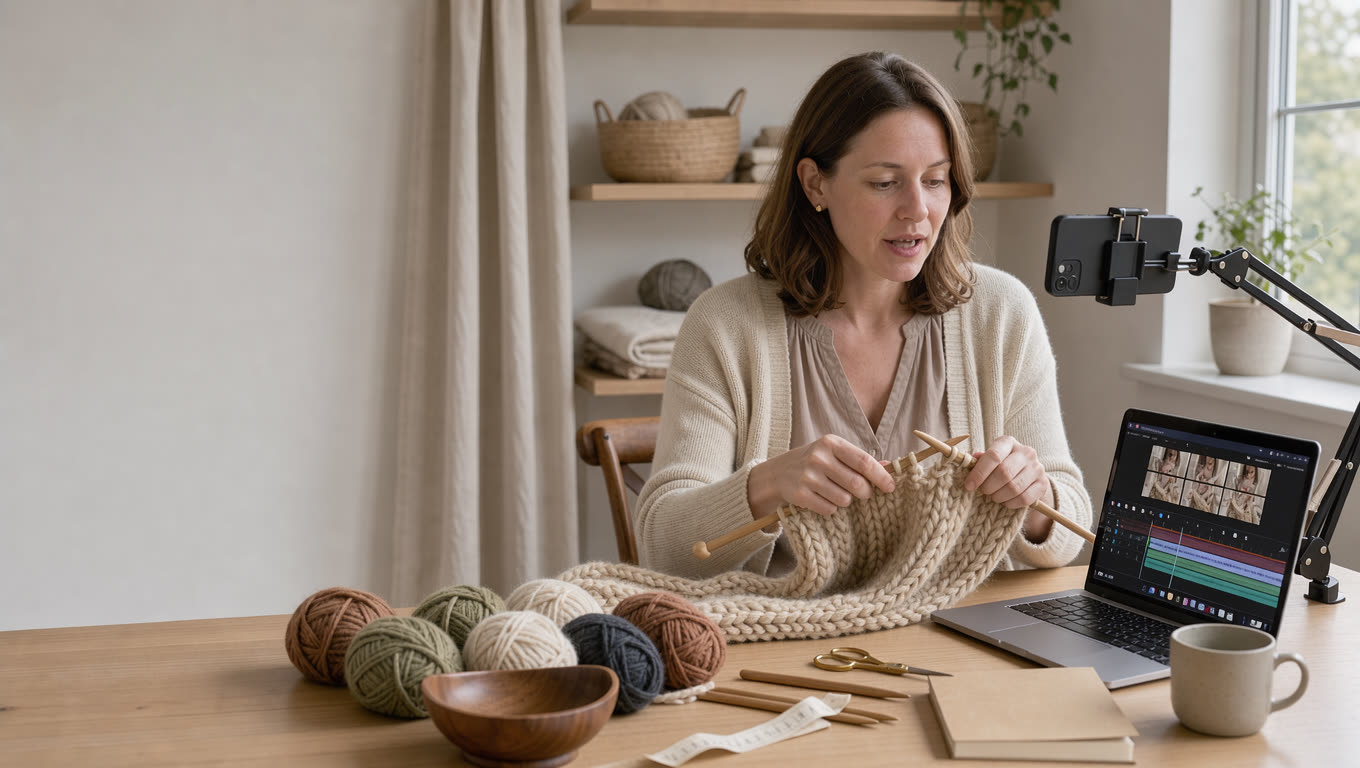
A modern phone, a window and a clip-on microphone are enough to produce a course that looks deliberate. Viewers forgive a modest set; they do not forgive muffled audio or a camera angle that hides your hands.
Four choices matter more than the camera: an overhead arm mount above the table, a lavalier or shotgun microphone within 30 cm of your voice, diffused daylight from a window, and short lessons. Thinkific's completion research reports microlearning formats at 80–90% completion against roughly 30% for longer traditional courses, and Udemy's average course length fell from 6.5 hours in 2020 to 3.8 hours in 2024, according to Skillademia's compilation of platform data.
DaVinci Resolve and CapCut cover cuts, captions and colour for free. Captions also give you short clips for social media without extra filming.
Launch to an Audience, Not to an Empty Room
Build the audience before the course is finished, and launch to a warm list rather than a cold feed. A course published to nobody is the most common failure in this business, and it is entirely avoidable.
Pinterest remains one of the strongest discovery channels for craft buyers, with 600 million global monthly active users in the third quarter of 2025 (Pinterest Q3 2025 results). Email converts that attention: in Litmus's 2025 State of Email survey, 30% of marketing leaders reported $36 to $50 back for every dollar spent on email, and another 35% reported $10 to $36.
A four-week pre-launch works: weeks one and two, publish a free mini tutorial and waitlist page and pin process photos linking to it; week three, send three emails covering the story, the exact outcome and the five most common objections; week four, open ten early-bird seats with a hard deadline and run a live Q&A before the cart closes. Then keep the list warm weekly — the second launch usually outperforms the first.
Stay Legal: Refunds, Taxes and Honest Claims
Sell as a registered business, publish clear refund terms and account for tax on digital sales before your first payout. If you sell to customers in the European Union, a course counts as an electronically supplied service: cross-border B2C sales above a €10,000 annual EU-wide threshold are taxed at the customer's local rate and declared through the One Stop Shop (European Commission, VAT One Stop Shop rules). In the United States, taxability of digital goods varies by state, so a platform that calculates sales tax automatically saves considerable admin.
Three protections belong in place early: a 14-day refund window conditional on not having completed more than 30% of the course; safety disclaimers for candle, soap and skincare content, plus a note that the course is not a certification; and clean intellectual property — never teach from someone else's paid pattern or imply a brand affiliation you do not have.
Grow Beyond the First Course
One course is a product; a small library plus recurring revenue is a business. Deepen the same niche rather than jumping to unrelated topics, because your existing students are the cheapest buyers you will ever have.
Where you sell changes what you keep. Kajabi reports that its average creator earns about $37,000 a year, while marketplace instructors on Udemy average roughly $3,300 a year according to platform data compiled by Ruzuku (2026) — a gap that reflects price control and customer ownership more than teaching quality.
Extensions worth planning: a second course at the next level, a membership at $19–$29 a month, bundles pairing two courses with a kit, B2B workshops for craft stores and schools, and low-price pattern sales. Track revenue per student, completion rate and list growth monthly: falling completion means the course is too long or too lonely; falling revenue per student means the offer ladder is too thin.
Frequently Asked Questions
How much can I realistically earn from an online craft course?
Most creators earn modestly at first. A realistic first launch is 20 to 50 students at $97 to $149, roughly $2,000 to $7,000 before fees. Growth comes from repeat launches, a second course and a membership rather than from a single viral video.
Do I need a professional camera to record a craft course?
No. A recent smartphone shooting 1080p in daylight, mounted overhead for handwork and paired with a clip-on microphone, is enough for a paid course. Audio quality and hand visibility matter far more than sensor size.
Should I sell on Udemy or Skillshare instead of my own site?
Use marketplaces as an extra discovery channel, not as your foundation. They control pricing and own the customer relationship, and Skillshare now requires at least 50 followers plus 75 watched minutes a month for royalty eligibility. Host on your own platform and keep the email list.
How long should a craft course be?
Two to four hours of video across four to six modules is the sweet spot for a first course. Shorter lessons and a single finished project keep completion high; a 12-hour course nobody finishes produces no testimonials.
Do I need a business licence to sell online courses?
Requirements depend on your country and city, but most places expect you to register a business, declare the income and charge tax where applicable. Register before your first sale, open a separate bank account and keep receipts for materials and equipment.
How do I stop students from sharing my course videos?
You cannot eliminate sharing, but you can reduce it. Use a platform with logged-in access and expiring video links, avoid downloadable full-resolution files, and add value a copied file cannot carry — live calls, feedback and community.
Conclusion
An online craft course business rewards specificity and patience. Choose one craft, one student and one finished project; run the first cohort live and record it; price for the outcome rather than the runtime; and build the email list before the launch, not after. Add kits when the course proves itself, keep lessons short and technically clean, and treat taxes and refunds as part of the product rather than an afterthought.
The demand is not speculative. Crafting is a $17.8 billion market in the United States alone, and online learning is a $352.98 billion global industry. Your share of it will not come from being the best maker in your category, but from being the clearest teacher for one specific beginner — and from building the audience that trusts you before you ask her to buy.
Sources
- Mintel, US Arts and Crafts Consumer Report 2025, reported by CO— by the U.S. Chamber of Commerce — 71% of U.S. consumers identify as crafters; $17.8 billion market. uschamber.com
- Grand View Research, E-Learning Services Market Report, 2025 — $352.98 billion in 2025, projected $1,485 billion by 2033. grandviewresearch.com
- Ruzuku, Course Completion Rate Benchmarks, 2026 — 41.9% open-access vs 53.4% scheduled completion across 1.3 million enrollments; 78.3% vs 17.2% first-week completion across ~920,000 enrollments. ruzuku.com
- Ruzuku, State of Online Courses 2026 — median one-time price $150, middle 50% $49–$357 across 11,691 courses; Kajabi ~$37,000 vs Udemy ~$3,300 average creator earnings. ruzuku.com
- Personify, Online Course & E-Learning Statistics 2026 — median $97 course price in a 2025 Teachable creator survey. personify.fyi
- Teachable pricing, 2026 — Starter $39/month with 7.5% transaction fee; Builder $89/month at 0%. teachable.com/pricing
- Thinkific pricing, 2026 — Start $109/month or $82/month billed annually. thinkific.com/pricing
- Skillshare Help Center, Teacher Earnings Update (Effective January 1, 2026) — 50-follower minimum plus 75 watched minutes per month; 90% of affected teachers earned under $5/month. help.skillshare.com
- Market Research Future, Craft Supplies Market Report — $41.08 billion in 2024; online retail projected from $8.0 billion to $13.0 billion by 2035. marketresearchfuture.com
- Thinkific blog, Course Completion Dashboard — microlearning at 80–90% completion vs ~30% for longer courses. thinkific.com/blog
- Skillademia, Online Course Completion Statistics — Udemy average course length 6.5 hours in 2020, 3.8 hours in 2024. skillademia.com
- Pinterest, Q3 2025 results — 600 million global monthly active users. businesswire.com
- Litmus, State of Email 2025 — 30% report $36–$50 return per $1; 35% report $10–$36. litmus.com
- European Commission, VAT One Stop Shop — €10,000 EU-wide annual threshold for cross-border B2C electronically supplied services. ec.europa.eu