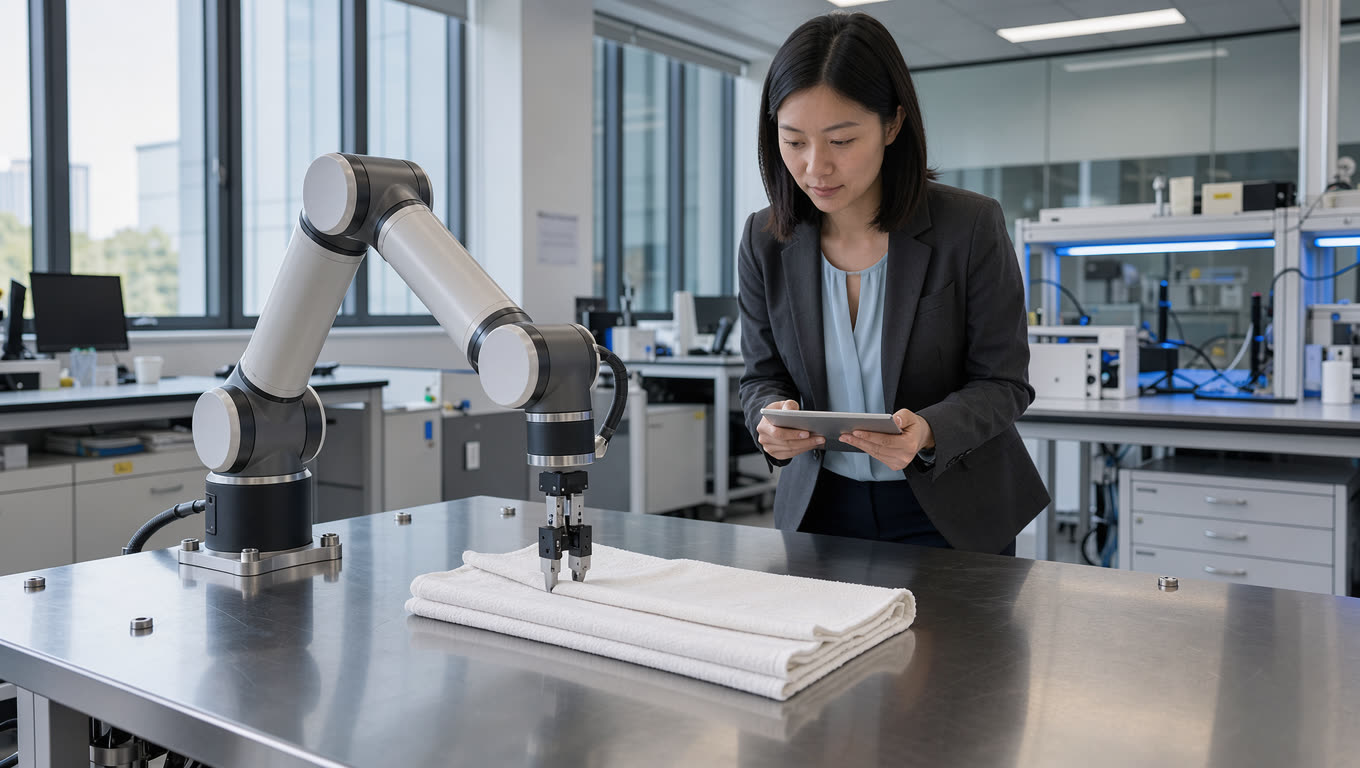
Physical intelligence is the ability of a machine to understand and act in the real world: to fold laundry it has never seen before, pack a box, or slide a filter into an espresso machine without being programmed move by move. After a decade of promise, it has become the central ambition of AI research, and it is redefining what a small team with a bold idea can build.
This guide explains what physical intelligence means in 2026, why AI and robotics stayed in separate lanes for so long, and where the technology actually works today. You will also find the practical implications for founders who want to build around machines that learn, following the same builder mindset profiled in Farah Zafar's journey from humble beginnings to the digital revolution.
Table of Contents
- What Physical Intelligence Really Means
- Why AI and Robotics Stayed Apart
- Robot Foundation Models Change the Game
- From Text and Images to Real-World Action
- Learning From Humans, Not Code
- Where Physical Intelligence Goes to Work First
- The Barriers That Still Remain
- Opportunities for Founders and Small Teams
- Frequently Asked Questions
- Conclusion
- Sources
What Physical Intelligence Really Means
Physical intelligence is the combination of perception, reasoning and motor skill that lets a machine complete a physical task in an environment it was not specifically prepared for. It answers a simple question: can the machine figure out what to do with its hands, here and now, instead of following a script written by an engineer?
The concept borrows from developmental psychology, where human infants learn to grasp, stack and pour through trial and error rather than instruction. A physically intelligent robot works the same way: it observes a situation, forms a plan, executes it and adjusts when the cup slides or the towel is heavier than expected. That adaptability is what separates today's systems from the industrial arms that have repeated one welded motion on car assembly lines since the 1970s.
Why AI and Robotics Stayed Apart
AI and robotics stayed apart for decades because software intelligence and mechanical reliability advanced on completely different timelines, and the two rarely met in the same budget. Language models lived in data centres, while robots lived in factories where a failed pick costs real product.
Three frictions explain the gap. First, physical data was expensive: a robot generates far fewer learning examples per day than a web crawler collects pages, and each example had to be collected with real hardware. Second, simulation looked convincing but drifted from reality, so skills learned in a simulator often collapsed on contact with a real object. Third, the economics discouraged experimentation, because a hardware iteration cycle takes weeks while a software team ships daily. Researchers in places such as MIT's Computer Science and Artificial Intelligence Laboratory spent years trying to close this gap, but only the arrival of large pre-trained models changed the arithmetic.
Robot Foundation Models Change the Game
A robot foundation model is a single AI model, trained on huge amounts of robot and video data, that can be reused across many robots and many tasks instead of training one brain per machine. It is the moment when physical intelligence became a product category rather than a research project.
The clearest example is Physical Intelligence, the San Francisco lab whose robot foundation models drew a 600 million dollar Series B led by Alphabet in late 2025, as reported by The Robot Report. According to the same coverage, the company's latest vision-language-action model doubled throughput on demanding tasks such as inserting a filter into an espresso machine, folding previously unseen laundry and assembling a cardboard box, while reducing failure rates over hours of operation compared with imitation learning alone. The company claims operators can now express goals in plain language, such as "make a flat white" or "pack chocolates into this box," and let the model plan the motions. Whether or not every benchmark survives independent testing, the direction is unambiguous: general-purpose robot brains are being funded and shipped at industrial scale.
From Text and Images to Real-World Action
Text and images translate into real-world action when a model trained on language and video is paired with a robot's camera and joints, turning "pack this box" into a sequence of physical movements. That pairing is exactly what a vision-language-action model does.
Because such a model already understands objects, spatial relationships and instructions from billions of images and captions, it starts from a vast priorknowledge of the world instead of starting from zero. A command like "pack the fragile items separately" makes sense to it in the way it makes sense to a person, and it can translate that understanding into grasp points and grip forces. The practical consequence for builders is that custom software per task is being replaced by prompting, demonstration and fine-tuning, which lowers the cost of automating a new workflow from years of engineering to days of training.
Learning From Humans, Not Code
Robots learn from humans when a person demonstrates a task a few times and the model generalises from those examples, so expertise flows through demonstration instead of hand-written code. This shift is the single biggest reason physical intelligence improved so quickly.
Imitation learning lets a non-programmer teach a machine: an operator guides the arm through a folding sequence ten or twenty times, and the model extracts the underlying skill. The frontier technique goes further, combining that demonstration with reinforcement learning so the robot keeps practising on its own and beats the human's success rate, which is how the throughput gains reported by Physical Intelligence were achieved. For businesses, the meaning is concrete: the person who knows the job, not the person who can write firmware, becomes the trainer of the robot.
Where Physical Intelligence Goes to Work First
Physical intelligence is going to work first in structured, repetitive, high-mix environments: warehouses, e-commerce fulfilment, food preparation, laboratory work and small manufacturing cells where labour is scarce. These settings share the same profile — tasks people find boring or punishing, with enough structure that errors are recoverable.
Warehouses and fulfilment centres are the early beachhead because items are already catalogue objects with barcodes and known locations, and because seasonal peaks make human staffing painful. Food service follows, from coffee preparation to packaging, since portioning and placement are exactly the kind of dexterous work these models handle. Laboratories and pharmacies are close behind, where precise repetitive handling of samples frees trained staff for analysis. Consumer homes remain the furthest out, because clutter and variety are extreme and the tolerance for failure is low.
The Barriers That Still Remain
The main barriers that still remain are reliability over long shifts, safety certification, and the cost of hardware that can survive real contact with the world. A demo that works nine times out of ten is not yet a machine a factory manager will sign for.
Degrade rates compound: at ninety-five percent success per action, a ten-step task fails more often than it succeeds, which is why the reported reduction in failure rates over hours of operation matters more than any single impressive clip. Safety is the second wall, since a model that improvises is harder to certify than a fixed automation cell, and regulators are still catching up. Finally, actuators, grippers and sensors remain expensive and fragile, and supply chains for them are thin. Each of these barriers is engineering and capital, not physics, which is why serious money keeps arriving.
Opportunities for Founders and Small Teams
The opportunities for founders and small teams lie in the application layer: datasets, fine-tuning, task design, integration and vertical services built on top of general robot models. You no longer need a robotics lab to build a robotic product.
Practical entry points include curating task-specific demonstration data for a niche such as bakery packing or salon tool handling, building the integration between a robot API and a customer's warehouse management system, and offering robot-as-a-service workflows to small manufacturers priced out of classic automation. The founder story of Cathryn Lavery, who moved from architecture to productivity products built around AI, shows how quickly a domain expert can ride a platform shift. Founders who combine that domain credibility with the discipline to start narrow are best placed, and the same playbook produced today's AI application companies. Women founders, who are often strongest in exactly the sectors where these robots will work first, should treat physical intelligence as an infrastructure wave to build on, not a distant forecast.
Frequently Asked Questions
What is physical intelligence in AI?
Physical intelligence is a machine's ability to perceive its surroundings, decide what to do and carry out the movement with precision, adapting in real time to objects and conditions it has never encountered before.
How is it different from traditional industrial robotics?
Traditional industrial robots repeat one hard-coded motion in a fixed cell, while a physically intelligent system learns general skills from data and adapts them to new objects, layouts and instructions on the spot.
What is a robot foundation model?
A robot foundation model is one large AI model trained on broad robot and video data that can control different robots and perform many tasks, instead of training separate software for every machine and application.
Which industries will adopt physical intelligence first?
Warehouses, e-commerce fulfilment, food preparation, laboratories and small-scale manufacturing will adopt it first, because their tasks are repetitive, their environments are semi-structured and their labour shortages are most acute.
Will physically intelligent robots replace human workers?
They are more likely to absorb the tasks people do not want — heavy lifting, repetitive packing, night shifts — while shortages in care, hospitality and skilled trades persist; the near-term effect is a shift in job content rather than a wave of elimination.
How can a small business start using physical intelligence?
Start with one painful, well-defined task, test rented or robot-as-a-service hardware before buying, and treat the model as trainable by your own staff through demonstration rather than as a project that requires custom engineering.
Conclusion
Physical intelligence has moved from academic papers to funded products: robot foundation models now learn from demonstration, take plain-language instructions and post measurable gains on real tasks. The technology is not finished, but the direction of travel is settled enough to plan around. Founders who pick one narrow, unglamorous job and make a machine genuinely good at it will build the companies of the next decade, and the smartest first move is to begin this year, not next.