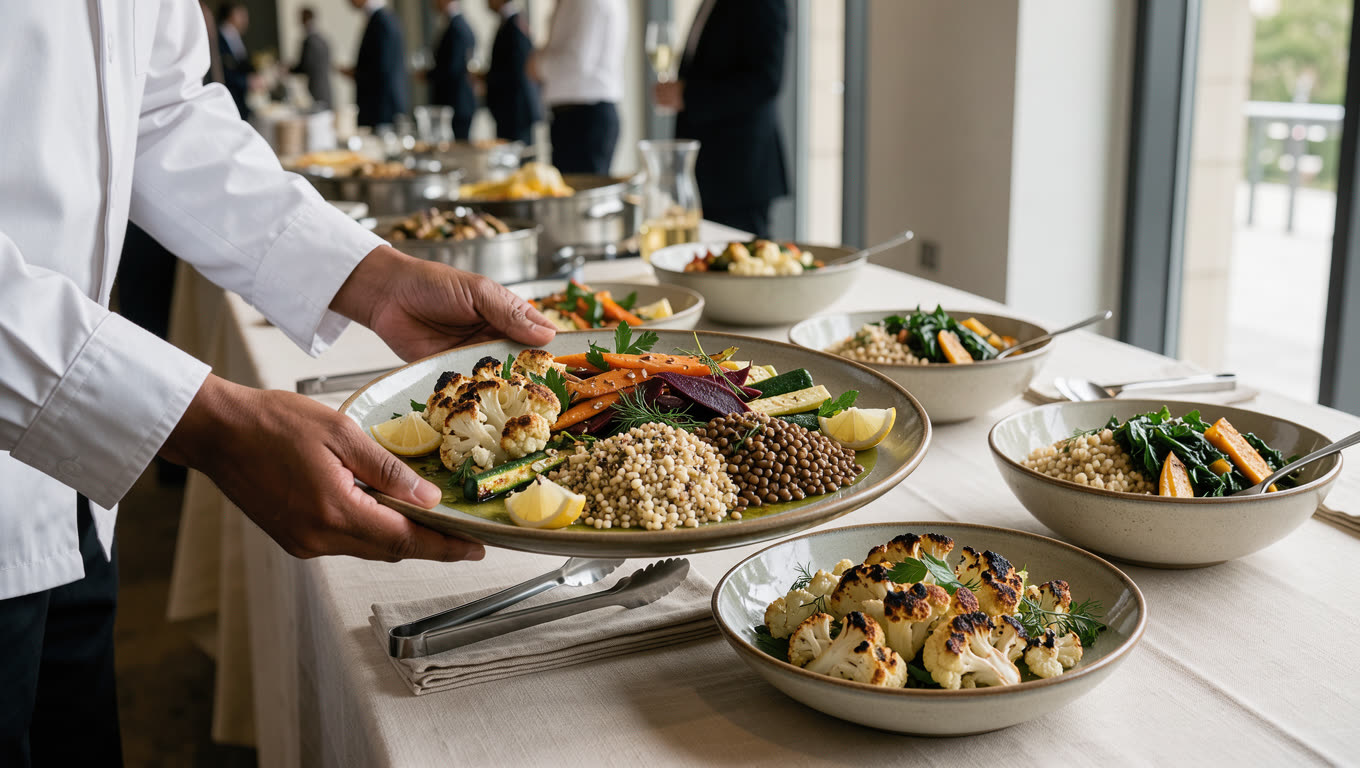
Plant-based catering is a food service business built around vegetables, grains, legumes, and plant proteins rather than meat and dairy. Demand here runs ahead of the supply of specialists: most caterers still treat plant-based food as a vegetarian add-on, leaving planners without an obvious vendor for a mixed room.
The business case is not that everyone is going vegan. It is that nearly every large event now has to accommodate plant-based guests, and the caterer who does that well gets booked again. This guide covers the legal groundwork, menu economics, pricing, and sales channels that turn a cooking skill into a company that survives its first two years.
Table of Contents
- Why Plant-Based Catering Is a Real Opportunity in 2027
- Choose Your Service Model Before Your Kitchen
- Licensing, Food Safety, and Where You Can Legally Cook
- Building a Menu Omnivores Will Actually Order
- Pricing for Margin, Not for Volume
- Winning Corporate Contracts and Recurring Revenue
- Suppliers, Commissary Space, and Logistics
- Marketing a Catering Business on a Founder's Budget
- Startup Costs and Realistic First-Year Numbers
- Five Mistakes That Sink New Caterers
- Frequently Asked Questions
- Conclusion
- Sources
Why Plant-Based Catering Is a Real Opportunity in 2027
Plant-based catering works as a niche because the catering market is large and fragmented while specialist plant-based operators remain rare. IBISWorld sized the US Catering Services industry at $15.7 billion in 2026, with no company holding more than a 5 percent market share — so a two-person operation competing on menu style is not fighting a national brand for the same booking.
Demand is broader than the vegan label suggests. The US retail market for plant-based food totaled $8.1 billion in 2024, and 59 percent of US households bought plant-based foods that year, according to SPINS data commissioned by the Good Food Institute and the Plant Based Foods Association. Datassential's 2024 Plant-Forward Opportunity Report found about one in four US consumers actively limits meat.
The supply gap is the opening: GFI's analysis of Technomic's 2025 Top 500 data found only 8 percent of the top 250 restaurant chains appeared to offer dishes built on plant-based protein analogs. A good plant-based spread is still scarce in a market where almost every large event has to serve a mixed room.
Choose Your Service Model Before Your Kitchen
The service model sets margins, staffing, and legal setup, so decide it before signing a kitchen lease. Three practical options exist.
Drop-off means delivering finished food and leaving. Labor runs 8 to 15 percent of revenue, which makes food cost look high as a percentage even when the food is cheap to produce; it is the right entry point for a founder cooking alone.
Buffet and stations add on-site staff to tend the line, plus hot holding equipment and rentals. Labor climbs to roughly 25 to 35 percent of revenue, but price per guest multiplies several times over.
Full-service plated is the highest-revenue, highest-risk model. It needs captains, servers, and a contract with a hard end time; an event that runs 90 minutes long can turn a healthy margin into a loss through overtime alone.
For cost structure, the National Restaurant Association's 2025 Operations Data Abstract reported a median food and non-alcohol beverage cost of 32.0 percent of sales for full-service respondents in 2024, and 32.4 percent for limited-service. The International Caterers Association puts total direct event costs at 40 to 50 percent of sales, with net profit of 5 to 15 percent for a well-run operation.
Licensing, Food Safety, and Where You Can Legally Cook
You cannot legally run catering from a home kitchen in most US jurisdictions, and the exemption list is narrower than internet advice suggests. Catering is regulated as retail food service: the FDA Food Code 2022 is the model code state and local health departments adopt, and enforcement happens at county or city level.
A permit usually requires three things. A licensed, inspected base of operations: your own commercial kitchen or a commissary kitchen where all food is stored and prepared. A food safety certification: most states require at least one Certified Food Protection Manager, obtained through an ANSI-accredited exam such as ServSafe Manager — $175 for course and exam through Iowa State University Extension, valid five years. And insurance: general plus product liability, since you serve food off your premises.
Two plant-specific safety points belong in your procedure from day one. Cooked rice, beans, and legumes carry Bacillus cereus risk and need fast chilling and strict time-temperature control. Raw sprouts are a recurring contamination source and worth avoiding entirely. A plant-based menu is not automatically safer than a meat menu.
Budget certification, permit, commissary contract, and insurance before equipment; opening without the commissary arrangement is the fastest way to get shut down.
Building a Menu Omnivores Will Actually Order
Design the menu so a guest who eats meat daily orders without noticing it is plant-based, then label it clearly for the guests who care. Datassential's 2024 research identifies taste as the single biggest barrier keeping consumers from eating more plant-based food, not price or availability.
Build around formats people already trust and remove the animal product without apologizing for it: mushroom and black bean tacos, grain bowls with roasted vegetables and tahini, lentil pasta, curries, hearty sandwiches, and a properly dressed salad. Every dish needs a protein anchor and a fat that carries flavor, or it reads as sad vegetables.
Be careful with processed analogs as the centerpiece. Plant-based proteins sold through broadline distributors into food service were worth $289 million in 2024, down 5 percent in dollars and 4 percent in pounds, according to Circana data reported by GFI; analogs are expensive per pound and make the menu look like a substitution rather than a cuisine.
Price can work in your favor: Datassential found 31 percent of consumers will pay more for plant-forward items against 26 percent who will not.
Pricing for Margin, Not for Volume
Price per guest, with a minimum, and never quote a per-head number without a staffing plan behind it. Margin disappears in three places: underpriced labor, uncharged delivery and setup time, and events that run past their contracted end time. Build three packages — drop-off, buffet, plated — so the client chooses between price points rather than negotiating one price down.
Work backwards from a food cost target. With the industry median for full-service food cost at 32.0 percent of sales, a menu built on grains, legumes, and seasonal vegetables can run below that — an advantage that should show up as margin, not as a discount. No item goes on the sheet until its plate cost is calculated from actual supplier invoices.
Then price the invisible work. Delivery beyond a set radius is a line item. Staffing is a line item with a markup — the International Caterers Association cites a 33 percent average, with 50 percent as the goal. Deposits usually cover food purchasing at 50 percent at booking. And put the end time in the contract with an overtime rate; that clause protects more margin than any purchasing trick.
Winning Corporate Contracts and Recurring Revenue
Workplace catering is where a plant-based specialist builds predictable revenue, because offices order repeatedly and one decision-maker needs a menu that satisfies a whole team. ezCater's 2025 workplace food report, surveying more than 2,300 stakeholders, found 43 percent of organizations now run a recurring meal program — up 17 percent year over year — with average order value up 12 percent to $420.
The sales motion that works is a paid trial, not a pitch deck. Offer one office a two-week pilot at a fixed per-head price with a one-page menu, deliver on time twice, and you have a reference account. Bring a certificate of insurance and a W-9 to the first meeting; procurement stalls for weeks without paperwork. Then ask for a recurring schedule.
Recurring contracts change purchasing too: a standing Tuesday and Thursday lunch for 40 people lets you buy consistent volumes, prep in batches, and hold a crew — the difference between netting 15 percent and working seven days a week for 3. If your clients also build wellness programming, there is adjacent revenue in corporate wellness consulting.
Suppliers, Commissary Space, and Logistics
Your supply chain is simpler than a meat caterer's — no seafood or raw poultry — and harder in one way, because produce quality and seasonality drive the menu. Global retail sales of plant-based meat, dairy, and related categories reached $28.6 billion in 2024, according to Euromonitor data reported by GFI, so specialty ingredients once hard to find are standard catalog items.
Set up three tiers: a broadline distributor for staples and frozen components, a produce wholesaler for volume vegetables, and a farm relationship for the two or three ingredients that define your menu. Never build on one specialty item from one supplier, and buy enough insulated containers and hot boxes to hold a full event without borrowing.
Marketing a Catering Business on a Founder's Budget
Catering marketing converts on proof, not reach, and the highest-return channel puts food in front of people who did not pay for it. ezCater's 2025 data found 70 percent of employees who first try a restaurant through an employer-provided meal later order from it themselves, a 49 percent increase over the prior year.
Beyond sampling through offices, four things matter more than a website redesign: professional photography of every dish, a complete Google Business Profile with review requests after each event, relationships with the planners and office managers who control vendor lists, and a listing on at least one workplace catering marketplace. If weddings become a revenue line, the discipline overlaps with running a wedding planning business.
Startup Costs and Realistic First-Year Numbers
A plant-based catering business costs a fraction of a restaurant because there is no dining room, front-of-house staff, or street-front rent.
Build the budget in order: permits and certification, insurance, commissary hours, transport and holding equipment, smallwares, then a three-month fixed-cost reserve. Catering revenue is seasonal; a business that cannot cover a slow January does not reach its first spring wedding season.
Set expectations from the data. The National Restaurant Association reported a median pre-tax income of 1.1 percent of sales for full-service operators under $2 million in 2024, against 4.3 percent for those above $2 million. A catering operation can do better, and the International Caterers Association points to 5 to 15 percent net; plan for the low end in year one.
If product development is part of your longer plan, licensing and labeling change substantially — see launching a functional food brand. Weekly batch cooking is covered in starting a meal prep business.
Five Mistakes That Sink New Caterers
Most catering businesses fail for operational reasons, not bad food.
- Underpricing labor. Quoting from food cost alone, then discovering staffing and setup consumed the margin.
- No minimum order. Accepting 12-guest drop-offs that consume a delivery slot and half a prep day.
- An analog-heavy menu. Paying premium prices for plant-based meat to look credible, then pricing above the local market for food tasters dislike.
- Verbal agreements. No headcount deadline, overtime clause, cancellation terms, or deposit — then absorbing the client's changes as your own cost.
- Client concentration. One office account at 60 percent of revenue, where a single procurement decision ends the business.
Frequently Asked Questions
Do I need a commercial kitchen to start a plant-based catering business?
Yes, in almost every US jurisdiction. Catering is regulated as retail food service, so you need either a permitted commercial kitchen or a licensed commissary kitchen where all food is stored and prepared. Home kitchen exemptions generally cover low-risk cottage foods sold direct to consumers, not catered events.
How much does it cost to get certified and licensed?
A Certified Food Protection Manager course plus exam typically runs about $150 to $180, and the certificate is valid for five years. On top of that, budget for the health permit, the commissary kitchen agreement, and general plus product liability insurance — the last is often the largest annual fixed cost in year one.
Should the whole menu be vegan, or can I offer both?
Both models work, but the specialist position sells better. An all-plant-based menu is easier to market, simpler to prep, and removes cross-contamination risk. A mixed menu reaches more clients but competes on price with every other caterer in town. Most founders start fully plant-based and add conventional options only when a specific contract requires it.
What should I charge per guest?
There is no universal number; it depends on service style, market, and menu. The rule that matters is to price from actual plate cost plus a staffing plan, keeping food cost in the range of roughly 25 to 32 percent of the per-guest price. Drop-off lunch service and plated dinners sit in completely different price bands, and both can be profitable.
How do I find my first corporate clients?
Start with offices you can physically reach and offer a paid two-week pilot at a fixed per-head price. Bring insurance certificates and a W-9 to the first meeting so procurement can move. Then ask for a recurring schedule rather than a single booking — recurring workplace meals are the most stable revenue a small caterer can hold.
How long before the business is profitable?
Most catering companies reach break-even within their first full season if fixed costs stay low, but net margins are thin at small scale — industry benchmarks sit between 5 and 15 percent for well-run operators, and lower for restaurants. Expect year one close to break-even, with real profit arriving as recurring accounts and purchasing volume grow.
Conclusion
Plant-based catering has a genuine structural advantage: a large fragmented market, few specialists, and a cost of goods often below a conventional menu's. None of it matters without the unglamorous foundation — commissary kitchen, permit, certified manager, insurance, and pricing built from real plate costs rather than optimism.
Start with one service model, one menu, and one type of client. Deliver it flawlessly twenty times, photograph everything, and let recurring workplace accounts stabilize revenue. Durable catering companies are rarely run by the best cooks in town; they are run by people whose contracts, invoices, and temperature logs are as consistent as their food.
Sources
- IBISWorld, Catering Services in the US — market size $15.7 billion (2026) and market fragmentation data. ibisworld.com
- The Good Food Institute, 2024 State of the Industry: Plant-based meat, seafood, eggs, dairy, and ingredients — US plant-based retail market $8.1 billion (SPINS data). gfi.org
- The Good Food Institute, Plant-based retail market overview — 59% of US households purchased plant-based foods in 2024; 1.1% of retail food dollars. gfi.org
- The Good Food Institute, U.S. foodservice market insights for plant-based foods — $289 million in broadline distributor sales (Circana, 2024), -5% in dollars; 8% of top 250 chains offering plant-based protein analogs (2025). gfi.org
- Datassential, The 2024 Plant-Forward Opportunity Report — taste as the primary barrier, 31% willing to pay more, one in four consumers limiting meat. datassential.com
- National Restaurant Association, 2025 Restaurant Operations Data Abstract (analysis published September 2025) — median food and non-alcohol beverage cost of 32.0% of sales (full service) and 32.4% (limited service) in 2024; median pre-tax income 1.1% under $2M sales versus 4.3% above. restaurant.org
- ezCater, 2025 Feeding the Workplace report — 43% of organizations with a recurring meal program (+17% year over year), average order value up 12% to $420, 70% of employees reordering independently. ezcater.com
- US Food and Drug Administration, FDA Food Code 2022 — model retail food safety code adopted by state and local jurisdictions. fda.gov
- Iowa State University Extension and Outreach, ServSafe Certified Food Protection Manager Course — $175 course and exam, five-year certificate validity. extension.iastate.edu
- International Caterers Association, Budgeting for 2024 (operations budgeting webinar) — direct event costs 40–50% of sales, net profit 5–15%, average staff markup 33%. internationalcaterers.org