Home cleaning is one of the few trades a woman can start with a few hundred dollars of equipment, a reliable car and a weekend of paperwork. It is also a trade that women already dominate: the U.S. Bureau of Labor Statistics counts 1.39 million maids and housekeeping cleaners, and 86.4% of them are women. What changes between earning an hourly wage and owning a cleaning company is not the cleaning itself — it is pricing, insurance, hiring and systems.
Table of Contents
- Why Home Cleaning Counts as a Skilled Trade
- Equipment, Licenses and Insurance: What You Actually Need
- How to Price Home Cleaning Jobs in 2026
- Landing Your First Clients and Keeping Them
- Hiring Your First Cleaner: Pay, Screening and Retention
- From Solo Cleaner to Cleaning Agency
- Frequently Asked Questions
Why Home Cleaning Counts as a Skilled Trade
Home cleaning is a skilled trade in the formal sense: it requires certified technique, specialist equipment, chemical knowledge and a legal framework of licensing, bonding and insurance. Women already hold the majority of those jobs — 86.4% of the 1.39 million U.S. maids and housekeeping cleaners are women, according to the Bureau of Labor Statistics' 2025 Current Population Survey table. Yet women remain almost absent from the paid trades overall: the U.S. Department of Commerce estimates they hold less than 5% of skilled trade occupations, and about 11% of construction jobs. Cleaning is the trade where that gap closes first, because the barrier to entry is capital, not credentialing.
The market is large and steady rather than glamorous. IBISWorld sizes U.S. residential cleaning services at $18.8 billion in 2024, growing 1.2% that year. Women are also the fastest-growing group of owners in that market: the Census Bureau reports that women owned 14.2 million U.S. businesses generating $2.8 trillion in receipts, including 1.4 million employer firms. Residential cleaning rewards operators who treat it as a business rather than a job — recurring routes, repeat clients and a small team that can carry more homes than one pair of hands ever could.
Equipment, Licenses and Insurance: What You Actually Need
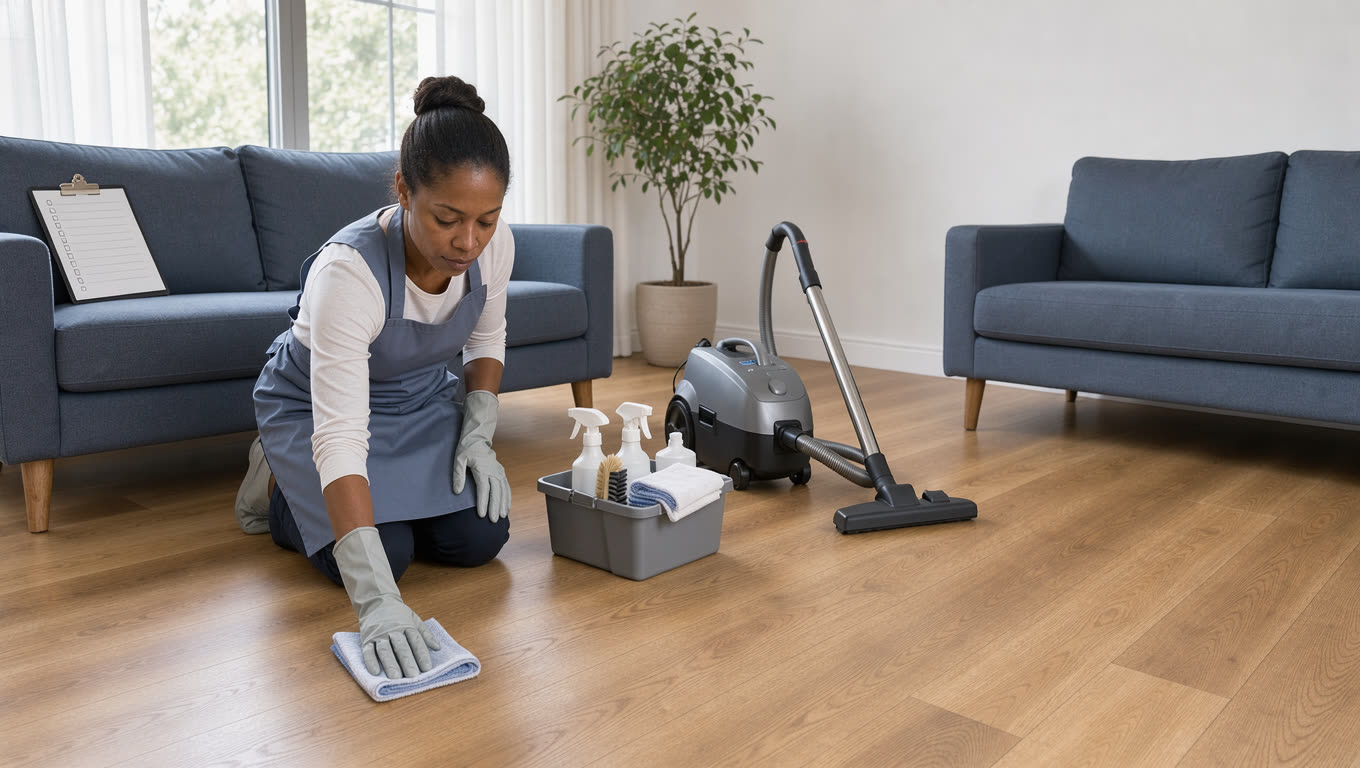
A residential cleaning business realistically launches for $2,000 to $10,000, according to Aspire's 2025 cost breakdown, and most of the equipment line item is under $800. The professional kit for a home-cleaning route is deliberately simple: a commercial vacuum, a mop and bucket system, microfiber cloths, scrub brushes, glass and all-purpose cleaners, rubber gloves, aprons and shoe covers. Aspire puts the residential starter supplies at $20 to $800; commercial-grade machines such as floor buffers or carpet extractors only become relevant once you sell those services deliberately.
Legal setup is cheap compared to insurance. Budget $100 to $500 for a business license and permits, and $300 to $1,500 for a basic website, vehicle decals and local advertising. Insurance is the line most new owners underestimate: general liability runs about $48 a month ($580 a year), workers' compensation about $136 a month, commercial auto about $173 a month, and a janitorial bond — which reimburses a client if something goes missing — about $11 a month, per Jobber's published industry figures. General liability and a bond are the two clients ask for first; you can add workers' compensation the day you hire, which is also the day it becomes legally required in most states.
Use your own car for the first year. A new van can cost upward of $43,000, and even a used one runs $24,500 to $38,750 — capital that should go into route density instead. Branded vehicle decals ($300 to $700) turn every driveway into advertising.
How to Price Home Cleaning Jobs in 2026
Price per job, not per hour, once you know how long a home takes. Thumbtack's national data puts house cleaners at $40 to $55 an hour, with a one-time visit averaging $174 to $256, a deep clean at $190 to $265 and a move-out clean at $200 to $286. Housecall Pro's 2026 pricing guide puts a standard residential visit at $120 to $280 flat, and recommends charging 50% to 100% more for deep work. Flat rates are what recurring clients prefer, because the bill is the same every two weeks regardless of how long the job takes you.
The gap between wages and rates is where your margin lives. The Bureau of Labor Statistics' May 2025 Occupational Employment and Wage Statistics put the median wage for maids and housekeeping cleaners at $35,510 a year, or about $17.07 an hour; half of all workers earn between $30,350 and $39,590. A client paying $40 to $55 an hour is therefore funding roughly two to three times the median wage — and that surplus has to cover payroll taxes, drive time, supplies, software, insurance and profit before it reaches you. A practical formula: divide total monthly expenses plus your target profit by the billable hours you can realistically sell, then check the number against local rates before you quote.
Landing Your First Clients and Keeping Them
Your first ten clients come from marketplaces and neighbours; your next hundred come from recurring bookings. Thumbtack reports that a one-time visit averages $174 to $256, while a cleaning every two weeks averages $160 to $220 — slightly less per visit, but the revenue compounds into a predictable route. HomeAdvisor's national average is $176 per visit within a $118 to $238 range, which is the number to beat when you build your own price sheet.
Start with a Google Business Profile, Thumbtack and Angi listings, and a referral incentive for your first clients. The decisive lever is service mix: add-ons such as fridge cleaning ($187 to $268), oven cleaning ($195 to $273) or interior windows ($196 to $274) raise the average ticket without adding new clients. Then sell frequency at the quote, not after the job — offering weekly, biweekly and monthly options on the first visit converts more one-time bookings into routes. If you want adjacent revenue later, the same operational muscle works in pet sitting and dog walking or home care for seniors.
Hiring Your First Cleaner: Pay, Screening and Retention
Hire when you are fully booked for a month straight, and treat retention as the core skill of the agency phase. The cleaning industry runs turnover near 200% a year — Swept and BSCAI put janitorial turnover between 75% and 375%, against a national average of roughly 18% in the BLS Job Openings and Labor Turnover Survey. Replacing a cleaner costs recruiting time, training hours and the rework when quality drops, which is why the owners who pay above the local median usually finish the year ahead of those who race to the bottom.
Screen properly: reference checks, a background check where your state permits it, and a paid trial clean in a real home before either of you commits. Pay above $17.07 an hour — the BLS median for the occupation — and pay for travel time between homes, or the cleaner who leaves will take the client's confidence with them. Systemise from day one: a checklist per home, photo notes, and scheduling software such as Jobber (Core plan, $29 a month billed annually for one user) or Housecall Pro (Basic, $59 a month billed annually), both verified on their official pricing pages in October 2026. Software is what lets a second pair of hands work without you standing in the driveway.
From Solo Cleaner to Cleaning Agency
The move from solo operator to agency happens when one cleaner's route covers its own costs plus payroll, and your job shifts from cleaning to scheduling, quality control and sales. The economics are simple: a solo operator sells their own hours, capped near 25 to 30 billable hours a week once travel and admin are counted. An agency sells hours you do not personally work, so revenue scales with crews rather than with your calendar. Route density is what makes it profitable — homes within fifteen minutes of each other cut drive time and raise the number of jobs a team can complete.
Compare that path with buying a franchise: Neighborly's Molly Maid franchise requires an investment of roughly $144,000 to $204,000, including a $14,900 franchise fee, and Molly Maid's own materials note that franchise owners recruit and manage rather than clean. That brand buys recognition; an independent owner keeps the equity and the pricing freedom, and spends a fraction of the capital. Most women who scale take the independent route: build the brand locally, document the process, promote your best cleaner to crew lead, and reinvest into software and training. The same playbook applies to home-based food businesses and service businesses like notary work — systems, then people, then growth.
Frequently Asked Questions
How much does it cost to start a home cleaning business?
Most residential cleaning businesses launch for $2,000 to $10,000, with supplies at $20 to $800, licensing at $100 to $500 and general liability insurance around $48 a month. If you already own a car and start solo, the practical floor is closer to $2,000.
What should I charge per hour for house cleaning?
Thumbtack's national data puts house cleaners at $40 to $55 an hour in 2026, with a one-time visit averaging $174 to $256. Local rates vary widely — high-cost cities run $50 to $80 an hour — so check competitors in your area before quoting.
Do I need insurance and a license to clean houses?
A business license ($100 to $500) is required nearly everywhere; insurance is not always legally mandatory for a solo owner without employees, but general liability at roughly $48 a month and a janitorial bond at about $11 a month are what clients ask to see before signing. Workers' compensation becomes required once you hire in most states.
How do I get my first cleaning clients?
Start with a Google Business Profile plus listings on Thumbtack and Angi, then ask every first client for a referral. The fastest growth comes from converting one-time bookings into recurring biweekly or monthly routes, which average $160 to $220 a visit nationally.
When should I hire my first employee?
Hire when your own calendar has been fully booked for a straight month and you are turning work away. Industry turnover near 200% a year means retention matters more than recruiting speed: pay above the $17.07 an hour BLS median, pay for travel time, and train against a written checklist.
Is buying a cleaning franchise worth it?
A Molly Maid franchise runs about $144,000 to $204,000 including a $14,900 franchise fee. You are buying a brand and a playbook; an independent agency built with your own name, local reviews and scheduling software reaches revenue for a small fraction of that capital, though it grows more slowly.
Conclusion
Starting a home cleaning business is less about cleaning skill than about running a small, disciplined operation: buy a $2,000 to $10,000 kit, insure it, price jobs at $120 to $280 rather than $17.07 an hour, and sell recurring routes instead of one-off visits. Hire above the median wage when you are booked out, and build systems before you build a team — that is what turns a trade you are good at into an agency that pays you while you sleep.
Sources
- U.S. Bureau of Labor Statistics — Employed People by Detailed Occupation, Sex (Current Population Survey, 2025)
- U.S. Bureau of Labor Statistics — Occupational Employment and Wage Statistics, Maids and Housekeeping Cleaners (May 2025)
- U.S. Census Bureau — Characteristics of Employer and Nonemployer Business Owners (2024 Annual Business Survey, released 2025)
- IBISWorld — Residential Cleaning Services in the US, Market Size (2024)
- Thumbtack — 2026 House Cleaning Prices and Costs
- Housecall Pro — How Much to Charge for House Cleaning: 2026 Pricing Guide
- HomeAdvisor — How Much Does It Cost to Hire a House Cleaner (2025 data)
- Jobber — Cleaning Business Insurance: Costs and Types
- Aspire — How Much It Costs to Start a Cleaning Business (2025)
- Swept — Janitorial Industry Turnover Rate
- U.S. Bureau of Labor Statistics — Job Openings and Labor Turnover Survey
- Neighborly — Molly Maid Franchise Investment Details
- Employment Training for Adults — Women in Trades (U.S. Department of Commerce figure)