Mobile bartending is one of the last event businesses you can start with a folding table, two coolers and a certification — then grow into a seasonal operation that books every Saturday from May to October. The version that survives 2027 is not a bar on wheels selling drinks. It is a service company selling trained hands, a styled bar and a drink program, while the client supplies the alcohol. That distinction decides whether you launch legally in sixty days or get shut down at your first wedding.
Table of Contents
- Why mobile bartending is a strong 2027 opportunity
- What you actually sell: three service models
- The licensing rule that catches most beginners
- Insurance, certification and the risk you cannot skip
- Equipment: cart, trailer or rented bar
- How to price a mobile bar without underpricing
- Weddings versus corporate events
- Staffing your first season
- Unit economics and break-even
- Marketing: get booked by planners, not by ads
- Frequently Asked Questions
- Sources
Why mobile bartending is a strong 2027 opportunity
Mobile bartending works in 2027 because demand comes from two large, repeating pools of events — weddings and corporate gatherings — and startup costs are a fraction of a catering company's. The CDC recorded 2,128,446 marriages in the United States in 2024, a rate of 6.3 per 1,000 people, and every one needed someone to pour.
The money inside them is visible. The Knot's 2025 Real Weddings Study, surveying couples married in 2024, put the average wedding at $33,000 with alcohol averaging $2,800 — roughly one dollar in twelve. It also found 58% of couples hosted a full open bar, precisely the format that needs staff, glassware and a signature cocktail rather than a self-serve cooler.
Labor supply is not the constraint either: the Bureau of Labor Statistics counts 762,600 bartender jobs and projects 5% growth through 2035, with about 121,200 openings a year. Weekend-heavy seasonal work also fits around a day job or a family.
What you actually sell: three service models
There are three models in mobile bartending, each with a different legal profile and margin. Beginners blend all three and then price the result as the cheapest one.
Dry hire. The client buys the alcohol; you supply bartenders, tools, ice, garnish, mixers and the bar. Fastest to launch, and it avoids liquor licensing in most states because you never possess the alcohol.
Full bar package. A per-guest price covering mixers, glassware, garnishes, ice and staff, while the client or a caterer buys the spirits. This is where margin lives — consumables and styling earn more than labor.
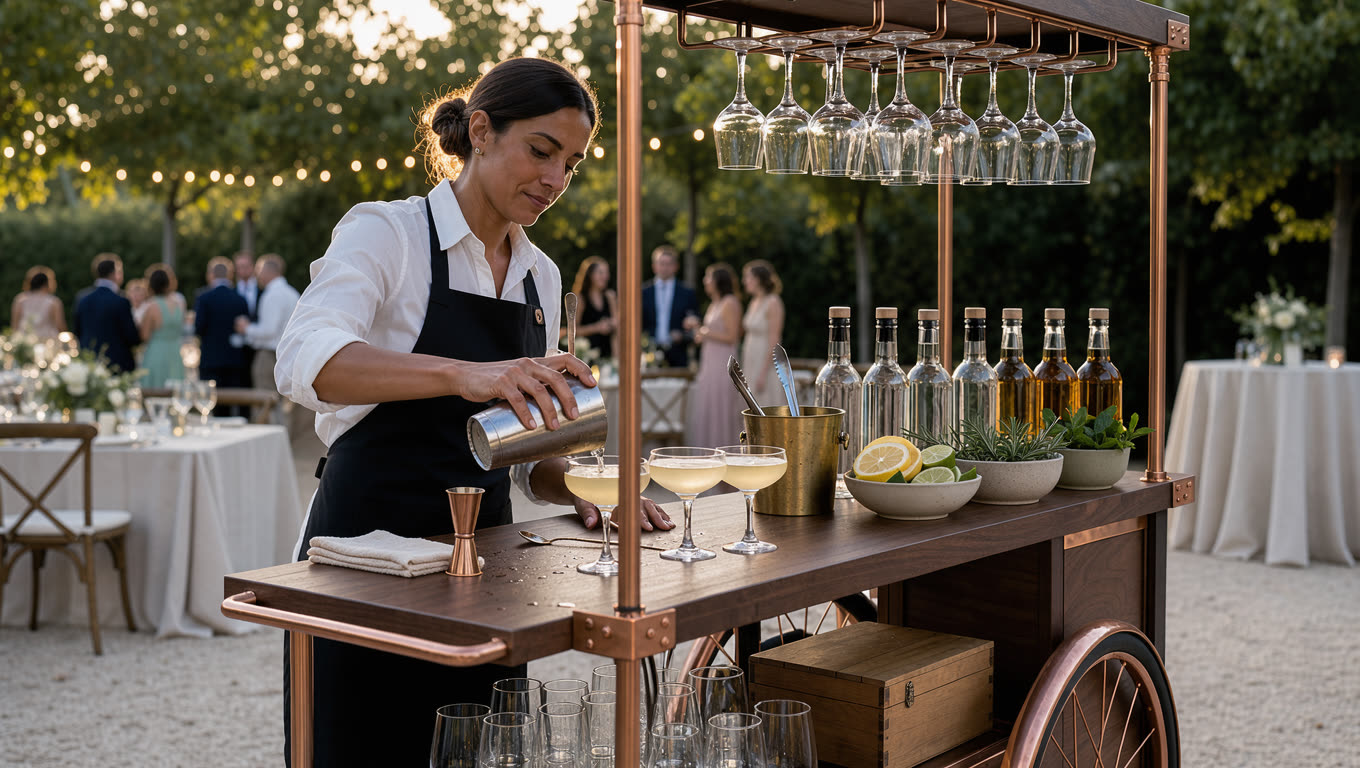
Trailer or cart rental plus staffing. A converted trailer, tap wall or styled cart rented by the day with your team pouring. It makes the business sellable and demands capital and storage.
Sequence it: dry hire for ten events, packages once consumable costs are measured, a trailer only when you are turning dates down — each step funded by the previous one.
The licensing rule that catches most beginners
In most states you can run a mobile bartending business legally without a liquor license — provided you never buy, transport or sell the alcohol. You sell labor and non-alcoholic supplies; the client brings the bottles.
That is written into state guidance. New Jersey's Division of Alcoholic Beverage Control, in Advisory Notice 2026-03, says it does not license mobile bartending businesses because a permanent premises is required, but that the services are allowed — and that such a business "cannot provide, sell, or transport alcoholic beverages on behalf of its customers." It may charge only for service and supply non-alcoholic drinks, mixers, recipes, ice, glassware and garnishes. Pennsylvania's Liquor Control Board says the same.
Two consequences follow. Buying and pouring your own inventory — cash bars, retail-style service — requires a caterer's permit, special-event permit or retail license, a different business with different capital; California's Type 58 and Texas's caterer's permit are common routes. Some cities also require bar cards for individual servers. Call your state alcohol authority and city clerk before printing a menu and ask, exactly: what authorization covers a mobile bar serving client-supplied alcohol at a private event here?
Insurance, certification and the risk you cannot skip
Liquor liability insurance — dram shop coverage — is not optional in practice, even where no statute demands it. Venues ask for a certificate naming them, and one uninsured over-service claim can end the company.
It costs less than founders expect: general liability plus liquor liability starts around $550 a year, about $35 a month, from specialist carriers such as Insurance Canopy — a floor that assumes certified staff.
Certification is the other half. There is no national bartending license; what states and insurers want is responsible beverage service training. TIPS courses run $15 to $38, take about three hours and last around three years. Oregon requires an individual service permit, Texas seller-server certification, and many cities a local card.
Equipment: cart, trailer or rented bar
You can start under $2,000 or spend $70,000 on a trailer, and both can be right. The mistake is buying the asset before the calendar proves demand.
A low-end professional kit is a folding bar or styled table, two coolers, an ice bin, speed pours, jiggers, shakers, a bar mat, glassware, linens, menu signage and lighting. It handles 50 to 120 guests and fits in a hatchback.
Trailers are real capital. The Hudson Trailer Company lists a 14-foot bar trailer from $46,000 and a compact teardrop from $24,000, with finished builds at $52,000 to $70,000. A 2026 California build-versus-rent guide puts custom builds at $40,000 to $180,000 and notes that operators booking under eight events a year are better off renting, at $2,500 to $7,500 per event.
Order it rationally: rent in year one, buy used in year two past 15 events, build only against a deposit-backed calendar. Storage and towing capacity belong in the math.
How to price a mobile bar without underpricing
Price per guest with a per-event minimum, and put labor inside that minimum — hourly-only quotes reward you for working slowly.
For context, 2026 wedding bar service typically lands at $2,500 to $9,000, with full open bars for 100 to 150 guests at $4,000 to $10,000 before tax and service charges. Bartender fees run $100 to $300 each, and planners expect 20% to 25% on top.
Build your number from four lines: labor hours at your target rate, consumables at cost plus 60% to 100%, transport and setup, and a margin that survives a slow month. Set a floor: a three-hour cocktail hour for 40 guests still consumes an evening, a vehicle and insurance. Publish a starting price, not "contact for quote."
Weddings versus corporate events
Weddings pay more per event but cluster into about twenty usable weekends; corporate work pays less per hour but fills weekdays and repeats. A wedding-only business has a five-month revenue window.
Wedding demand is also format-specific: with 58% of couples running a full open bar, your styling, menu cards and glassware are part of the product. Charge for them.
Corporate work stabilizes the year. The BLS counts 172,100 event planners, projects 6% growth to 2035 and a median wage of $61,160 — buyers who book holiday parties and offsites on weekdays, with purchase orders and repeat dates. A 60/40 split smooths the season.
Staffing your first season
Hire your first bartender before your fourth event, not after your first disaster. One person cannot pour for 120 guests, restock ice and watch for over-service at once.
Pay structure matters more than the headline rate. The BLS puts the median bartender wage at $16.51 an hour in May 2025, but event work commands a premium — weekends, on-site, often requiring a car and certification. Budget above the local rate plus a transparent tip split.
Scale by standardizing. A one-page playbook — arrival, load-in, layout, menu build sheet, ice quantities, closing checklist, incident reporting — lets you send a trained lead alone, which is how weekend revenue stops eating your weekend.
Unit economics and break-even
A well-run mobile bar keeps roughly 40% to 55% of gross revenue after staffing, insurance, storage and consumables — the number to model before buying anything. A 2026 California operator guide reports that range for businesses booking 30 to 50 events at $3,000 to $5,000 each.
Run it on your market. On a $3,500 package, subtract $450 in wages for two bartenders over five hours, $250 in ice, mixers and glassware, $150 in transport and $200 for insurance, storage, software and card fees. About $2,450 is left before your own labor — which is why labor discipline, not volume, decides profitability.
Against a $46,000 trailer, that funds about 19 events before the asset is paid off and before your pay. Against an $1,800 cart, break-even arrives in month one. The cheap asset buys the calendar; the calendar buys the trailer.
Marketing: get booked by planners, not by ads
Your best channel is venue and planner relationships, because those buyers already have a date, a budget and a client — and need a vendor who carries insurance and answers email.
Build a referral engine. Visit ten venues a month with a one-page PDF: services, insurance certificate, certification cards, two photos of an identical setup. Photograph every event — a wide shot of the bar, a bartender pouring, a detail of the menu card — because venues repost good images.
Then close the basics: a Google Business Profile with real photos, a booking form capturing guest count and venue, and a contract stating what you do not supply — alcohol, others' permits, hours outside the quote. Written boundaries prevent the classic disputes: who bought the liquor, and who stayed until midnight.
Frequently Asked Questions
Do I need a liquor license to start a mobile bartending business?
In most states, no — if you only provide bartending service and never buy, transport or sell alcohol. New Jersey and Pennsylvania both state explicitly that mobile bartending services are allowed while alcohol must be supplied by the client. Supplying or selling alcohol yourself requires a caterer's permit, special-event permit or retail license.
How much does it cost to start a mobile bartending business?
A dry-hire setup with a folding bar, coolers, tools and glassware can be assembled for under $2,000. Add about $550 a year for general and liquor liability insurance and $15 to $38 per person for responsible service certification. A purpose-built trailer is separate, from about $24,000 for a compact model.
How much can I charge per event?
Wedding bar service typically runs $2,500 to $9,000, with full open bars for 100 to 150 guests commonly budgeted at $4,000 to $10,000 before tax and service charges. Independent bartender fees are usually $100 to $300 per bartender per event. Price from your own costs and set a per-event minimum.
Is bartender certification legally required?
There is no national bartending license, but responsible beverage service certification is mandatory in several states — Oregon requires an individual service permit, Texas requires seller-server certification for many alcohol employees. Elsewhere insurers and venues often require it. TIPS courses cost roughly $15 to $38 and last about three years.
Do I need a commercial kitchen or storage space?
Some permit types require a fixed base address for storage and paperwork, and any operation handling ice or cut garnish may fall under local health rules. Even where it is not required, dry, lockable, insured storage protects your equipment and makes you a credible vendor to venues.
How long before the business replaces my income?
Model it in events. Divide the profit you need by your contribution per event: at roughly $2,400 kept on a $3,500 package, replacing a $40,000 salary needs about 17 events — realistic in a second full season with venue referrals, unrealistic in a first summer built from scratch.
Conclusion
Mobile bartending rewards operators who know what they sell. The service is the product; the alcohol belongs to the client unless you hold a permit; the bar is styling and logistics; profit comes from a price floor, disciplined staffing and a calendar mixing weddings with corporate weekdays.
Start with dry hire, a certification, insurance and a bar that photographs well. Add packages once costs are measured, and consider a trailer only when you turn work away. Make the licensing call first, in your state, in writing — then build what makes you bookable: a repeatable setup, a signature drink, and ten venues who know your name.
Sources
- Centers for Disease Control and Prevention, NCHS — provisional number of marriages and marriage rate, United States, 2000–2024. https://www.cdc.gov/nchs/data/dvs/marriage-divorce/national-marriage-divorce-rates-00-24.pdf
- The Knot Worldwide — "The Knot 2025 Real Weddings Study" press release (average wedding cost $33,000). https://www.theknotww.com/press-releases/weddings-shine-bright-in-2025-the-knot-study-reveals-couples-prioritize-celebration-joy-and-connection-amid-socioeconomic-instability
- The Knot — "How Much Does Alcohol Cost for a Wedding?" (average alcohol spend $2,800; 58% full open bar), updated April 2025. https://www.theknot.com/content/average-cost-wedding-alcohol
- U.S. Bureau of Labor Statistics, Occupational Outlook Handbook — Bartenders (median $16.51/hour, May 2025; 762,600 jobs; 5% growth 2025–35). https://www.bls.gov/ooh/food-preparation-and-serving/bartenders.htm
- U.S. Bureau of Labor Statistics, Occupational Outlook Handbook — Meeting, Convention, and Event Planners (172,100 jobs; 6% growth; median $61,160). https://www.bls.gov/ooh/business-and-financial/meeting-convention-and-event-planners.htm
- New Jersey Division of Alcoholic Beverage Control — Advisory Notice 2026-03, mobile bartending businesses. https://njoag.gov/wp-content/uploads/2026/02/AN-2026-03-Regarding-Mobile-Bartending-Businesses-2.27.26_klk.pdf
- Pennsylvania Liquor Control Board — Legal FAQs: mobile bartending. https://pa.gov/content/dam/copapwp-pagov/en/lcb/documents/legal/documents/legal_faqs_mobile_bartending.pdf
- LiquorReady — "Do mobile bars need a liquor license?" (caterer's and special-event permits, TIPS/ServSafe). https://liquorready.com/articles/license-types/do-mobile-bars-need-a-liquor-license
- TIPS / 360training — certification course pricing and validity. https://beveragetraining.com/tips-certification
- Insurance Canopy — Mobile Bartender Insurance (general and liquor liability from $35.42/month or $550/year). https://www.insurancecanopy.com/alcohol-serving-business-insurance/mobile-bartender-2
- The Hudson Trailer Company — Mobile Bar Trailers (14-foot from $46,000; teardrop from $24,000). https://hudsontrailerco.com/mobile-bar-trailers
- Paperlust — "How Much Does a Wedding Bar Cost? (2026 Guide)". https://paperlust.co/blog/how-much-does-a-wedding-bar-cost
- Innovative Visions — "How Much Does a Mobile Bar Trailer Cost? Build vs. Rental Guide (2026)". https://innovsb.com/insights/mobile-bar-trailer-cost