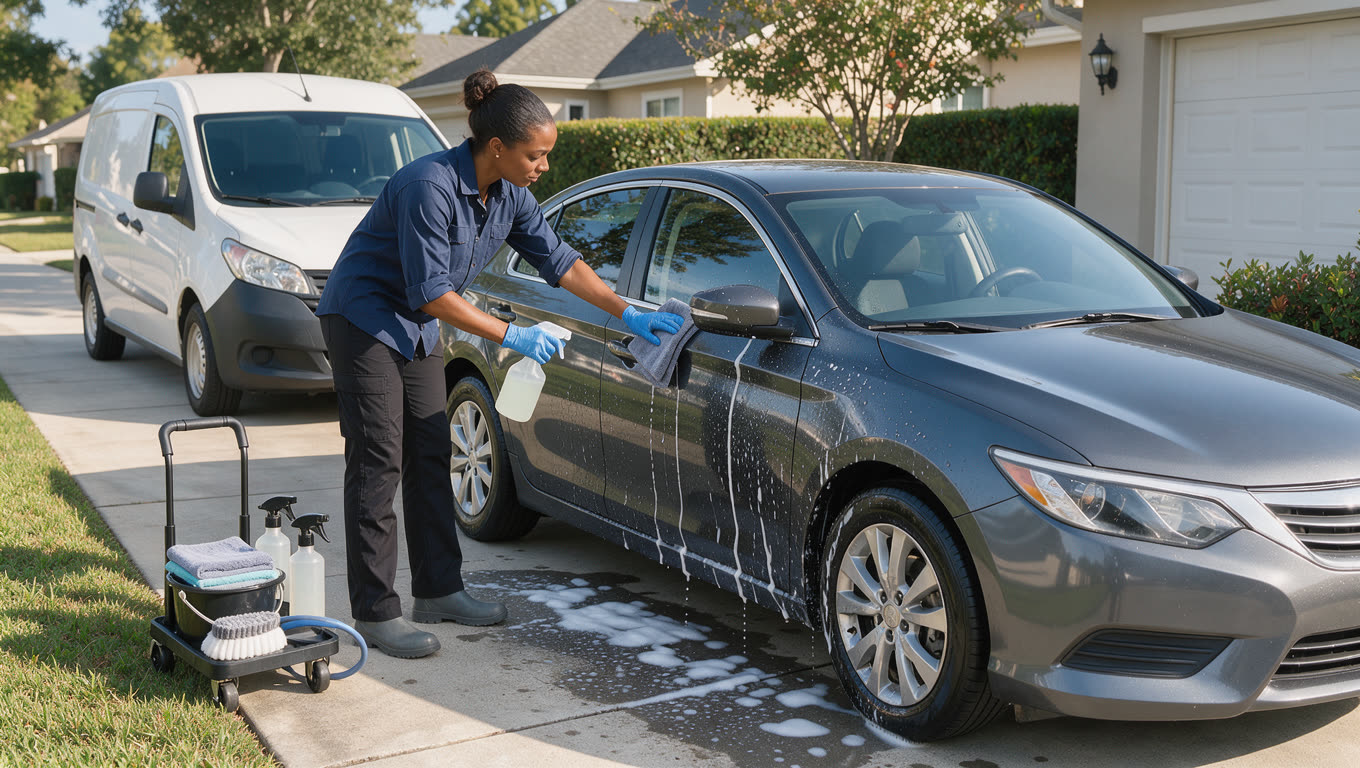
A mobile car detailing business brings professional cleaning, polishing and interior restoration straight to the customer's driveway or workplace. You work out of a car or van loaded with a pressure washer, a vacuum and a few gallons of chemicals — no rent, no wash bays, no waiting room. This guide covers the whole launch path: defining services and prices, buying a starter kit, handling licenses and water rules, landing your first clients, and building fleet subscriptions that pay you every month.
Table of Contents
- Why Mobile Detailing Is a Strong Business in 2027
- Set Your Services and Prices First
- The Starter Kit: What to Buy First
- Licenses, Insurance and Water Rules
- How to Land Your First Clients
- Fleet Subscriptions and B2B Prospecting
- Scaling Beyond Yourself
- Frequently Asked Questions
Why Mobile Detailing Is a Strong Business in 2027
Mobile detailing is a growing, fragmented market with low entry costs: the U.S. car detailing services market generated $12.35 billion in 2025 and is forecast to reach $18.53 billion by 2033, a compound annual growth rate of 5.3% (Grand View Research, 2025). The fastest-growing slice of that market is on-demand service — customers booking a detailer to come to them, which is exactly the mobile model.
The wider car wash and auto detailing industry is projected at $20.2 billion in 2025, up 1.9% from $19.8 billion in 2024, and industry observers note that mobile detailing keeps gaining traction as time-strapped customers want service at home or at work (Carwash Magazine / International Carwash Association, 2025). Demand has shifted permanently: the share of U.S. drivers who wash their cars most often at professional shops climbed from 50% in 1996 to 79% in 2023 (International Carwash Association).
Two structural facts make this friendly to newcomers. First, no single company controls more than about 5% of industry revenue (IBISWorld, 2025) — nobody owns the category. Second, the average business in the sector turns over $313,200 a year with an average profit of $45,098, and the average operation runs on just 3.4 employees (IBISWorld, 2025). You do not need a big team or a big brand to take a slice of a market where the biggest players are local independents.
Set Your Services and Prices First
Price your work with three flat-rate packages — basic, standard and premium — because a 2026 study of 89 mobile detailing operators across four large U.S. cities found national averages of $158 for a basic detail, $278 for a standard detail and $443 for a premium detail (AutoDetailer, 2026). Interior-only jobs averaged $217 and exterior-only jobs $177 in the same study, so a full interior-plus-exterior package sits naturally in the middle of your menu.
Build each tier from a fixed checklist rather than a per-car estimate. Most operators publish menu pricing: 54% of detail shops charge from a fixed-price menu instead of quoting every vehicle individually (Auto Laundry News, 2025 Detailing Survey). A workable structure looks like this:
- Basic — hand wash, wheels, tire dressing, vacuum, dashboard wipe-down, glass. Aim for 60–90 minutes of work.
- Standard — everything in Basic plus clay bar, carpet shampoo, upholstery cleaning and a sealant. Two to three hours.
- Premium — everything in Standard plus paint decontamination, machine polishing and a longer-lasting protection layer. Half a day, priced accordingly.
Keep add-ons separate so customers can climb the ladder on their own: headlight restoration, pet-hair removal, engine-bay cleaning and odour treatment all sell as one-line upgrades. Your goal is a menu simple enough to quote from a phone in under a minute, with a premium tier that makes the standard tier look like the obvious choice.
The Starter Kit: What to Buy First
A competent mobile setup costs between $1,000 and $2,500, while a fixed-location shop runs $25,000 to $80,000 before you serve a single customer (Jim, 2026). Buy in this order: cleaning power first, presentation second, upgrades later.
- Pressure washer (1,500–2,000 PSI): $300–$700
- Wet/dry shop vacuum: $150–$300
- Dual-action polisher: $150–$400
- Chemicals and microfibers (soap, APC, glass cleaner, sealant, towels): $300–$600
- Water supply: a 65-gallon tank with pump and hose reel runs $300–$500; a water reclamation unit adds $500–$1,200 and is required in some municipalities (DetailPilot, 2026)
- Insurance: general liability bundled with garage keepers coverage typically costs $500–$900 per year (DetailPilot, 2026)
One industry breakdown puts mobile operations at 75–85% cheaper to start than a shop, with monthly overhead of $200–$600 instead of $1,500–$4,000 (DetailPilot, 2026). That gap is the strategic advantage of the model: your break-even arrives after a handful of details, and a slow month costs you very little.
Licenses, Insurance and Water Rules
You need three things before the first paid job: a business license or registration, liability insurance, and a wastewater plan — because car wash runoff is treated as a discharge from a point source under the federal Clean Water Act's NPDES permit program, run by the U.S. Environmental Protection Agency since 1972 (U.S. EPA). In practice this means soap and dirty water must not flow into a storm drain.
Check your city and state rules early, because they diverge. Some municipalities require a water reclamation system on the vehicle; others forbid washing in a residential driveway outright or restrict it to recycled water. The EPA program is administered through state agencies, so your state's NPDES authority is the place to confirm what applies to you. Budget a few hundred dollars for containment if you are unsure — a reclamation setup is far cheaper than a fine.
Insurance is the second non-negotiable. General liability covers damage you cause to a customer's property or vehicle, while garage keepers coverage protects cars left in your care. Bundle them together and you are looking at roughly $500–$900 a year (DetailPilot, 2026) — a line item that also becomes a selling point when you approach commercial accounts.
How to Land Your First Clients
Your first ten clients come from visible, local proof rather than a big ad budget, and timing matters: mobile detailers report that 42% of their detail business lands in the fall, ahead of the winter slowdown (Auto Laundry News, 2025 Detailing Survey). Plan your launch push six to eight weeks before your local peak season so your calendar fills exactly when demand does.
The practical playbook works in four moves:
- Document everything. Before-and-after photos of interiors and paint are the strongest sales asset in this trade. Post them consistently on social media and Google Business Profile.
- Get certified and say so. Certification has become a mainstream differentiator: more than three quarters of surveyed operators (76%) now employ detailers with certification credentials, up from 38% a year earlier (Auto Laundry News, 2025 Detailing Survey).
- Work one neighbourhood at a time. Cluster jobs by postcode so you can offer a small discount for multiple bookings on the same street, and turn each visit into a referral ask.
- Ask for reviews at handover. Local search decides who gets the next call, and a steady trickle of reviews beats a one-off campaign.
If you want a repeatable marketing engine rather than word of mouth alone, the same playbook applies to any local service business — see our guide on starting a social media management studio for content systems you can adapt, and our home cleaning business guide for a comparable route from solo operator to agency.
Fleet Subscriptions and B2B Prospecting
Fleet subscriptions turn one-off details into recurring revenue, and the commercial share of the market is genuinely open: household consumers account for about 70% of car wash and detailing industry revenue, leaving roughly 30% to commercial accounts (MMCG Invest, citing IBISWorld, 2025). Winning even a few of those accounts means predictable monthly income that does not depend on the weather.
The target list is shorter than it looks. Dealerships and rental agencies contract mobile detailers to prepare vehicles on site; rideshare and delivery drivers buy recurring interior cleans; small local fleets need vehicles presentable at all times. Small operators dominate commercial transport too — more than 91% of motor carriers run ten or fewer trucks (Federal Motor Carrier Safety Administration and American Trucking Associations, 2025), so the average fleet you can actually win is a handful of vans, not a national contract.
Package the offer as a monthly subscription per vehicle: a fixed number of cleans, a fixed price, invoiced automatically. Use field-service software such as Jobber to schedule recurring visits, send quotes and collect payment — the administrative side is what most solo detailers get wrong, and it is what makes a five-vehicle account worth keeping. Lead with a free pilot clean on two vehicles; the rest of the fleet follows when the results are visible on the lot.
Scaling Beyond Yourself
Scale by standardizing packages and hiring technicians, because the sector average is a small team: 59,394 businesses employ about 201,000 workers, an average of 3.4 employees each, at an industry profit margin of 14.4% (IBISWorld, 2025). A mobile operation with no rent can beat that margin, but only if every detail is run from the same checklist at the same price.
The sequence that works for most owners is: perfect one service area, add a second technician on a shared route, then raise average ticket with high-ticket add-ons such as paint correction and ceramic protection. Keep your own hands off the tools once you can sell two full-time weeks of work per month — your job becomes scheduling, quality control and the commercial accounts. If the goal is a local brand rather than a solo trade, the same scaling logic applies across service businesses, as we describe in our guide to building a service studio.
Frequently Asked Questions
How much does it cost to start a mobile car detailing business?
A mobile setup costs between $1,000 and $2,500 for equipment, supplies and first-month insurance, against $25,000 to $80,000 for a fixed shop (Jim, 2026). A leaner build with budget equipment runs $1,500–$2,500, while a professional-grade kit costs $3,500–$6,000 (DetailPilot, 2026).
How much should I charge for a mobile detail?
Charge from a published menu rather than per car: a 2026 study of 89 operators found national averages of $158 for a basic detail, $278 for a standard detail and $443 for a premium detail, with interior-only work averaging $217 (AutoDetailer, 2026). Adjust for vehicle size, condition and your local market.
Do I need a license to detail cars from home?
You will normally need a business license or registration plus liability insurance, and your city may add zoning or home-business rules for working on client vehicles. Requirements vary by state and municipality, so confirm with your local small business office before your first booking.
How do I handle wastewater when I wash cars outdoors?
Runoff from vehicle washing is a point-source discharge regulated under the Clean Water Act's NPDES program (U.S. EPA), and many municipalities require a water reclamation system or a defined containment method. Capture your wash water, dispose of it at an approved point, and never let soapy water reach a storm drain.
How do I get my first five clients?
Post before-and-after photos consistently, claim your Google Business Profile, work one neighbourhood at a time and ask every customer for a review at handover. Launch six to eight weeks before your local peak season — mobile detailers report 42% of their detail business falls in the fall (Auto Laundry News, 2025).
Is mobile detailing a seasonal business?
Demand varies through the year — mobile operators in the 2025 industry survey reported their strongest quarter in the fall and their weakest in winter — but it never disappears, because winter road salt, spring pollen and daily driving keep cars dirty. Plan cash flow around the slow weeks and push subscriptions to smooth the curve.
Conclusion
A mobile car detailing business is one of the cheapest service businesses to launch and one of the easiest to fill: $1,000–$2,500 in kit, a market growing at 5.3% a year, and customers who increasingly expect the detailer to come to them. Start with three menu-priced packages, stay on the right side of wastewater rules, document every result, then convert your best customers into monthly fleet subscriptions. Do those four things consistently and the calendar takes care of itself.
Sources
- Grand View Research — U.S. Car Detailing Services Market Outlook, 2033 (market size 2025, CAGR 2026–2033, on-demand segment): grandviewresearch.com
- Carwash Magazine — The Detailing Industry in 2025 ($20.2B industry projection, mobile detailing trend): carwash.com
- IBISWorld — Car Wash & Auto Detailing in the US, NAICS 81119A (market size 2026, fragmentation, professional wash usage 1996–2023): ibisworld.com
- GetDetaild — Car Detailing Market Report, citing IBISWorld Industry Report 81119A, March 2025 (segment revenue, average revenue and profit per business): getdetaild.com
- Auto Laundry News — 2025 Detailing Survey (seasonality, fixed-price menu adoption, certification): carwashmag.com
- AutoDetailer — Mobile Detailing Prices 2026, study of 89 operators (basic/standard/premium averages): autodetailer.com
- Jim — How to Start a Car Detailing Business in 2026 (mobile vs fixed startup costs, core equipment): jim.com
- DetailPilot — Mobile Detailing Startup Costs (equipment tiers, water reclamation, insurance, overhead): detailpilot.com
- U.S. Environmental Protection Agency — National Pollutant Discharge Elimination System (NPDES), created under the Clean Water Act: epa.gov/npdes
- MMCG Invest — U.S. Car Wash & Auto Detailing Industry Overview (2025), citing IBISWorld (household vs commercial revenue share): mmcginvest.com
- FMCSA and American Trucking Associations — fleet carrier size distribution, 2025, via Truck Wash University: truckwashuniversity.com
- Jobber — field service scheduling and invoicing software: getjobber.com